Evergreen Senior Living in Katy: What to Check First
By Ivan Urrego | Last updated: May 2026
What You'll Find in This Guide
- What Evergreen Cottages Is
- Check 1: How Evenings Run
- Check 2: Who Is on Shift and How Many
- Check 3: What a Normal Day Holds
- Check 4: Where the Cottages Are
- Check 5: Five Questions to Ask on Any Senior Living Visit
- Where Caregivers Can Get Help This Month
- Memory Care at Evergreen Cottages
- Assisted Living: What It Covers
- Alzheimer's and Dementia Care
- Frequently Asked Questions
- Your Next Step: See 5:30 p.m. for Yourself
- Sources
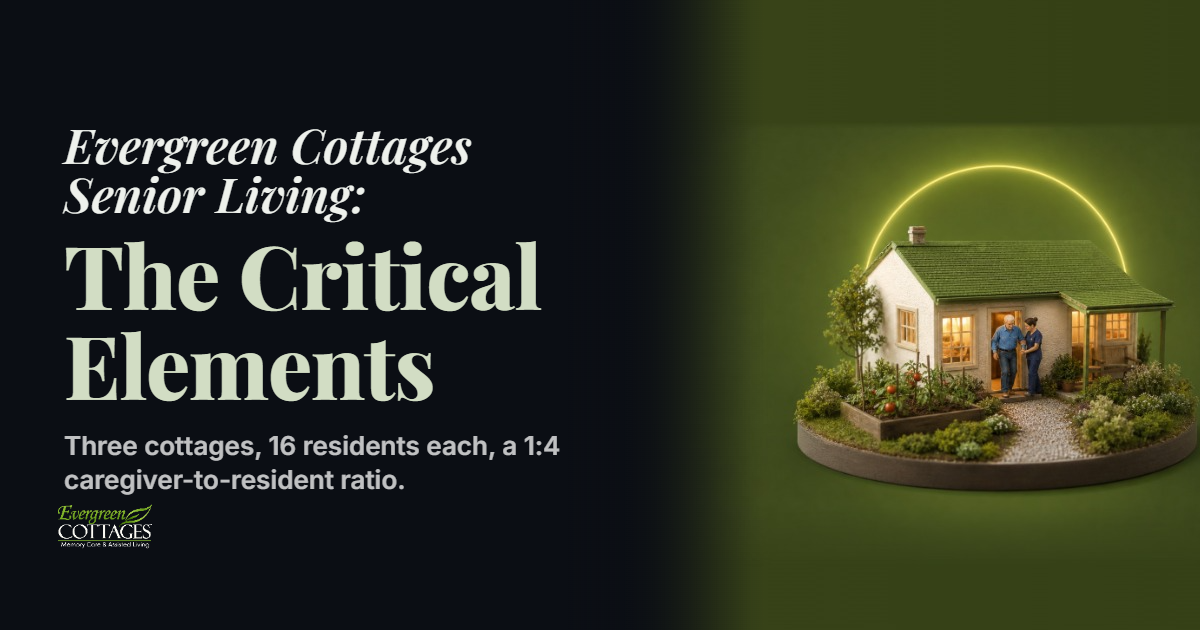
What Evergreen Cottages Is: Three 16-Person Cottages, Not a Large Building
Evergreen Cottages is not a traditional senior living facility — and that distinction matters more than most families realize when they begin comparing options.
Instead of one large building with long hallways and dozens of unfamiliar faces, Evergreen Cottages is built around three separate residential homes, each limited to sixteen residents. That ceiling is intentional. Research published in the NIC 2025 Consumer Research Report consistently finds that smaller group sizes reduce anxiety in seniors with memory loss, support stronger caregiver-to-resident relationships, and correlate with higher family satisfaction scores.
A Home, Not a Facility
Each cottage is designed to feel like someone's house — because it is. Residents share common spaces, eat together, and settle into the same rhythms every day. That familiarity is therapeutic, not incidental. For someone living with Alzheimer's or another form of dementia, predictability is a form of safety.
Who Lives Here
The cottages serve adults who need memory care, assisted living, Alzheimer's care, or dementia care. Some residents arrive early in their diagnosis; others come when care needs have grown beyond what a family can manage at home. What they share is the need for a consistent, calm environment staffed by people who know them by name.
Check 1: How Evenings Run Once the Clocks Fall Back
The most revealing hour in any senior living community is not 10 a.m. on a sunny Tuesday — it is 5:30 p.m. in late autumn, when daylight has vanished and many residents with dementia begin to feel the pull of sundowning.
The 5:30 p.m. Lamp-and-Tea Routine
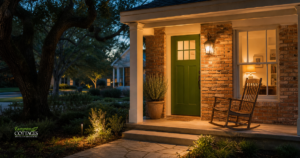
At Evergreen Cottages, the late-afternoon transition is managed with the same intentionality as any medical protocol. By 5:30 p.m., warm lamps replace overhead lighting — softer light reduces visual disorientation. Herbal tea and a light snack are served at the table where residents already feel comfortable. Familiar music plays at a low volume. The routine is the same every evening, every season.
This matters because sundowning — increased confusion, agitation, or restlessness in the late afternoon and evening — affects up to 20 percent of people with Alzheimer's disease, according to the Alzheimer's Association 2025 Facts and Figures report. A community's evening protocol is one of the clearest signals of whether staff are trained to manage this predictably or simply react to it.
What to Watch for on a Late-Afternoon Visit
- Are lights dimmed or adjusted, or is the fluorescent overhead still blazing?
- Is the environment noticeably calmer than midday, or louder?
- Do caregivers redirect residents with gentle conversation, or do they raise their voices?
- Is there a structured activity — however simple — to anchor the transition to evening?
Check 2: Who Is on Shift and How Many
Staff-to-resident ratio is one of the most important — and most misunderstood — numbers in senior care. Knowing it changes what you can reasonably expect.
The 1:4 Ratio at Evergreen Cottages
Evergreen Cottages maintains a 1:4 caregiver-to-resident ratio, meaning one trained caregiver is responsible for no more than four residents at any given time. By comparison, the national average in memory care settings often runs closer to 1:6 or 1:8, particularly during evening and overnight shifts. The Alzheimer's Association and LeadingAge both cite low ratios as a primary predictor of resident safety and quality of life.
24/7 Nursing Coverage
Beyond caregiver staffing, Evergreen Cottages provides nursing oversight around the clock. This is not standard across all assisted living communities. Having a licensed nurse available at any hour means medication changes, health shifts, and middle-of-the-night concerns are addressed by a clinical professional — not deferred until morning.
Questions to Ask About Staffing
| Question | What a Strong Answer Looks Like |
|---|---|
| What is the ratio on the overnight shift? | Same as day shift, or clearly stated policy |
| Is there a nurse on-site 24 hours? | Yes, not just "on call" |
| How long has the average caregiver worked here? | Low turnover; tenured team |
| What dementia-specific training do caregivers complete? | Named program, documented hours |
Check 3: What a Normal Day Holds
Care quality lives in the daily details — what residents eat, what they do, and whether anyone truly knows them. Here is what a typical day looks like inside a cottage.
Home-Cooked Meals
Meals at Evergreen Cottages are prepared fresh in the cottage kitchen, not delivered from a central facility kitchen down the hall. Residents often smell breakfast being made before they reach the table — a simple but meaningful sensory cue that signals morning and belonging. Diet and nutrition are increasingly linked to cognitive health; the Alzheimer's Association notes that diet is one of the modifiable risk factors associated with dementia progression.
Music, Pet Therapy, and Gardening
The structured activities at Evergreen Cottages are drawn from research on dementia-specific engagement. Music therapy has demonstrated measurable effects on mood and reduced agitation in multiple peer-reviewed studies. Pet therapy visits introduce genuine moments of joy and tactile connection. Gardening — even container gardening on a porch — engages fine motor skills, sensory memory, and a sense of purpose. These are not filler activities; they are part of the care model.
What ALFA and LeadingAge Say About Daily Engagement
Both ALFA (Assisted Living Federation of America) and LeadingAge emphasize that meaningful daily engagement — not just safety and medication management — is a core quality indicator in senior living communities. When you tour, ask to see the activities calendar, not just a printed brochure describing activities.
Check 4: Where the Cottages Are
Evergreen Cottages operates three distinct residential locations, each serving a specific community need. Knowing which cottage best fits your loved one's level of care is a practical starting point before a tour.
Bridgewater Cottage
Bridgewater Cottage is designed for residents who benefit from a structured, calm memory care environment. The cottage is intentionally designed so that movement through the space is intuitive — residents do not feel lost in their own home.
Jasmine Cottage
Jasmine Cottage blends assisted living and memory care services, making it a natural fit for residents in earlier stages of cognitive change who still benefit from a high degree of independence within a supportive setting.
Magnolia Cottage
Magnolia Cottage provides memory care for residents whose needs have advanced. The environment, staffing, and programming are calibrated for residents who require more consistent orientation support and hands-on assistance throughout the day.
Check 5: Five Questions to Ask on Any Senior Living Visit
Whether you are visiting Evergreen Cottages or any other senior living community nearby, these five questions cut through the brochure language and reveal what daily life actually looks like.
The Five Questions
- "Can I visit at 5:30 p.m.?" Any community confident in its evening care will say yes without hesitation. Resistance is itself informative.
- "What is your overnight staffing ratio?" Many communities reduce staff after 10 p.m. Ask specifically about nights, not just daytime hours.
- "How do you handle a resident who refuses care — a shower, medication, or a meal?" The answer reveals training depth and philosophy.
- "What happens if my loved one's care needs increase?" Understand whether the community can accommodate progression or requires a move to a different facility.
- "May I speak with a family member of a current resident?" A reputable community will have references. First-person experience from another family is worth more than any marketing material.
Where Family Caregivers Can Get Help This Month
You do not have to navigate this alone. Two organizations provide immediate, free support to families right now — no insurance required, no appointment needed.
Alzheimer's Association Helpline
The Alzheimer's Association operates a 24/7 helpline at 800-272-3900. Trained specialists can help you understand a diagnosis, work through placement options, navigate financial questions, and simply listen when the weight of caregiving feels too heavy. The line is free, confidential, and available in multiple languages. The Alzheimer's Association 2025 Facts and Figures report estimates that more than 11 million Americans provide unpaid care for someone with Alzheimer's or dementia — which means the people on that line have heard your situation before.
Caregiver Action Network
The Caregiver Action Network (caregiveraction.org) offers online peer support communities, care planning tools, and a library of practical guides. Their resources are especially useful during the research phase — when you are comparing communities and trying to organize your own thoughts before a tour.
Evergreen's Own Family Resources
Evergreen Cottages also maintains a dedicated family resources library with guidance on dementia care, financial planning, and what to expect during the transition to assisted living.
Memory Care at Evergreen Cottages
Memory care is a specialized level of residential care designed specifically for people living with Alzheimer's disease, dementia, or other forms of cognitive decline. It is distinct from standard assisted living in its staffing, environment design, and programming.
What Makes It Different
At Evergreen Cottages, memory care in Katy means dementia-trained staff, a secure environment that prevents wandering without feeling institutional, and an activities calendar built around cognitive engagement — music, reminiscence, sensory experiences, and gentle movement. Every care plan is individualized and reviewed regularly as the resident's needs evolve.
Who Benefits Most
Memory care is appropriate when a loved one experiences significant confusion, repeated disorientation, or behavioral changes that make independent living unsafe — even with family support at home. The NIC 2025 Consumer Research Report found that the majority of families who delayed placement reported wishing they had moved sooner once they saw the stabilization in their loved one's mood and safety.
Assisted Living: What It Covers
Assisted living bridges the gap between fully independent living and skilled nursing. It is the right level of care when a person needs daily support but does not yet require round-the-clock medical intervention.
Services Included
At Evergreen Cottages, assisted living covers personal care (bathing, grooming, dressing), medication management, meals, housekeeping, transportation, and access to the full activity program. Residents retain as much independence as they can safely manage — caregivers assist, they do not take over.
When to Consider the Transition
Signs that it may be time to explore assisted living include: missed medications, unexplained falls, weight loss due to skipped meals, increasing social isolation, or a family caregiver reaching the point of physical or emotional exhaustion. All of these are common, and none of them are failures — they are signals.
Alzheimer's and Dementia Care
Alzheimer's disease is the most common cause of dementia, but it is not the only one. At Evergreen Cottages, care is designed to meet the specific challenges of each diagnosis — not apply a one-size approach to every resident.
Understanding the Difference
Dementia is an umbrella term for a group of symptoms — memory loss, impaired reasoning, personality changes — caused by various underlying conditions. Alzheimer's accounts for approximately 60–80 percent of dementia cases, according to the Alzheimer's Association 2025 Facts and Figures. Other types include Lewy body dementia, vascular dementia, and frontotemporal dementia, each with different progressions and care needs.
How Evergreen Approaches Each Case
Care plans at Evergreen Cottages account for diagnosis type, behavioral profile, communication preferences, life history, and family input. A resident with Lewy body dementia, for example, may have specific sensitivities to certain medications or lighting conditions that require a different protocol than someone in mid-stage Alzheimer's.
Frequently Asked Questions
What does "evergreen senior living" refer to in Katy?
It refers to Evergreen Cottages, a senior living community in Katy, TX that operates three small residential cottages — Bridgewater, Jasmine, and Magnolia — providing memory care, assisted living, Alzheimer's care, and dementia care for up to sixteen residents each.
How does the cottage model differ from a traditional senior living facility?
Traditional facilities often house sixty to two hundred or more residents in a single large building. The cottage model limits each home to sixteen residents, creating a quieter, more familiar environment. Research consistently links smaller group sizes with lower anxiety in dementia patients and higher satisfaction among families.
Is Evergreen Cottages state-licensed?
Yes. Evergreen Cottages is licensed by the state of Texas as an assisted living community. Licensing information and inspection history are publicly available through the Texas Health and Human Services Commission. You can also read more on the community's own licensing page.
Does Medicare or Medicaid pay for assisted living at Evergreen Cottages?
Medicare generally does not cover assisted living. Medicaid coverage depends on individual eligibility and program availability. Many families use a combination of personal savings, long-term care insurance, and VA benefits if applicable. Evergreen's family resources section has detailed guidance on payment options.
How do I know if memory care or assisted living is right for my loved one?
Memory care is designed for residents with significant cognitive decline, wandering risk, or behavioral symptoms related to dementia. Assisted living is appropriate for those who need daily support but do not have advanced cognitive impairment. The Evergreen care team can help you determine the right level during an initial consultation or tour.
How soon can a loved one move in after a tour?
Move-in timelines vary depending on current availability, the level of care needed, and the completion of the intake assessment. Some families move within a few weeks of a tour; others take longer to prepare. Contacting Evergreen directly after your visit is the fastest way to understand current availability and next steps.
Your Next Step: See 5:30 p.m. in a Cottage for Yourself
Everything in this checklist is easier to understand once you have stood inside a cottage at the end of the day. The lamp light. The smell of dinner. A caregiver calling a resident by name without looking at a chart. Those details do not appear in brochures — they reveal themselves in person.
If you have been searching for evergreen senior living and you are ready to move from research to a real conversation, the next step is a tour. You can visit at any time of day, and we genuinely encourage you to come at 5:30 p.m. so you can see the routine that matters most.
No pressure. No hard sell. Just an honest look at whether this is the right place for the person you love.
Explore Evergreen Cottages
Found this helpful? Share it with someone navigating the same decision.
Ivan Urrego
Ivan Urrego is a professional copywriter for the senior living industry and an award-winning contributor to Argentum, MALA, and other leading care associations. He writes exclusively for Evergreen Cottages, bringing more than a decade of experience helping families understand memory care, assisted living, and dementia care options with warmth, clarity, and clinical grounding.
Sources
- Alzheimer's Association. 2025 Alzheimer's Disease Facts and Figures. alz.org/alzheimers-dementia/facts-figures
- NIC (National Investment Center for Seniors Housing & Care). 2025 Consumer Research Report: What Families Want in Senior Living. nic.org
- LeadingAge. Quality Standards in Aging Services: Staffing and Engagement Benchmarks. leadingage.org
- ALFA (Assisted Living Federation of America / Argentum). Senior Living: State of the Industry. argentum.org
- Texas Health and Human Services Commission. Assisted Living Facility Licensing Standards. hhs.texas.gov
- Caregiver Action Network. Caregiver Help Desk and Peer Support Resources. caregiveraction.org