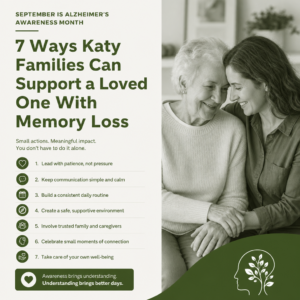
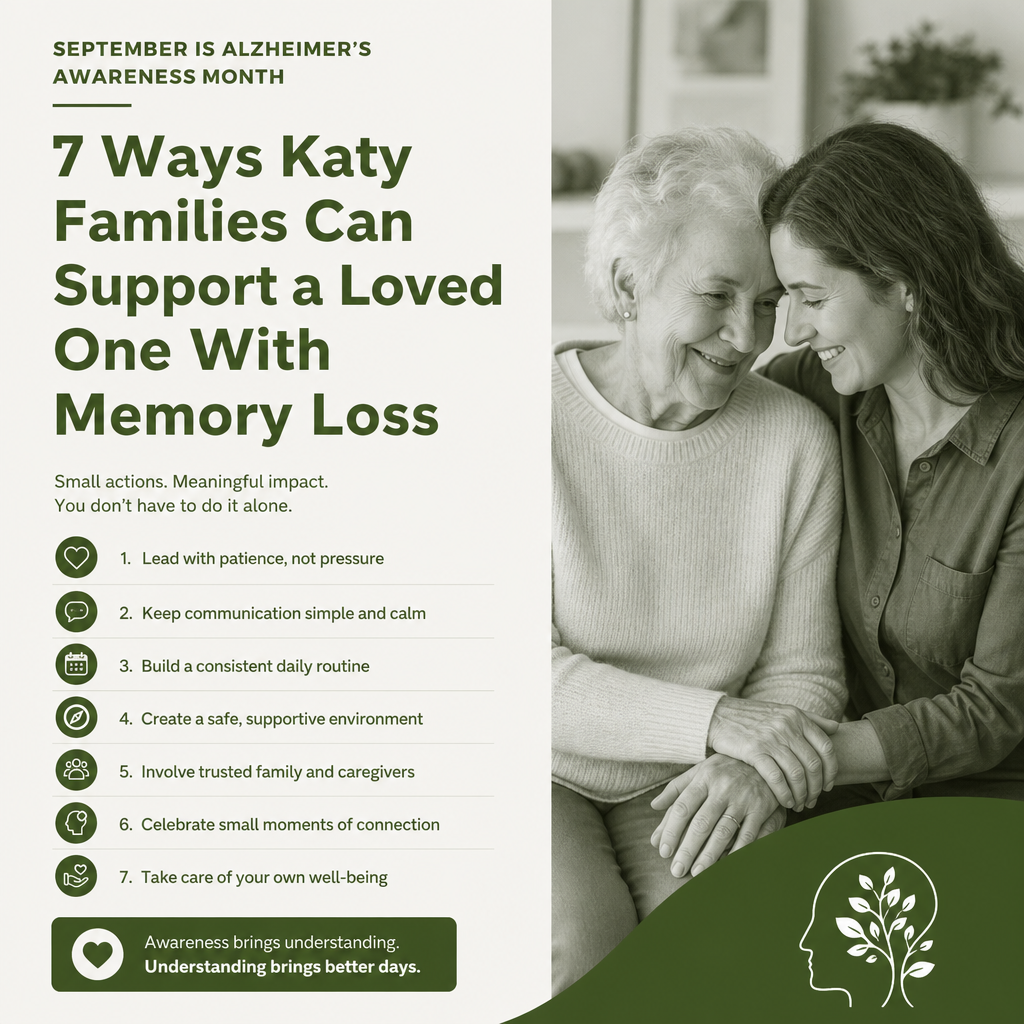
September Is Alzheimer's Awareness Month: 7 Ways Katy Families Can Support a Loved One With Memory Loss (2026)
By Ivan Urrego | Last updated: May 2026
Table of Contents
- Why Alzheimer's Awareness Month Matters for Katy Families
- Way 1: Truly Understand the Disease
- Way 2: Create a Safe, Familiar Environment
- Way 3: Communicate With Compassion
- Way 4: Engage Them in Meaningful Activities
- Way 5: Build a Local Care Team
- Way 6: Prioritize Your Own Health as a Caregiver
- Way 7: Know When to Explore Professional Memory Care
- Understanding the Stages of Alzheimer's
- Local Memory Care Resources in Katy, TX
- How Evergreen Cottages Supports Families Year-Round
- Frequently Asked Questions
- Conclusion
Why Alzheimer's Awareness Month Matters for Katy Families
Alzheimer's Awareness Month, observed every September, is a global call to action — and for families right here in Katy, TX, it's deeply personal. According to the Alzheimer's Disease International, more than 55 million people worldwide are living with dementia, and that number is expected to nearly double by 2050. In Texas alone, over 400,000 people currently live with Alzheimer's, according to the Alzheimer's Association 2025 Facts and Figures report.
A Month That Drives Real Change
Awareness months aren't just symbolic. Research shows that communities with higher Alzheimer's literacy make earlier care decisions, resulting in better outcomes for patients and less caregiver burnout. This September, Katy families have an opportunity to go beyond awareness — and into action.
The Katy, TX Context
Katy is one of the fastest-growing communities in the Houston metro area, with a senior population expanding rapidly. That growth means more families are suddenly navigating diagnoses they weren't prepared for. The good news: you don't have to figure this out alone.
Way 1: Truly Understand the Disease
The single most powerful thing a Katy family can do during Alzheimer's Awareness Month is to get educated — not just Google-educated, but genuinely informed about how Alzheimer's progresses and how it differs from normal aging.
Alzheimer's vs. Dementia: Know the Difference
Dementia is an umbrella term for a group of symptoms affecting memory, thinking, and daily function. Alzheimer's disease is the most common cause, accounting for 60–80% of cases, per the Alzheimer's Association. Understanding this distinction shapes how you communicate with doctors and plan care. Learn more on our blog: Alzheimer's Disease or Dementia — What's the Difference?
Early Signs Families Miss
Forgetting names occasionally is normal. Forgetting the word for "chair" — and never recovering it — is not. Other red flags include getting lost on familiar routes, repeating the same question within minutes, and personality shifts that feel sudden and out of character. Our guide on Recognizing the Early Signs of Dementia at Home covers these in detail.
Reputable Learning Resources
Visit alzint.org for globally recognized research and family education tools. The Alzheimer's Association's 24/7 helpline (1-800-272-3900) is also an excellent first call for Katy families seeking guidance.
Way 2: Create a Safe, Familiar Environment
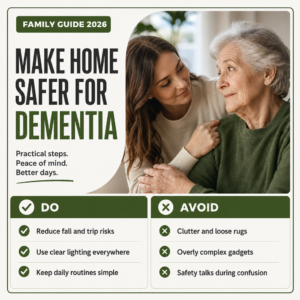
Safety modifications at home can dramatically reduce falls, wandering incidents, and confusion-related injuries. This is one of the most tangible ways to support a loved one with memory loss — and it begins with a simple walk-through of their living space.
Common Home Hazards to Address
| Area | Risk | Recommended Fix |
|---|---|---|
| Bathroom | Slippery floors, hot water burns | Grab bars, non-slip mats, thermostat cap at 120°F |
| Kitchen | Stove left on, sharp objects | Stove knob covers, knife drawer locks |
| Entry/Exit Doors | Wandering | Door alarms, high-placement deadbolts |
| Stairs | Falls | Handrails on both sides, bright lighting |
The Power of Familiarity
Familiar objects — a favorite quilt, family photos, a well-loved chair — serve as cognitive anchors for someone with Alzheimer's. Resist the urge to redecorate. Consistency in the physical environment reduces anxiety and agitation, especially during the middle stages of the disease.
When Home Modifications Aren't Enough
If wandering is becoming a safety crisis, or if medication management has become dangerous, home modifications have limits. Our article on Memory Care vs. Home Care: Which Is Better for Dementia? walks through this decision honestly.
Way 3: Communicate With Compassion
How you speak to someone with Alzheimer's matters as much as what you say. Language that corrects, argues, or overwhelms typically escalates distress — while validation and simplicity calm it.
The Golden Rules of Memory Care Communication
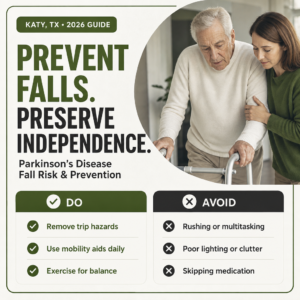
- Enter their reality. If your mother believes it's 1985, don't argue. Join her where she is.
- Use short, simple sentences. One idea at a time. One question at a time.
- Make eye contact. Get to their eye level before speaking.
- Speak slowly and warmly. Tone carries meaning even when words don't.
Avoid These Common Mistakes
Asking "Do you remember…?" is often painful and unproductive. Saying "I already told you that" creates shame. Instead, try "Tell me more about that" or "That sounds wonderful — what was it like?" These conversation pivots preserve dignity while reducing friction.
When Sundowning Makes Communication Harder
Sundowning — increased confusion and agitation in the late afternoon and evening — can make communication feel impossible. Our deep-dive guide on What Is Sundowning? offers specific strategies Katy families can use at home.
Way 4: Engage Them in Meaningful Activities
Purposeful activity isn't a luxury in memory care — it's medicine. Research published in the Journal of Alzheimer's Disease confirms that regular engagement in structured activities reduces behavioral symptoms and improves quality of life in people with dementia.
Activities That Work Best
| Activity Type | Examples | Why It Helps |
|---|---|---|
| Music | Listening to favorite songs from their era | Activates preserved long-term memory pathways |
| Movement | Chair yoga, gentle walks | Reduces agitation, improves sleep |
| Reminiscence | Looking through old photo albums | Supports identity and emotional connection |
| Creative Arts | Painting, simple crafts | Provides expression without verbal demands |
Music Therapy: A Special Mention
Music is one of the most powerful tools in memory care. Even in advanced Alzheimer's, individuals often recall song lyrics clearly. See how this works in our article: Helping Alzheimer's and Dementia Patients Reconnect Through Music Therapy.
Way 5: Build a Local Care Team in Katy, TX
No family should navigate Alzheimer's alone. Building the right care team — medical, legal, and emotional — is one of the most protective things you can do for both your loved one and yourself.
Who Belongs on the Team
- Primary care physician — for overall health management and referrals
- Neurologist or geriatrician — for diagnosis confirmation and medication management
- Elder law attorney — for power of attorney, advance directives, and estate planning
- Social worker or care manager — for community resource navigation
- Memory care specialist — for day-to-day care planning and behavioral guidance
Legal Planning Is Urgent
One of the most important — and overlooked — steps during Alzheimer's Awareness Month is completing legal documents while your loved one can still participate. Power of attorney, healthcare proxies, and advance directives must be established early. Once cognitive decline advances, legal options narrow significantly.
Financial Planning for Katy Families
Understanding what memory care costs — and what pays for it — removes a major barrier to timely decisions. Our comprehensive guide on How to Pay for Assisted Living in Katy, TX covers Medicaid, VA benefits, and more.
Way 6: Prioritize Your Own Health as a Caregiver
You cannot pour from an empty cup. Family caregivers of people with Alzheimer's experience depression at roughly twice the rate of non-caregiving adults, according to the Alzheimer's Association 2025 Facts and Figures. Taking care of yourself isn't selfish — it's essential.
Signs of Caregiver Burnout
- Feeling resentful or trapped — and then feeling guilty about those feelings
- Neglecting your own medical appointments
- Withdrawing from friends and activities you used to enjoy
- Feeling constantly exhausted regardless of how much sleep you get
- Snapping at your loved one — and immediately hating yourself for it
Respite Care: The Break You're Allowed to Take
Respite care refers to short-term, professional care that allows family caregivers to rest, travel, attend to personal health, or simply decompress. Evergreen Cottages offers respite care in Katy, TX specifically designed to provide this relief without compromising continuity of care for your loved one.
Way 7: Know When to Explore Professional Memory Care
This is the way most families resist the longest — and the one that, when embraced at the right time, often delivers the greatest relief and the best outcomes for their loved one. Alzheimer's Awareness Month is the perfect moment to have this conversation honestly.
Signs It May Be Time
- Wandering that has resulted in near-miss safety incidents
- Inability to manage medications safely despite reminders
- Significant weight loss due to forgetting to eat
- Aggression or agitation that is escalating and difficult to manage
- Your own health declining as a direct result of caregiving demands
If several of these resonate, our article 10 Signs Your Parent May Need More Care Than You Can Provide may be one of the most important things you read this month.
Letting Go of Guilt
Guilt is the primary barrier that delays care decisions — often to the detriment of the person with Alzheimer's. Professional memory care isn't giving up. It's recognizing that your loved one deserves round-the-clock specialized support that no single family can replicate alone. Read more: Is Guilt Preventing You From Placing Your Loved One in Professional Care?
What to Ask During a Tour
When evaluating memory care communities in Katy, TX, ask about staff-to-resident ratios, dementia-specific training, activity programming, and how they communicate with families. Our full checklist is here: Questions to Ask When Touring Memory Care Communities.
Understanding the Stages of Alzheimer's Disease
Alzheimer's progresses through defined stages, and understanding where your loved one is helps you plan more effectively. The Alzheimer's Association describes a seven-stage model, commonly grouped into three phases for practical planning.
| Stage | Common Symptoms | Care Focus |
|---|---|---|
| Early (Mild) | Forgetting recent events, mild confusion, repeating questions | Safety planning, legal documents, support groups |
| Middle (Moderate) | Difficulty recognizing family, wandering, behavioral changes | Increased supervision, structured routines, possible memory care evaluation |
| Late (Severe) | Loss of speech, full assistance with daily living, swallowing difficulty | Comfort-focused, hospice-level support, family presence |
Why Staging Matters for Katy Families
Each stage demands a different care response. Families who understand staging make proactive decisions rather than reactive ones — which is both better for the person with Alzheimer's and less traumatic for the family. September's Alzheimer's Awareness Month is a timely reminder to assess where your loved one currently stands.
Local Memory Care Resources in Katy, TX
Katy families have access to a growing network of dementia and Alzheimer's support resources — both locally and through national organizations that serve Texas communities.
Community and Online Support
- Alzheimer's Association Houston and Southeast Texas Chapter — offers caregiver support groups, education workshops, and a 24/7 helpline (1-800-272-3900)
- Alzheimer's Disease International (alzint.org) — globally recognized research, policy resources, and family education tools
- Texas Health and Human Services — provides information on Medicaid waiver programs and state-licensed care facilities
- Veterans Affairs Aid and Attendance — if your loved one is a veteran, they may qualify for benefits that help cover memory care costs. See our guide: Veterans Affairs Aid and Attendance — Am I Eligible?
Evergreen Cottages as a Local Hub
Evergreen Cottages isn't just a place to live — it's a community resource for Katy families navigating memory loss at every stage. From family education nights to our robust Family Resources page, we believe support should extend well beyond our front door.
How Evergreen Cottages Supports Families Year-Round
Alzheimer's Awareness Month may come once a year, but at Evergreen Cottages in Katy, TX, the commitment to memory care excellence never pauses. Our model is built around a simple belief: every person with Alzheimer's deserves to live with dignity, purpose, and joy.
A Deliberately Small Community
Unlike large institutional facilities, Evergreen Cottages operates as a small, home-like community. Research consistently shows that smaller environments reduce anxiety and behavioral symptoms in memory care residents. Our staff know every resident by name — and more importantly, by story. Learn why this matters: The Science of Belonging: Why Small, Home-Like Communities Reduce Stress for Seniors.
Specialized Care Types We Offer
- Memory Care — structured, safe environment with dementia-trained staff
- Alzheimer's Care — person-centered programming tailored to disease stage
- Assisted Living — support with daily activities while preserving independence
- Dementia Care — specialized protocols for behavioral and cognitive needs
- Respite Care — short-term stays for caregiver relief
What Families Tell Us
The families who tour Evergreen Cottages most often tell us the same thing: they wish they had come sooner. Not because their loved one needed it sooner necessarily — but because seeing the warmth, the activity, and the genuine relationships here dissolves the fear they had been carrying for months.
Frequently Asked Questions About Alzheimer's Awareness Month and Memory Care
What is Alzheimer's Awareness Month and why is September significant?
Alzheimer's Awareness Month is observed every September to increase public education about Alzheimer's disease and dementia, support caregivers, and advocate for research funding. It was officially designated by the U.S. Congress in 1983 and is now recognized globally, with Alzheimer's Disease International coordinating World Alzheimer's Month each September.
How is Alzheimer's different from other forms of dementia?
Alzheimer's disease is the most common cause of dementia, accounting for 60–80% of cases according to the Alzheimer's Association. Other dementia types include Lewy body dementia, vascular dementia, and frontotemporal dementia. Each has different causes, symptoms, and care needs. Our blog covers 10 types of dementia Katy families should know.
What does memory care at Evergreen Cottages in Katy, TX look like day to day?
Residents enjoy structured daily routines that include music therapy, gentle exercise, reminiscence activities, nutritious meals, and meaningful social engagement — all within a safe, home-like environment. Staff are dementia-trained, and care plans are individualized by stage and personal history. Explore our Daily Living page for details.
When should a Katy family consider moving a loved one to memory care?
Key indicators include wandering, inability to manage medications safely, significant weight loss, escalating behavioral changes, or caregiver health deteriorating. The earlier the conversation happens — ideally during early-stage Alzheimer's — the more options and time families have. Our guide on timely care decisions addresses this directly.
How much does memory care cost in Katy, TX, and what pays for it?
Memory care costs in Katy, TX vary by community and care level. Private pay, long-term care insurance, VA Aid and Attendance benefits, and some Medicaid waiver programs are the primary funding sources. Medicare generally does not cover long-term memory care. Our 2025 cost guide — What Does Alzheimer's Care Cost in Katy, TX? — breaks this down clearly.
Conclusion
September's Alzheimer's Awareness Month is more than a ribbon or a hashtag. For Katy families carrying the weight of a loved one's memory loss, it's a doorway — an invitation to get informed, get connected, and get the support you both deserve.
The seven ways outlined in this guide aren't a checklist to complete in a weekend. They're practices to weave into your caregiving life, one intentional step at a time. Educate yourself. Adapt the environment. Communicate with patience. Engage meaningfully. Build a care team. Care for yourself. And when the time comes, trust that professional memory care can be an act of profound love — not surrender.
At Evergreen Cottages in Katy, TX, we've walked alongside hundreds of families through this journey. We know it's hard. We also know that the families who reach out — even just to ask questions, even just to tour — consistently say it was the moment things started to feel more manageable. That moment could be today.
Ready to Take the Next Step?
Schedule a personal tour of Evergreen Cottages in Katy, TX. Ask every question. Bring your list. We're here to help you find clarity — and peace of mind.
Schedule a Tour at Evergreen Cottages Contact Our Team
Explore Evergreen Cottages
Found This Helpful? Share It With a Katy Family Who Needs It.
About the Author: Ivan Urrego
Ivan Urrego is a professional copywriter and award-winning contributor to Argentum, MALA, and other leading senior living associations. He writes exclusively for Evergreen Cottages in Katy, TX, translating complex memory care decisions into clear, compassionate guidance for families navigating Alzheimer's, dementia, and assisted living choices.
Sources
- Alzheimer's Disease International (ADI). World Alzheimer Report 2024. www.alzint.org. Accessed May 2026.
- Alzheimer's Association. 2025 Alzheimer's Disease Facts and Figures. alz.org. Accessed May 2026.
- NIC — National Investment Center for Seniors Housing & Care. 2025 Consumer Research Report: Senior Living Decision-Making. nic.org. Accessed May 2026.
- LeadingAge. Dementia Care Standards and Best Practices for Residential Communities. leadingage.org. Accessed May 2026.
- Argentum (formerly ALFA). Senior Living State of the Industry 2025. argentum.org. Accessed May 2026.
- Journal of Alzheimer's Disease. Structured Activity Programming and Behavioral Symptom Reduction in Dementia. IOS Press, 2024. Referenced via Alzheimer's Association research portal.