Evergreen Cottages · Katy, TX · 2026 Family Guide
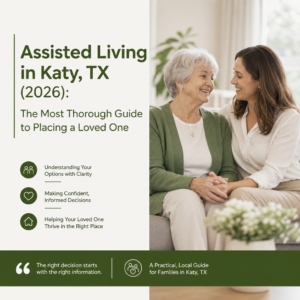
Assisted Living in Katy, TX (2026):
The Most Thorough Guide to Placing a Loved One
By Ivan Urrego | Last updated: May 2026 | Evergreen Cottages, Katy, TX
📋 Table of Contents
- Why This Decision Feels So Hard — and Why That's Normal
- What Is Assisted Living, Really? (Definitions That Matter)
- 10 Signs It May Be Time for Assisted Living in Katy, TX
- Understanding Care Levels: Assisted Living, Memory Care & More
- What to Look for in Assisted Living in Katy, TX
- What Does Assisted Living Cost in Katy, TX? (2026 Numbers)
- How to Pay for Assisted Living: Funding Sources Explained
- Texas Licensing, Regulations & What They Mean for Your Family
- The Touring Checklist: 20 Questions to Ask Every Community
- Memory Care & Alzheimer's Care in Katy, TX: A Closer Look
- Helping Your Loved One Transition: Practical Steps That Work
- Frequently Asked Questions About Assisted Living in Katy
- Why Evergreen Cottages Is Different — and Why Katy Families Choose Us
Searching for assisted living in Katy can feel like drinking from a fire hose. There is no shortage of options, brochures, or advice — but there is a serious shortage of clear, honest information written specifically for families like yours. This guide changes that. Whether your loved one needs help with daily activities, is showing early signs of memory loss, or has already been diagnosed with Alzheimer's or dementia, the sections below will give you a confident, step-by-step path forward.
1. Why This Decision Feels So Hard — and Why That's Normal
The short answer: Placing a loved one in assisted living is one of the most emotionally loaded decisions a family will ever face. Guilt, grief, uncertainty, and love are all present at the same time — and that is exactly as it should be.
If you are reading this guide at midnight, running on little sleep after a long day of caregiving, know this: you are not failing your parent. You are doing the opposite. The fact that you are researching, asking questions, and seeking the best possible care is the definition of love in action.
The Hidden Weight of Family Caregiving
According to the Alzheimer's Association 2025 Facts and Figures report, more than 11 million Americans provide unpaid care for people with Alzheimer's or other dementias, logging an estimated 18.4 billion hours of care annually. In Texas alone, hundreds of thousands of families are quietly absorbing the physical and emotional toll of full-time caregiving without adequate support. The result is caregiver burnout — a real, documented health condition that affects the caregiver's wellbeing just as seriously as it affects the person receiving care.
The Guilt Trap — and How to Escape It
Many families delay the decision to explore assisted living in Katy because guilt tells them that asking for professional help is a betrayal. But consider this: you would not feel guilty calling a surgeon if your loved one needed surgery. Professional memory care and assisted living are medical and therapeutic services, not an abandonment. Our blog post Is Guilt Preventing You from Placing Your Loved One in Professional Care? dives deeper into this dynamic and may offer some relief.
Why Earlier Is Almost Always Better
Research consistently shows that seniors who transition to assisted living communities while still in earlier stages of decline adapt more successfully, form stronger social bonds, and report higher quality of life. Waiting for a crisis — a fall, a wandering incident, a medical emergency — forces a reactive decision under extreme stress. The NIC 2025 Consumer Research Report found that 72% of families who waited for a crisis to act reported significantly higher levels of regret about the timing of the placement, compared to families who planned proactively.
2. What Is Assisted Living, Really? (Definitions That Matter)
Assisted living is a licensed residential care setting that provides personal care services, medication management, meals, and social programming to seniors who need support with daily activities but do not require the intensive medical care of a nursing home.
The term gets used loosely, so let's define the care types that matter most for Katy families in 2026:
Assisted Living (AL)
Designed for seniors who are largely independent but need help with one or more activities of daily living (ADLs) — bathing, dressing, grooming, medication management, or mobility. Residents live in private or semi-private rooms within a community setting. Staff are available around the clock, but the environment is intentionally homelike, not clinical. At Evergreen Cottages' Assisted Living program, we design daily life around each resident's preferences, not an institutional schedule.
Memory Care (MC)
A specialized form of assisted living designed specifically for individuals living with Alzheimer's disease, dementia, or other forms of cognitive decline. Memory care communities feature secured environments to prevent wandering, structured programming rooted in cognitive engagement, and staff trained in dementia-specific communication and behavioral support. Learn more on our Memory Care page.
Alzheimer's Care & Dementia Care
These terms are often used interchangeably with memory care. Alzheimer's disease is the most common cause of dementia, accounting for 60–80% of cases according to the Alzheimer's Association 2025 Facts and Figures. Dementia is the umbrella term for a cluster of symptoms — memory loss, impaired judgment, personality changes — caused by a variety of underlying conditions. Our dedicated Alzheimer's vs. Dementia explainer is a helpful read for families navigating a new diagnosis.
| Care Type | Best Suited For | Key Features |
|---|---|---|
| Assisted Living | Seniors needing help with ADLs | 24/7 staff, meals, medication mgmt, social activities |
| Memory Care | Diagnosed cognitive decline | Secure environment, dementia programming, specialized staff |
| Alzheimer's Care | Alzheimer's disease at any stage | Stage-specific care plans, behavioral support |
| Dementia Care | Any form of dementia | Person-centered, sensory engagement, family partnership |
3. 10 Signs It May Be Time for Assisted Living in Katy, TX
The clearest signal that it's time to explore assisted living in Katy is when the safety, health, or quality of life of your loved one — or your own — is being consistently compromised at home.
Most families can identify a single alarming incident. What they miss are the quieter, cumulative signs that have been building for months. Here are the ten most common indicators our care team at Evergreen Cottages hears from families who say, "I wish we had come sooner."
Unexplained Falls or Near-Falls
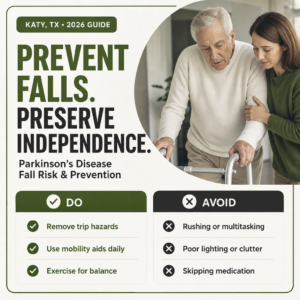
Falls are the leading cause of injury-related death among adults 65 and older, according to the CDC. If your loved one has fallen, or you've found them on the floor without knowing how long they were there, this is a serious red flag requiring immediate action.
Medication Errors
Missed doses, doubled doses, or taking the wrong medication are all dangerous. Managing multiple prescriptions is genuinely complex, and errors increase exponentially when cognitive decline is present.
Weight Loss or Poor Nutrition
If your loved one is losing weight, skipping meals, or living on crackers and canned soup, it signals that meal preparation is beyond what they can safely manage independently.
Declining Personal Hygiene
Wearing the same clothes for days, skipping showers, or dental neglect often indicate that bathing and grooming — activities that require coordination, balance, and memory — have become unsafe or overwhelming.
Getting Lost While Driving or Walking
Disorientation in familiar places is one of the most alarming early signs of cognitive decline. If your loved one has gotten lost driving home from the grocery store in Katy, it's time for a comprehensive assessment.
Social Withdrawal and Isolation
Seniors living alone in Katy who no longer attend church, visit friends, or engage in hobbies are at high risk. Chronic loneliness is now recognized as a health risk comparable to smoking 15 cigarettes a day, according to research cited by the U.S. Surgeon General's 2023 Advisory on Loneliness.
Caregiver Burnout in Family Members
If you, a sibling, or a spouse is exhausted, resentful, physically depleted, or sacrificing your own health to provide care, this is not sustainable — and the quality of care your loved one receives will suffer as a result.
Unsafe Home Environment
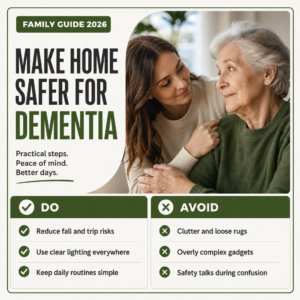
Stove left on, doors unlocked at night, stacks of unopened mail, signs of a recent small fire — these are all indicators that the home is no longer a safe environment.
Frequent Hospitalizations
Repeated emergency room visits or hospital stays for preventable conditions — UTIs, falls, medication mismanagement — signal that the current level of care at home is insufficient.
Your Loved One Has Asked for Help
Sometimes seniors tell us directly — "I'm scared to be alone," "I can't do this anymore," "I don't want to be a burden." If your loved one has expressed this, honor that voice. It takes enormous courage to ask.
4. Understanding Care Levels: Assisted Living, Memory Care & More
Not all care needs are the same, and the right community is the one that matches your loved one's current needs while having the capacity to meet future ones as those needs evolve.
In Texas, senior living options span a wide spectrum. Understanding where your loved one falls on that spectrum is critical before you start touring communities in Katy.
The Texas Senior Living Spectrum
| Level of Care | Who It's For | Staffing | Key Distinction |
|---|---|---|---|
| Independent Living | Active, largely self-sufficient seniors | Limited on-site staff | Lifestyle-focused; no personal care services |
| Assisted Living | Need help with 1+ ADLs | 24/7 personal care staff | Licensed, supervised personal care |
| Memory Care | Cognitive impairment / dementia | Dementia-trained specialists | Secure, structured cognitive programming |
| Skilled Nursing | Complex medical needs | RN/LVN supervision daily | High-acuity medical oversight |
| Hospice | End-of-life care | Palliative care team | Comfort-focused, not curative |
What "Level of Care" Means in Practice at Evergreen Cottages
At Evergreen Cottages, we conduct a thorough care assessment before any resident moves in. This assessment examines physical health, cognitive status, mobility, behavioral considerations, medication complexity, and personal preferences. The result is a personalized care plan — not a generic protocol — that is reviewed and updated on a regular schedule. You can read more about our approach on the Our Care Approach page.
When Needs Change: Aging in Place Within a Community
One of the biggest anxieties families in Katy express is: "What happens if Mom gets worse — will she have to move again?" At Evergreen Cottages, our model is specifically designed to support residents as their needs evolve. The NIC 2025 Consumer Research Report found that the ability to "age in place" within a single community was the number one factor families cited when choosing an assisted living or memory care provider. We hear that clearly, and it is built into how we operate.
5. What to Look for in Assisted Living in Katy, TX
The best assisted living community in Katy isn't necessarily the newest or the largest — it's the one that fits your loved one's personality, care needs, and values while giving your family genuine peace of mind.
Here is a research-backed framework for evaluating any community you tour in Katy or the surrounding Houston suburbs.
Staff-to-Resident Ratio
This single metric is one of the most predictive indicators of care quality. The lower the ratio, the more individual attention each resident receives. LeadingAge recommends families always ask for the actual overnight staffing ratio, not just the daytime number — this is where under-staffing most commonly occurs and where risks are highest. At Evergreen Cottages, our intentionally small, cottage-style community means our ratios are significantly better than large institutional settings. Our post on Why Less Is More explores this in depth.
Staff Continuity and Training
High staff turnover is one of the most reliable warning signs of a poorly run community. Seniors with dementia, in particular, thrive on consistent faces and relationships. Ask any community you visit: "What is your annual staff turnover rate?" and "What ongoing dementia training do your caregivers receive?" Industry-wide turnover in assisted living averages 65–75% annually according to ALFA (Assisted Living Federation of America) data. Communities that do significantly better than this number have built a culture worth paying attention to.
Physical Environment: Size, Safety, and Feel
Walk the hallways. Smell the air. Listen. Is the space calm and residential, or busy and institutional? Are there outdoor spaces that are safe and accessible? Is the lighting warm? Small communities — like the cottage-style model at Evergreen Cottages — are scientifically linked to lower cortisol levels, reduced anxiety, and stronger social belonging among residents.
Activities and Daily Life
Ask to see the actual activities calendar — not a printed sample, but last week's real schedule. Quality programming goes far beyond "bingo on Tuesdays." Look for purpose-driven activities, music therapy, outdoor time, spiritual programming, and opportunities for residents to maintain their identity and sense of contribution. Our Daily Living page gives a real look at what life looks like at Evergreen Cottages every day.
Family Communication and Transparency
How does the community communicate with families when something changes? Do they use a digital platform? Do they call proactively, or only when there's a crisis? The best communities in Katy will be transparent about incidents, care plan changes, and your loved one's daily wellbeing without waiting for you to ask. This is a non-negotiable for most families we work with.
6. What Does Assisted Living Cost in Katy, TX? (2026 Numbers)
The honest answer: assisted living in Katy, TX in 2026 typically ranges from $3,500 to $6,500 per month, depending on the level of care, the size of the community, and the specific services included in the base rate.
Cost is one of the most anxiety-producing parts of this conversation — so let's break it down clearly and without sugarcoating anything.
2026 Cost Ranges: Katy, TX
| Care Type | Monthly Low | Monthly High | Typical Average |
|---|---|---|---|
| Assisted Living (Katy, TX) | $3,500 | $5,800 | ~$4,600/month |
| Memory Care (Katy, TX) | $4,200 | $6,500 | ~$5,400/month |
| Home Health Aide (Full-Time Equivalent) | $4,800 | $9,000+ | ~$6,500/month |
| Skilled Nursing Facility (TX avg.) | $6,000 | $11,000+ | ~$8,000/month |
Sources: Genworth 2025 Cost of Care Survey; NIC 2025 Consumer Research Report. Ranges reflect Katy / greater Houston suburban market.
What's Included — and What's Not
Most assisted living communities in Katy quote a base monthly rate that covers housing, meals, housekeeping, laundry, basic activities, and standard staffing. Additional charges typically apply for higher levels of personal care, medication management beyond a set threshold, incontinence supplies, and specialized programming. Always ask for a complete fee schedule — not just the base rate — before signing any agreement.
Is Assisted Living More Affordable Than Staying Home?
For many Katy families, the honest math surprises them. When you add up home health aide costs, adult day programs, home modifications for safety, transportation, meals, medication management services, and the hidden cost of a family member reducing work hours to provide care — staying home is often more expensive than moving to a quality assisted living community, while providing less consistent oversight. Our detailed cost breakdown is at What Does Assisted Living Cost in Katy, TX?
7. How to Pay for Assisted Living: Funding Sources Explained
Most families in Katy pay for assisted living through a combination of private funds, long-term care insurance, and — for qualifying veterans — VA benefits. Understanding all your options is essential before ruling anything out based on cost alone.
Private Pay: The Most Common Funding Source
The majority of assisted living residents in Texas pay privately using retirement savings, Social Security income, pension income, proceeds from selling a home, or a combination. The good news: with the new $200,000 Texas Senior Homestead Exemption for 2026, many Katy families are finding that renting (rather than selling) the family home generates reliable monthly income that covers assisted living costs. Read our detailed analysis at The $200,000 Texas Senior Homestead Exemption 2026.
Long-Term Care Insurance
If your loved one purchased a long-term care (LTC) insurance policy, this is typically the most straightforward funding source. Policies vary significantly in terms of daily benefit amounts, elimination periods (the wait before benefits kick in), and inflation protection. Pull the policy and read it carefully — or work with the insurer directly to understand exactly what is covered in an assisted living or memory care setting in Katy.
Veterans Benefits: Aid & Attendance
The VA's Aid and Attendance (A&A) pension benefit is one of the most underutilized financial resources for senior care in the country. Eligible veterans and surviving spouses can receive up to $2,431 per month (2026 rates) to offset the cost of assisted living or memory care. Eligibility is based on wartime service, financial need, and a medical need for assistance with ADLs. Our Veterans Affairs Aid & Attendance guide explains eligibility in plain terms.
Does Medicare or Medicaid Pay for Assisted Living?
This is one of the most common misconceptions we encounter. Medicare does not cover assisted living. It covers acute medical care, not custodial care in a residential setting. Medicaid in Texas does fund some community-based care through specific waiver programs, but waitlists are long and eligibility criteria are strict. Our comprehensive breakdown is at Does Medicare or Medicaid Pay for Assisted Living?
| Funding Source | Covers Assisted Living? | Notes for Katy Families |
|---|---|---|
| Private Pay (savings, home sale) | ✅ Yes | Most flexible; most common method |
| Long-Term Care Insurance | ✅ Yes (if policy qualifies) | Review policy terms carefully |
| VA Aid & Attendance | ✅ Yes (for qualifying veterans) | Up to $2,431/month; apply early |
| Medicare | ❌ No | Covers skilled nursing, not AL |
| Texas Medicaid (STAR+PLUS) | ⚠️ Limited | Waitlists; strict income/asset limits |
| Life Insurance (conversion) | ✅ Sometimes | Life settlement or policy loan options |
8. Texas Licensing, Regulations & What They Mean for Your Family
In Texas, all assisted living facilities (ALFs) must be licensed by the Texas Health and Human Services Commission (HHSC). Understanding this regulatory framework helps you ask better questions and verify any community's legitimacy before you commit.
Two Types of Texas ALF Licenses
The state issues two types of licenses based on the level of care provided:
- Type A ALF: For residents who are capable of self-preservation in an emergency — meaning they can respond to an alarm, move on their own, and do not require continuous nursing supervision.
- Type B ALF: For residents who require more oversight, including those who cannot self-evacuate and may need nighttime assistance. Memory care communities in Texas typically operate under a Type B license.
How to Check a Community's License and Inspection History
Texas HHSC maintains a publicly accessible database of all licensed ALFs in the state, including their inspection reports, complaint history, and any enforcement actions. You can search by community name or city at the HHSC Long-Term Care Regulatory website. This is a step every Katy family should take before signing a contract. A clean inspection history is a meaningful signal; a pattern of deficiencies is a red flag that should prompt very specific questions during your tour.
Evergreen Cottages: State Licensed and Proud of It
Evergreen Cottages maintains full Texas HHSC licensure and operates under the highest standards of care compliance. We are transparent about our regulatory status and encourage every family to do their due diligence. Our post Are You a State Licensed Community? answers the most common questions we receive about licensing, what it means, and what it doesn't mean.
What Regulations Don't Cover — and Where to Fill the Gaps
State licensing sets a floor, not a ceiling. A community can be fully compliant with all HHSC regulations and still provide mediocre, impersonal care. The regulations don't measure warmth, purpose-driven programming, staff empathy, or family communication quality. That's why a thorough personal visit — and honest conversations with current residents' families — is irreplaceable in your research process.
9. The Touring Checklist: 20 Questions to Ask Every Community
Touring a community without a prepared list of questions is like buying a house without a home inspection. The building may look beautiful and feel right — but the most important information is invisible to the casual eye.
Below is the touring checklist we recommend to every Katy family who visits Evergreen Cottages — or any other community on their list.
About Staffing and Training
- What is your current staff-to-resident ratio during the day? At night?
- What is your annual staff turnover rate?
- What specific dementia and memory care training do all caregivers receive?
- Is the same caregiver consistently assigned to my loved one?
- Who covers when a regular caregiver is absent?
About Care and Safety
- How is the initial care assessment conducted, and who participates?
- How frequently are care plans reviewed and updated?
- How do you handle behavioral symptoms of dementia (wandering, agitation)?
- What is your fall prevention protocol?
- How are medical emergencies handled? Is there a nurse on-site overnight?
- How do you manage medication for residents — and what happens if a dose is missed?
About Daily Life and Environment
- Can I see the actual activities calendar from this week?
- How do you support residents who prefer solitude or have social anxiety?
- Are meals prepared on-site? May I see a full week's menu?
- Can residents personalize their room with their own furniture and belongings?
- How are family visits handled — are there any restrictions?
About Operations and Finances
- What is included in the base monthly rate, and what costs extra?
- What is your policy if care needs increase significantly?
- Under what circumstances would a resident be asked to leave?
- Can you share your most recent state inspection report?
10. Memory Care & Alzheimer's Care in Katy, TX: A Closer Look
If your loved one has been diagnosed with Alzheimer's disease, dementia, or another form of cognitive decline, memory care in Katy is a distinct and specialized care path — not simply assisted living with a locked door.
The Alzheimer's Association 2025 Facts and Figures reports that 6.9 million Americans age 65 and older are currently living with Alzheimer's disease, a number projected to reach 13.8 million by 2060. In Texas — one of the fastest-growing states — the impact is especially pronounced. Understanding what genuine memory care looks like will help you recognize it when you see it.
What Real Memory Care Looks Like
Authentic memory care is not defined by locked doors and extra supervision. It is defined by a philosophy of personhood — the belief that even in the presence of cognitive decline, every individual retains their identity, their preferences, their emotional life, and their capacity for joy and connection. Best-practice memory care communities design every element of the physical environment, daily schedule, and staff interaction around this philosophy.
At Evergreen Cottages, our Memory Care program incorporates:
- Individualized life history profiles that inform all care interactions
- Structured sensory and cognitive programming calibrated to each resident's stage
- Music therapy proven to reduce anxiety and improve mood in dementia patients
- Purposeful outdoor time in a secure garden environment
- Family education and support resources throughout the care journey
The Difference Between Memory Care and Home Care for Dementia
Many families initially pursue home care as an alternative to memory care placement, which is understandable. But as dementia progresses, home care becomes increasingly inadequate for two key reasons: safety (wandering risk, cooking hazards, medication errors) and cognitive stimulation (a home health aide cannot replicate the structured, socially rich environment of a quality memory care community). Our in-depth comparison is at Memory Care vs. Home Care: Which Is Better for Dementia?
Sundowning, Behavioral Symptoms, and How We Respond
Sundowning — the increase in confusion, agitation, and behavioral disturbances that many dementia patients experience in the late afternoon and evening hours — is one of the most challenging aspects of dementia caregiving. At Evergreen Cottages, our team is trained in evidence-based sundowning management strategies. Our comprehensive guide, What Is Sundowning? What It Means, Why It Happens, and How Families in Katy, TX Can Respond, is a resource we share with every family we work with.
Alzheimer's Care at Every Stage
The approach to Alzheimer's care must evolve as the disease progresses through early, middle, and late stages. What works in year one may not work in year three. Our team continuously reassesses and adjusts care plans, ensuring that the care always meets your loved one where they are — not where they used to be. Learn more at How Evergreen Cottages Supports Families Through Alzheimer's Care.
11. Helping Your Loved One Transition: Practical Steps That Work
The first 30 days after move-in are the most emotionally complex for both the resident and the family. Having a clear plan — and realistic expectations — makes an enormous difference in how smoothly the transition unfolds.
Before the Move: Preparation Is Everything
Start involving your loved one in the process as early and as genuinely as possible. If they