What Services Do Memory Care Communities Provide in Katy, TX? (2026 Complete Guide for Families)
By Ivan Urrego, Professional Copywriter for the Senior Living Industry | Last updated: May 2026
Award-winning contributor to Argentum and MALA (Mid-America Living Association); Ivan has researched and written for memory care, assisted living, and dementia care communities across Texas and the Houston metro, helping families navigate the most important decisions of their lives with clarity and confidence.
- What Is Memory Care — and How Is It Different from Assisted Living?
- 24/7 Supervised Care and a Secure Environment
- Personalized Dementia Care Plans
- Medication Management and Clinical Support
- Structured Activities and Cognitive Enrichment Programming
- Dementia-Friendly Dining and Nutrition Services
- Personal Care Assistance and ADL Support
- Family Communication and Caregiver Support
- Respite Care Services for Family Caregivers
- Specialized Alzheimer’s Care Services
- The Physical Environment: Safety and Design
- Staff Training and Dementia-Specific Expertise
- Frequently Asked Questions About Memory Care in Katy, TX
If you are searching for memory care in Katy, TX, the first question families almost always ask is: what exactly do memory care communities do? The short answer is that memory care provides a specialized, structured, and secure environment designed exclusively for people living with Alzheimer’s disease, dementia, or other forms of cognitive decline. Unlike standard assisted living, every service in a memory care community is deliberately designed around the unique needs, rhythms, and challenges of dementia — from the layout of the building to the training of every staff member on shift.
Below, we break down each category of services in detail so you can compare options and know exactly what to look for when you tour a community here in Katy, Texas.
1. What Is Memory Care — and How Is It Different from Assisted Living?
Memory care is a licensed level of long-term care specifically designed for individuals living with Alzheimer’s disease, dementia, or other forms of cognitive impairment. It provides all the services of assisted living — meals, personal care, medication management, activities — but layers on additional safeguards, dementia-trained staff, and therapeutic programming that standard assisted living cannot offer.
The Core Distinction: Specialization
In a traditional assisted living community, residents with dementia may share space and programming with residents who have primarily physical care needs. In a dedicated memory care community, every single service, staff interaction, daily schedule, and physical space is designed for one population: people living with cognitive decline. That specialization changes everything — the pace of care, the way meals are served, the way staff communicate, and the way activities are structured.
Texas State Licensing for Memory Care
In Texas, communities that provide memory care must be licensed by the Texas Health and Human Services Commission (HHSC) as an Assisted Living Facility (ALF) and must meet additional requirements under the Texas Administrative Code if they operate a designated dementia care unit. This means communities like Evergreen Cottages in Katy, TX operate under direct state oversight — which gives families an important layer of accountability.
Memory Care vs. Assisted Living: A Quick Comparison
| Feature | Assisted Living | Memory Care |
|---|---|---|
| Staffing focus | General personal care | Dementia-trained specialists |
| Security | Standard | Enhanced (secured entrances/exits) |
| Programming | General social activities | Structured cognitive/sensory therapies |
| Staff-to-resident ratio | Lower (varies) | Higher (more intensive oversight) |
| Environment design | Residential | Dementia-specific (wayfinding, calm zones) |
| Family support programs | General | Dementia-specific education & counseling |
2. 24/7 Supervised Care and a Secure Environment
Around-the-clock supervision is the foundation of memory care. Because dementia can affect judgment, spatial awareness, and the ability to recognize danger, people living with Alzheimer’s or related conditions require constant oversight — not just during waking hours, but through the night as well.
What “24/7 Care” Actually Means
In a quality memory care community in Katy, TX, 24/7 care means licensed nursing staff or qualified caregivers are on the floor at all times — observing residents, responding to behavioral changes, assisting with nighttime needs, and preventing wandering incidents. According to the Alzheimer’s Association, approximately 60% of people with dementia will wander at some point during their illness, making continuous supervision not a luxury but a medical necessity.
Secured Perimeters and Wandering Prevention
Memory care communities use a combination of secured entry/exit doors, coded keypads, wander-alert systems (often using wearable technology), and thoughtfully designed floor plans that minimize dead ends and disorienting corridors. At Evergreen Cottages in Katy, Texas, the physical design of our community is intentional: residents can move freely within a safe, enclosed environment without ever feeling “locked in.”
Emergency Response Systems
Residents are typically equipped with personal emergency response devices (call pendants or wristbands), and facilities maintain emergency protocols specifically calibrated for dementia-related crises — including sundowning episodes, acute agitation, and fall events. Staff response times in dedicated memory care settings are significantly faster than in general assisted living environments because staff ratios are higher and training is more specialized.
3. Personalized Dementia Care Plans
No two people experience dementia the same way. A well-run memory care community in Katy, TX builds an individualized care plan for every resident — one that reflects their medical history, personality, preferences, life story, and current stage of cognitive decline.
The Assessment Process
Before or shortly after move-in, the care team conducts a comprehensive assessment using validated cognitive screening tools (such as the Mini-Mental State Examination or Montreal Cognitive Assessment) alongside a holistic intake interview that covers the resident’s career, hobbies, cultural background, daily routines, and long-term relationships. This information becomes the foundation of every care interaction.
What a Personalized Care Plan Covers
- Cognitive status and behavioral patterns
- Personal care preferences and routines (morning vs. evening bather, preferred foods, etc.)
- Medical diagnoses and medication schedules
- Communication abilities and sensory needs
- Meaningful activities tied to lifelong interests
- Family involvement preferences
- Goals of care and advance directive documentation
Plan Review and Updates
Dementia is progressive, and care plans must evolve with the resident. Reputable communities conduct formal care plan reviews at least quarterly — or whenever a significant behavioral or medical change occurs. Families are invited participants in these reviews, not just passive recipients of updates. According to the National Investment Center for Seniors Housing & Care (NIC, 2025), communities that involve families in care planning report higher satisfaction scores and better resident outcomes.
4. Medication Management and Clinical Support
Medication management is one of the most critical — and most easily overlooked — services in memory care. Adults with dementia often take multiple medications daily, and cognitive impairment makes self-administration unsafe. Missed doses, double-dosing, or drug interactions can significantly accelerate cognitive and physical decline.
What Medication Management Includes
In a licensed memory care community in Katy, TX, medication management encompasses:
- Physician-prescribed medication orders reviewed and maintained by licensed nurses
- Administration at prescribed times by trained staff (not self-administration)
- Electronic medication administration records (eMAR) for accuracy and accountability
- Coordination with the resident’s primary care physician and specialists
- Monitoring for side effects or behavioral changes linked to medication adjustments
- Regular pharmacy reviews to check for polypharmacy risk
Access to Clinical Support
Many memory care communities partner with on-call physicians, geriatric psychiatrists, and visiting therapists (occupational, physical, and speech therapy). Hospice coordination is also available for residents who reach late-stage dementia. These partnerships mean residents can receive a significant level of clinical care without being transferred to a hospital or nursing facility for routine needs.
5. Structured Activities and Cognitive Enrichment Programming
Purposeful, structured daily activity is not optional in memory care — it is therapeutic medicine. Research published in the Journal of Alzheimer’s Disease and cited by the Alzheimer’s Association 2025 Facts & Figures confirms that structured engagement programs slow behavioral symptoms, reduce antipsychotic medication use, and improve quality of life for people living with dementia.
Evidence-Based Programming Approaches
Leading memory care communities in Katy, TX and nationally use proven therapeutic frameworks:
| Program Type | Description | Benefit |
|---|---|---|
| Music & Memory | Personalized playlists tied to long-term musical memories | Reduces agitation, improves mood |
| Reminiscence Therapy | Structured conversations using photos, objects, and stories | Preserves identity, reduces anxiety |
| Art & Creative Expression | Painting, collage, sensory crafts | Reduces depression, boosts engagement |
| Sensory Stimulation | Tactile, olfactory, and visual activities | Calms agitation, improves alertness |
| Gentle Movement / Chair Yoga | Low-impact physical activity adapted for cognitive impairment | Maintains mobility, reduces fall risk |
| Intergenerational Programs | Visits or virtual connections with children or grandchildren | Elevates mood, provides purpose |
Structured Routines Reduce Anxiety
People with dementia thrive on predictability. Memory care communities build daily schedules that follow consistent rhythms — wake-up routines, morning programs, lunch, afternoon activities, and evening wind-down — because familiarity reduces the anxiety and disorientation that is common with dementia. Spontaneity, which might be welcomed in general senior living, can actually be distressing for someone with cognitive decline.
Life Story Integration
The best memory care communities go beyond generic activities. At Evergreen Cottages, we work with families to understand who your loved one was before dementia — a veteran, a gardener, a seamstress, a coach — and we weave those identities into daily programming. A former teacher might lead a simple quiz activity; a lifelong baker might help fold napkins as part of a meal preparation routine. These moments of competence and connection are profoundly meaningful.
6. Dementia-Friendly Dining and Nutrition Services
Nutrition and hydration are major concerns in dementia care. As the disease progresses, individuals may forget to eat, lose appetite, have difficulty using utensils, or develop swallowing problems (dysphagia). A strong memory care community addresses all of these challenges with specialized dining practices.
How Dementia-Friendly Dining Works
- Finger foods and modified textures: For residents who struggle with utensils or swallowing, meals are adapted to be manageable and safe.
- High-contrast dishware: Research shows that people with dementia eat more when food contrasts clearly with the plate — red plates on white tablecloths, for example.
- Consistent seating: Residents eat in the same seat each meal to reduce disorientation.
- Guided assistance: Staff sit with residents, use verbal cues, and offer hand-over-hand assistance as needed — always maintaining dignity.
- Hydration monitoring: Dehydration is a leading cause of hospitalizations among seniors with dementia. Memory care communities track fluid intake carefully.
Dietitian Oversight
Quality memory care communities partner with registered dietitians to review resident nutrition profiles and make individualized recommendations — especially for residents with diabetes, heart disease, or significant weight loss. Meals are planned to be nutritionally balanced while also being recognizable and appealing to residents at various stages of cognitive decline.
7. Personal Care Assistance and Activities of Daily Living (ADL) Support
Personal care assistance — help with bathing, dressing, grooming, toileting, and mobility — is at the heart of daily memory care. These activities of daily living (ADLs) are the first domains affected by dementia’s progression, and providing them with dignity and consistency is a hallmark of excellent memory care.
ADL Support in Memory Care
Unlike general assisted living, memory care staff are trained specifically in dementia-appropriate personal care techniques. This means:
- Using simple, one-step verbal instructions rather than multi-part directions
- Allowing extra time and never rushing — agitation increases when residents feel hurried
- Honoring long-standing routines (shower in the morning vs. evening bath)
- Adapting to behavioral resistance with redirection and patience rather than force
- Maintaining privacy and modesty at all times
Continence Care
Incontinence is common in mid-to-late stage dementia and is one of the most emotionally difficult aspects of the disease for families. Memory care staff are trained to manage continence care proactively — scheduled toileting, appropriate incontinence products, and skin care protocols — without embarrassing or distressing the resident.
Mobility and Fall Prevention
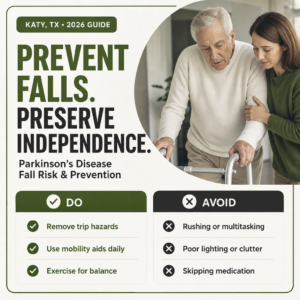
Balance and mobility challenges often accompany cognitive decline. Memory care communities implement individualized fall prevention plans, use adaptive equipment (grab bars, non-slip flooring, hip protectors), and monitor gait changes that can signal a fall risk before an incident occurs. Physical therapy is often available on-site or through visiting therapists.
8. Family Communication and Caregiver Support
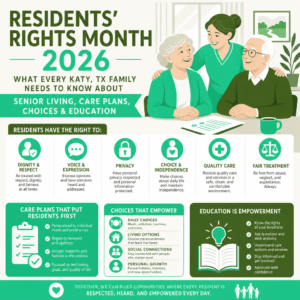
A memory care community that serves your loved one well also serves your family. Dementia doesn’t just affect the person diagnosed — it reshapes every relationship in the family system. Excellent memory care communities in Katy, TX recognize this and build robust family support services alongside resident care.
Regular Family Communication
Families should expect — and demand — consistent, proactive communication from their loved one’s care team. This includes:
- Regular care plan meetings (at minimum quarterly)
- Immediate notification of any significant health change, fall, or incident
- Monthly written or digital updates on behavioral and functional status
- Open-door access to the director and care team for questions or concerns
Caregiver Education and Support Groups
Many memory care communities offer dementia education programs for families — workshops on understanding disease stages, communication strategies for dementia, and grief support for the anticipatory loss families experience. Some communities partner with local chapters of the Alzheimer’s Association or Ageless Alliance to provide these resources. Caregiver burnout is a serious health risk; communities that invest in family wellbeing alongside resident wellbeing provide a significantly different level of service.
The Emotional Weight Families Carry
If you are researching memory care in Katy, TX right now, you may be carrying enormous weight — guilt about this decision, grief for who your loved one used to be, exhaustion from months or years of caregiving, and fear about what comes next. A compassionate memory care community acknowledges all of that. The right community will feel like a partner in your loved one’s care, not a replacement for you.
9. Respite Care Services for Family Caregivers in Katy, TX
Respite care provides short-term, temporary stays in a memory care community — giving family caregivers a break while their loved one receives professional care in a safe environment. It is one of the most underutilized yet valuable services in the senior living continuum.
Who Respite Care Is For
Respite care in Katy, TX is ideal for family caregivers who:
- Need to travel for work or a planned vacation
- Are recovering from their own health issue or surgery
- Are experiencing caregiver burnout and need time to rest
- Want to “try out” a memory care community before committing to long-term care
- Are bridging a gap between hospital discharge and a more permanent care decision
What Respite Care Includes
During a respite stay, your loved one receives the full complement of memory care services — meals, activities, personal care, medication management, supervision — exactly as a long-term resident would. The difference is simply the duration: respite stays typically range from a few days to 30 days, depending on the community’s policies.
The Secondary Benefit: Transition Familiarity
Families who use respite care before transitioning a loved one to full-time memory care report significantly smoother long-term transitions. The resident becomes familiar with the space, staff, and rhythms before making a permanent move — which reduces the disorientation and anxiety that often accompany major transitions for people with dementia.
10. Specialized Alzheimer’s Care Services
Alzheimer’s disease is the most common form of dementia, accounting for approximately 60–80% of all dementia cases (Alzheimer’s Association, 2025 Facts & Figures). While all memory care addresses dementia broadly, specialized Alzheimer’s care goes deeper — tailoring interventions to the specific progression patterns, behavioral manifestations, and communication challenges characteristic of Alzheimer’s disease.
Stage-Based Care Adjustments
Alzheimer’s disease progresses through early, middle, and late stages — and care needs shift dramatically across that continuum. A quality memory care community in Katy, TX adjusts care protocols as the disease progresses:
| Stage | Primary Needs | Memory Care Focus |
|---|---|---|
| Early Stage | Independence support, orientation, social connection | Cognitive stimulation, routine building, social programming |
| Middle Stage | Behavioral management, ADL assistance, wandering prevention | Structured activities, sensory therapies, close supervision |
| Late Stage | Comfort care, swallowing support, skin integrity | Palliative approach, hospice coordination, family support |
Behavioral Symptom Management
Behavioral and psychological symptoms of dementia (BPSD) — including aggression, paranoia, sundowning, repetitive behaviors, and wandering — affect up to 90% of people with Alzheimer’s at some point (Alzheimer’s Association, 2025). Trained memory care staff use non-pharmacological approaches first: redirection, validation therapy, environmental modification, and sensory interventions. Antipsychotic medications are used only when clinically necessary and with physician oversight — a practice aligned with the Centers for Medicare & Medicaid Services’ national initiative to reduce unnecessary antipsychotic use in dementia care.
Specialized Communication Techniques
As Alzheimer’s progresses, verbal communication becomes increasingly difficult. Memory care staff are trained in alternative communication approaches — music, touch, facial expression, familiar objects — that maintain connection even when words are lost. This is one of the most human and important services that specialized Alzheimer’s care provides.
11. The Physical Environment: Safety Features and Dementia-Sensitive Design
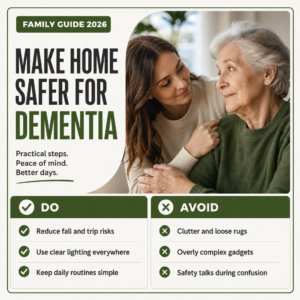
The built environment of a memory care community is itself a therapeutic tool. Research in environmental gerontology consistently shows that thoughtful design reduces agitation, prevents falls, supports independence, and improves overall wellbeing in people with dementia. When you tour a memory care community in Katy, TX, the physical space should communicate safety and calm at every turn.
Key Environmental Features to Look For
- Secured perimeters with alarm systems on all exit doors
- Circular floor plans that allow residents to walk freely without dead ends
- High-contrast visual cues (colored door frames, distinctive room markers) to support wayfinding
- Non-glare lighting that reduces hallucinations and nighttime disorientation
- Quiet zones and sensory rooms for residents who become overstimulated
- Outdoor access — safely enclosed gardens or walking paths where residents can experience fresh air and nature
- Residential, home-like aesthetics rather than clinical, institutional environments
- Small neighborhood clusters that reduce the disorienting scale of large facilities
The Cottage Model
Some of the most highly regarded memory care communities — including Evergreen Cottages in Katy, TX — use a “cottage” or small-house model, where residents live in intimate groups of 12–16 rather than large wings of 40–60. Research consistently shows that smaller environments reduce anxiety, improve staff-to-resident relationships, and lead to better behavioral outcomes for people with dementia. The scale matters.
12. Staff Training and Dementia-Specific Expertise
The quality of a memory care community ultimately comes down to its people. The physical environment, the programming, and the policies are all important — but what determines the daily quality of life for your loved one is the knowledge, compassion, and consistency of the staff who care for them every single day.
What to Expect from Memory Care Staff Training
In Texas, all assisted living staff who work in memory care units are required to receive dementia-specific training under state regulations. But the minimum is rarely enough. Look for communities whose staff receive:
- Initial orientation: Comprehensive dementia education before ever working with residents
- Ongoing continuing education: Regular refreshers on dementia stages, behavioral management, and communication
- Certification programs: National certifications such as the Certified Dementia Practitioner (CDP) credential from the National Council of Certified Dementia Practitioners
- Specialized technique training: Approaches like Validation Therapy, Teepa Snow’s Positive Approach to Care, or Person-Centered Dementia Care models
Staff Stability and Turnover
Staff turnover is one of the most significant quality indicators in senior living, and its impact is especially acute in memory care. People with Alzheimer’s depend on familiar faces — unfamiliar caregivers can trigger significant anxiety and behavioral decline. The national average annual caregiver turnover rate in assisted living exceeds 50% (LeadingAge, 2025). When evaluating communities in Katy, TX, ask directly about their turnover rate and their strategies for retaining experienced staff.
Staff-to-Resident Ratios
Texas state minimums for ALF staffing are a floor, not a target. Quality memory care communities maintain higher ratios during peak periods (mornings, meals, activities) and never drop below safe coverage levels at night. Ask to see the actual staffing schedule — not just the ratio that appears in the brochure.
13. Frequently Asked Questions About Memory Care in Katy, TX
Choosing Memory Care in Katy, TX: A Decision Made With Love
Memory care is not a single service — it is a comprehensive ecosystem of specialized support designed to help people living with Alzheimer’s and dementia experience the best possible quality of life at every stage of the disease. From 24/7 licensed supervision and personalized care plans to evidence-based programming, dementia-sensitive dining, expert medication management, and deep family support, the services provided by a quality memory care community go far beyond what any family can replicate at home — no matter how dedicated or loving they are.
If you are in Katy, Texas and beginning this research for a parent, spouse, or loved one, the most important next step is to visit a community in person. No website, no brochure, and no guide — including this one — can replace the experience of walking through a community, observing the staff with residents, and feeling whether the environment is truly calm, caring, and professional. At Evergreen Cottages, we welcome those visits and encourage you to come with every question on your mind. We have answered them all before, and we know how much is riding on this decision.
Ivan Urrego is a professional copywriter specializing in the senior living industry, recognized as an award-winning contributor to Argentum and MALA (Mid-America Living Association). He writes exclusively for Evergreen Cottages, an assisted living and memory care community in Katy, TX, bringing over a decade of experience researching, interviewing clinical experts, and translating complex dementia care information into clear, compassionate guidance for families navigating some of life’s most difficult decisions. His work has been featured across leading senior living publications and association conferences throughout Texas and the broader U.S. senior living community.
Sources
- Alzheimer’s Association. 2025 Alzheimer’s Disease Facts and Figures. alz.org/alzheimers-dementia/facts-figures
- National Investment Center for Seniors Housing & Care (NIC). 2025 Senior Housing Data & Benchmarks. nic.org
- LeadingAge. 2025 Workforce and Staffing Report: Assisted Living and Memory Care. leadingage.org
- Alzheimer’s Foundation of America (ALFA). Quality Standards for Memory Care Communities. alzfdn.org
- Texas Health and Human Services Commission. Assisted Living Facility Regulations: Dementia Care Requirements. hhs.texas.gov
- Centers for Medicare & Medicaid Services (CMS). National Partnership to Improve Dementia Care in Nursing Homes: Antipsychotic Drug Use. cms.gov