EVERGREEN COTTAGES · KATY, TX · www.evergreencottages.com
10 Signs Your Parent May Need More Care Than You Can Provide
A practical, compassionate guide for adult children navigating one of the hardest decisions in family life — and how to take action before a crisis forces the choice.
By Ivan Urrego, Professional Copywriter — Senior Living Industry | Last updated: April 2026
Ivan Urrego is an award-winning copywriter specializing in the senior living sector, recognized by Argentum, MALA, and multiple national senior housing associations. He has crafted content strategies for assisted living and memory care communities across Texas and the broader Sun Belt region, helping families find the right care at the right time.
Quick Summary
This guide identifies the 10 clearest warning signs that a parent’s care needs have outpaced what a family can safely manage at home — from physical safety risks and medication mismanagement to cognitive decline and caregiver burnout. It also explains what assisted living communities like Evergreen Cottages in Katy, TX provide, and how to begin the conversation with your loved one.
Table of Contents
- Unexplained Falls and Mobility Decline
- Medication Errors and Mismanagement
- Significant Weight Loss or Poor Nutrition
- Declining Home Safety and Personal Hygiene
- Memory Loss That Disrupts Daily Life
- Social Withdrawal and Signs of Depression
- Caregiver Burnout Within the Family
- Chronic Medical Conditions That Are Worsening
- Unsafe Driving and Loss of Independence
- Your Parent Has Asked for Help
- What Assisted Living Actually Provides
- How to Start the Conversation With Your Parent
- Why Evergreen Cottages in Katy, TX
- Frequently Asked Questions
The Hardest Conversation in Family Life
You visit your mother for the holidays and notice the refrigerator is stocked with expired food. Your father, who has driven the same roads for fifty years, mentions he got lost on the way to the grocery store last week. Your sister calls to say she found their parents’ pill organizer untouched — three days of medication still sitting there.
None of these moments feel like a crisis. But together, they are a pattern. And patterns, when it comes to aging parents, deserve serious attention.
Adult children across America are managing this reality right now. According to AARP’s 2024 caregiving research, more than 53 million Americans serve as unpaid caregivers — the majority of them providing support to a parent or parent-in-law. Of those caregivers, 40% report that their parent’s needs have exceeded what they can sustainably manage, yet they continue providing care because they don’t know when — or how — to make a change.
This guide is for that moment. Not to scare you or rush a decision, but to help you see clearly what you may be too close to notice — and to understand that moving a parent to an assisted living community like Evergreen Cottages in Katy, TX is not giving up. It is giving more.
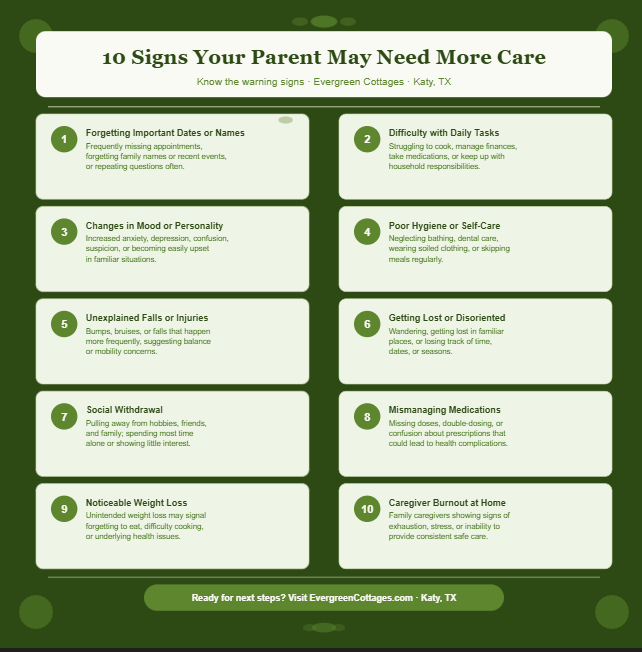
Sign 01 — Unexplained Falls and Mobility Decline
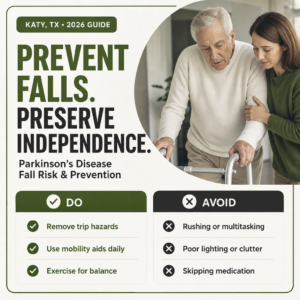
Falls are the leading cause of injury-related death among adults 65 and older, according to the Centers for Disease Control and Prevention (CDC). In 2022 alone, falls cost the U.S. healthcare system more than $50 billion in medical expenses. More important than the statistics, though, is the pattern behind them.
One fall may be a bad day. Two falls in a month warrant a conversation. Three or more falls, or an increasing fear of walking, getting up from a chair, or navigating stairs, is a clear signal that the home environment and the care available within it are no longer sufficient.
What to look for: Unexplained bruises, a reluctance to walk to the kitchen or bathroom unassisted, furniture being used as a handrail throughout the home, or a refusal to discuss recent falls out of embarrassment.
In an assisted living community, certified team members are present around the clock. Grab bars, non-slip flooring, emergency pull cords, and mobility assistance are built into the environment — not retrofitted after a crisis. At Evergreen Cottages, every cottage is designed with fall prevention as a foundational priority, not an afterthought.
Sign 02 — Medication Errors and Mismanagement
Managing multiple medications is one of the most demanding aspects of aging independently. The average older adult takes four to five prescription medications daily. For those with chronic conditions like heart disease, diabetes, or hypertension, that number can reach eight or more. Missing doses, double-dosing, or mixing incompatible medications is not a sign of irresponsibility — it is a mathematically complex task that becomes harder as cognition changes.
A 2023 study published in the Journal of the American Geriatrics Society found that medication non-adherence among adults over 65 accounts for approximately 30% of hospital admissions and 125,000 deaths annually in the United States.
What to look for: Pill bottles that are too full or already empty ahead of schedule, medications stored in the wrong location, missed refills, or reports from a primary care physician of unstable blood pressure, blood sugar, or other manageable markers.
Assisted living communities provide structured medication management as a standard service. At Evergreen Cottages, trained staff administer or assist with medications at prescribed times, maintain accurate medication logs, and coordinate directly with physicians and pharmacists on behalf of each resident.
Sign 03 — Significant Weight Loss or Poor Nutrition
Unintentional weight loss in an older adult — typically defined as losing more than 5% of body weight in six to twelve months without trying — is a medical red flag. It can signal depression, dementia, difficulty swallowing, loss of taste or smell, financial stress, or simply an inability to safely cook and eat regular meals.
Cooking for one is logistically and emotionally taxing. Many seniors eat less as a result of living alone, particularly after the death of a spouse. When cooking becomes physically difficult — arthritis makes chopping vegetables painful, standing at a stove for extended periods becomes unsafe — nutrition deteriorates rapidly.
What to look for: A refrigerator with little or expired food, clothes that have become notably loose-fitting, a parent who mentions skipping meals, reports of fatigue or dizziness, or evidence of eating the same simple foods (crackers, cereal) for most meals.
At Evergreen Cottages, residents enjoy restaurant-style dining with chef-prepared meals tailored to individual dietary needs. Three meals per day are included, with additional snacks available throughout the day. Adequate nutrition is no longer a logistical challenge — it is simply part of life.
Sign 04 — Declining Home Safety and Personal Hygiene
A home that once reflected a parent’s pride and care begins to reveal the weight they are carrying. Dishes pile up. Mail goes unopened. Laundry sits unfinished. The bathroom shows signs of infrequent use. These are not character flaws — they are evidence that activities of daily living (ADLs) are becoming unmanageable.
Personal hygiene decline is particularly telling and often the most emotionally difficult for adult children to address. When a parent who was once fastidious about their appearance is wearing the same clothes for multiple days or bathing infrequently, it signals that either the physical act of bathing has become dangerous, the cognitive drive to initiate self-care has diminished, or both.
What to look for: Noticeable body odor or unwashed clothing during visits, a home that is significantly more cluttered or dirty than in the past, unpaid utility bills or unopened mail stacked on surfaces, or evidence that basic chores like trash removal or vacuuming have not been done in weeks.
In an assisted living setting, support with ADLs — bathing, dressing, grooming, and housekeeping — is provided with dignity and consistency. Residents at Evergreen Cottages receive individualized assistance calibrated to what they need, preserving independence where possible while ensuring safety and wellbeing are never compromised.
Sign 05 — Memory Loss That Disrupts Daily Life
Mild forgetfulness is a normal part of aging. Forgetting where you put the car keys is different from forgetting you own a car. The distinction matters when assessing whether a parent’s cognitive changes are benign aging or signs of Alzheimer’s disease or another form of dementia.
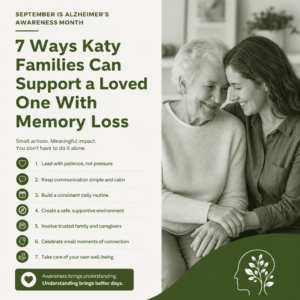
The Alzheimer’s Association reports that 6.9 million Americans age 65 and older are living with Alzheimer’s in 2024 — and that number is projected to nearly double by 2060. In Texas alone, more than 400,000 individuals are currently living with Alzheimer’s, with that number expected to grow significantly over the next decade.
What to look for: Repeating the same questions or stories within minutes, getting lost in familiar places, confusion about the month or year, difficulty following multi-step tasks like cooking a recipe, misplacing items in unusual locations, or uncharacteristic personality changes such as increased suspicion, anxiety, or withdrawal.
When dementia or Alzheimer’s is a factor, a standard assisted living community may not be enough — specialized memory care becomes the appropriate level of support. Evergreen Cottages provides structured programming, secure environments, and specially trained staff equipped to support residents navigating cognitive decline with compassion and evidence-based approaches.
Sign 06 — Social Withdrawal and Signs of Depression
Loneliness is not simply an emotional concern for older adults — it is a documented health risk. A 2023 U.S. Surgeon General advisory identified loneliness as a public health epidemic, citing research linking social isolation to a 29% increased risk of heart disease, a 32% increased risk of stroke, and a 50% higher risk of developing dementia.
When a parent stops calling friends, declines invitations, loses interest in hobbies they once loved, or seems flat and disengaged during your visits, those are warning signs that deserve a response — not rationalization. Depression among older adults is underdiagnosed and undertreated, partly because its symptoms are often misattributed to normal aging.
What to look for: A significant decrease in social activity or communication, loss of interest in hobbies, persistent sadness or hopelessness, increased television time replacing all other activity, withdrawal from grandchildren or other family members, or expressions of hopelessness about the future.
Community is one of the most powerful offerings of senior living. At Evergreen Cottages, residents live alongside peers in a structured social environment with organized activities, outings, fitness programming, and common spaces designed to encourage organic connection. The antidote to isolation is belonging — and belonging requires community.
Sign 07 — Caregiver Burnout Within the Family
This sign is about you as much as it is about your parent. Family caregiving is one of the most demanding unpaid roles in American life. According to the National Alliance for Caregiving (NAC), 70% of family caregivers report a decline in their own health as a direct result of their caregiving responsibilities. Many reduce or leave their own employment. Marriages face strain. Personal health is deferred.
Recognizing caregiver burnout is not self-indulgent — it is a critical safety signal. When a caregiver is exhausted, overwhelmed, resentful, or feeling chronically anxious about a parent’s wellbeing, the quality of care they can provide declines. An adult child running on empty is not equipped to provide the sustained, attentive support an aging parent deserves.
What to look for (in yourself): Constant fatigue that doesn’t improve with rest, increased irritability or impatience toward your parent, a sense of helplessness or feeling trapped in the role, physical symptoms like headaches or sleep disruption that began with caregiving, or a growing fear that a medical emergency is inevitable and you won’t be able to respond.
Choosing assisted living for a parent is not abandonment — it is a recalibration that allows you to return to being their child, not their sole caregiver. Families who transition a parent to Evergreen Cottages consistently report that their relationship with their parent improved: visits became joyful again because the weight of medical management, meal preparation, and safety monitoring was shared with a professional team.
Sign 08 — Chronic Medical Conditions That Are Worsening
Managing a chronic condition like congestive heart failure, COPD, Parkinson’s disease, or Type 2 diabetes requires consistency — consistent medication timing, consistent monitoring of vitals, consistent follow-up with specialists, and a living environment that supports the body’s changing needs. When that consistency breaks down at home, conditions that were stable can deteriorate rapidly.
Emergency room visits are often the first signal families receive that at-home management has failed. According to the Agency for Healthcare Research and Quality, adults 65 and older account for more than 43% of all emergency room hospitalizations — and a significant portion of those are preventable with adequate daily support and monitoring.
What to look for: Increased emergency room visits or hospitalizations over the past twelve months, reports from a primary care physician that a chronic condition is becoming harder to manage, visible changes in mobility, stamina, or pain levels, missed specialist appointments, or a parent who is increasingly homebound due to illness.
Assisted living provides a structured environment where trained staff can monitor changes in a resident’s health, coordinate with medical providers, and escalate concerns before they become emergencies. At Evergreen Cottages, care plans are individualized, reviewed regularly, and adjusted in collaboration with residents, families, and healthcare providers.
Sign 09 — Unsafe Driving and Loss of Independence
Driving is deeply intertwined with independence and identity for most older Americans. The conversation about whether a parent should stop driving is one of the most emotionally charged in family caregiving — and one of the most important. The AAA Foundation for Traffic Safety reports that drivers 85 and older have crash rates comparable to teenagers, with physical and cognitive changes significantly affecting reaction time, peripheral vision, and judgment.
Beyond driving, the gradual loss of the ability to manage one’s own transportation creates a cascade of secondary losses: missed medical appointments, reduced social activity, difficulty obtaining groceries and medications, and a growing dependence on family members for basic mobility needs.
What to look for: New dents or scratches on the vehicle that your parent doesn’t recall, reports of running red lights or stop signs, getting lost on familiar routes, anxiety about driving that leads to avoiding it entirely, or a primary care provider who has recommended driving cessation.
In an assisted living community, residents no longer need a car to have an active, connected life. Transportation for medical appointments, shopping, and outings is provided. The freedom that mobility represents is preserved through community infrastructure rather than personal vehicle dependence.
Sign 10 — Your Parent Has Asked for Help — or You Have Seen Fear in Their Eyes
This sign is the quietest and the most important. Sometimes a parent does not say the words directly. They say them sideways: “I just don’t want to be a burden.” “I worry about what happens if I fall when no one is around.” “I’ve been thinking maybe it’s time.” These are not throwaway comments — they are invitations.
Older adults are acutely aware of their own decline. Many resist acknowledging it aloud because they fear losing control, being placed somewhere against their will, or becoming a source of hardship for their children. When a parent opens that door, even slightly, walking through it with compassion and information can change the trajectory of what comes next.
What to do: Respond without pressure. Acknowledge what you’ve heard. Ask what they want their day-to-day life to look like. Offer to visit a community together — not as a decision, but as a conversation. Families who approach this transition as a collaborative process rather than a unilateral one report significantly greater resident adjustment and satisfaction.
At Evergreen Cottages, prospective residents and their families are always welcome to visit, ask questions, and spend time experiencing the community before any decision is made. There is no pressure. There is only honesty, care, and a genuine belief that the right environment can transform what feels like a loss into the beginning of a better chapter.
What Assisted Living Actually Provides
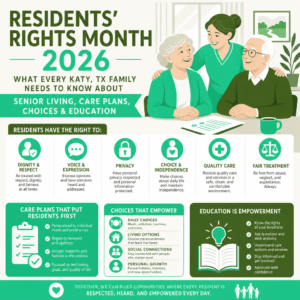
Many families operate under misconceptions about what assisted living is — and what it is not. It is not a nursing home. It is not a hospital. It is not a place where a parent goes to decline. Done well, assisted living is a residential community where older adults receive the support they need while living with purpose, connection, and dignity.
At Evergreen Cottages in Katy, TX, services are designed to address the full spectrum of a senior’s daily needs:
- 24/7 Staffing and Emergency Response: Trained team members are present and responsive around the clock, eliminating the risk of a parent spending hours on the floor after a fall before help arrives.
- Personalized Care Plans: Every resident receives an individualized care plan developed in collaboration with the resident, their family, and their healthcare providers — reviewed regularly and updated as needs change.
- Medication Management: Medications are administered or supervised by trained staff at prescribed times, with accurate documentation and direct coordination with prescribing physicians.
- Restaurant-Style Dining: Three chef-prepared meals daily, accommodating dietary restrictions, preferences, and medical nutritional needs — in a communal dining room that is also a social gathering space.
- Housekeeping and Laundry: Regular cleaning and laundry services mean residents are never living in a deteriorating environment due to physical limitations.
- Social and Recreational Programming: Daily activities, fitness classes, outings, and organized events provide structure, connection, and purpose.
- Transportation Services: Scheduled transportation for medical appointments, shopping, and community outings ensures mobility without vehicle dependence.
- Family Communication and Partnership: Families receive regular updates on their loved one’s health and wellbeing, and are treated as partners in care — not as observers from a distance.
How to Start the Conversation With Your Parent
Knowing the signs is one thing. Starting the conversation is another. Many families delay the assisted living discussion precisely because they dread the reaction — and that delay sometimes means waiting until a hospitalization or crisis forces a rushed decision under the worst possible emotional conditions.
Here is how to approach this conversation with the best possible outcome:
- Choose the right time and setting. A quiet, private moment — not during a holiday gathering or in the immediate aftermath of a frightening incident. A one-on-one conversation is typically more productive than a group family approach, which can feel like an intervention.
- Lead with love, not logistics. Begin with what you’ve noticed and why it worries you, not with a solution. “Dad, I’ve noticed you seem more tired lately and I’ve been worried about you being alone at night” opens a different door than “We’ve been researching assisted living communities.”
- Ask, don’t tell. Ask your parent what they want their life to look like. What matters most to them — staying active, being around people, feeling safe, maintaining independence where possible? Their answers will guide the decision more effectively than any checklist.
- Frame it as exploration, not a decision. Suggest visiting a community together out of curiosity, not commitment. “Would you be willing to just see what Evergreen Cottages looks like? No decisions, just a look” is a much lower-stakes invitation than a formal transition discussion.
- Include them in every step. Older adults who feel agency in the transition process adjust significantly better and faster than those for whom the decision was made without their meaningful input.
Why Evergreen Cottages in Katy, TX
Evergreen Cottages is a senior living community in Katy, TX serving the greater Houston metro area. The community is built on a simple but powerful belief: that aging well is not about accepting less — it is about receiving the right support to live more.
- A home-like environment, not an institutional one. Evergreen Cottages is designed to feel like the home your parent has always known — warm, personal, and scaled to human connection rather than clinical efficiency.
- Individualized care that grows with your parent. Care plans are not set once and forgotten. As a resident’s needs change, the care changes with them.
- Professionally trained, compassionate team members. Staff members are selected not only for their credentials but for their character — the kindness, patience, and genuine respect for older adults that no certification can fully confer.
- A community your parent will actually want to join. Meaningful social programming, beautiful communal spaces, and a culture of genuine belonging make Evergreen Cottages a place residents choose to engage with — not simply reside within.
- Family partnership at every level. From the initial tour through move-in and beyond, families are kept informed, included in care decisions, and treated as essential members of each resident’s care team.
Take the Next Step If you recognized one or more of these signs in your parent, the most important thing you can do is not wait for a crisis to force a decision. Visit Evergreen Cottages, ask your questions, and see what a community built around your parent’s wellbeing actually looks like.
📍 Evergreen Cottages · Katy, TX · www.evergreencottages.com
Frequently Asked Questions
How do I know if my parent needs assisted living versus home care? Home care is appropriate when a parent needs help with specific, limited tasks and their home remains a safe environment. Assisted living becomes the better option when care needs are consistent and multi-faceted — covering personal care, medication management, meals, safety oversight, and social engagement simultaneously. If a parent is regularly alone for extended periods, has experienced repeated falls, or requires monitoring around the clock, the scope of need has typically exceeded what home care can reliably provide.
What if my parent refuses to consider assisted living? Refusal is common and rarely the final word. Most parents who initially resist eventually acknowledge the need when the conversation is approached with patience and without pressure. A gradual approach — visiting communities together, speaking with residents, asking a trusted physician to frame the conversation — often shifts the discussion. If cognitive decline is a factor, a geriatric care manager or social worker can provide clinical guidance on navigating the conversation safely.
What does assisted living typically cost in the Katy, TX area? In the greater Houston-Katy metro area, monthly assisted living costs typically range from $3,000 to $6,000 per month for base accommodations, with additional costs for higher levels of care. Many families are surprised to find that when the true costs of aging in place — home modifications, home health aides, transportation, meal preparation, and emergency response systems — are added together, the gap between home care and assisted living narrows considerably. Contact Evergreen Cottages directly at www.evergreencottages.com for current pricing and availability.
Is assisted living covered by Medicare or insurance? Medicare generally does not cover the cost of assisted living, as it is considered custodial care rather than skilled medical care. Medicaid may provide some coverage depending on income and asset thresholds, and many states have Medicaid waiver programs that can apply to assisted living costs. Long-term care insurance, where applicable, can cover a significant portion of expenses. Veterans and their surviving spouses may qualify for Aid and Attendance benefits through the VA.
How long does the transition to assisted living typically take? From initial inquiry to move-in, the timeline varies widely. Some families begin researching six to twelve months in advance; others need to move within weeks following a health event. At Evergreen Cottages, the admissions team can guide families through the process as quickly or as gradually as needed. Most residents settle meaningfully into community life within the first four to eight weeks.
What happens if my parent’s care needs increase over time? At Evergreen Cottages, care plans are designed to evolve with each resident. As needs increase, additional services and support can be incorporated into the care plan. In cases where a resident’s needs advance to require memory care or skilled nursing, the care team will work with families to identify the most appropriate next level of care and facilitate a thoughtful transition.
The Right Time Is Before the Crisis
There is no perfect moment to have this conversation. There is no version of it that doesn’t involve some grief — for the independence your parent is losing, for the role reversal that aging brings, for the life chapter that is closing. That grief is real and it deserves to be honored.
But there is a version of this transition that happens on your family’s terms, with time to make a thoughtful choice, visit communities, ask questions, and allow your parent to participate in one of the most significant decisions of their later life. That version is only possible if you act on the signs before a fall, a hospitalization, or a cognitive crisis removes the choice from your hands.
If you recognized your parent in this guide — in the missed medications, the social withdrawal, the near-falls, the quiet comment about being a burden — take one step today. Just one. Look up Evergreen Cottages. See what assisted living actually looks like in 2026. Schedule a tour, not a decision.
The families who act on the early signs don’t just protect their parent from harm. They give their parent more time — more quality time — in a community designed around their flourishing.
About the Author: Ivan Urrego is an award-winning professional copywriter specializing in the senior living industry, recognized by Argentum, MALA, and multiple national senior housing associations. For inquiries, visit www.evergreencottages.com.
Sources: AARP 2024 Caregiving in the United States Report; Centers for Disease Control and Prevention (CDC) — Falls Data and Statistics, 2023; Journal of the American Geriatrics Society — Medication Non-Adherence Among Older Adults, 2023; Alzheimer’s Association 2024 Alzheimer’s Disease Facts and Figures; U.S. Surgeon General Advisory on Loneliness and Isolation, 2023; National Alliance for Caregiving (NAC) — Caregiving in the U.S., 2023; Agency for Healthcare Research and Quality — Older Adult Emergency Utilization Data, 2023; AAA Foundation for Traffic Safety — Older Driver Safety Research, 2023.