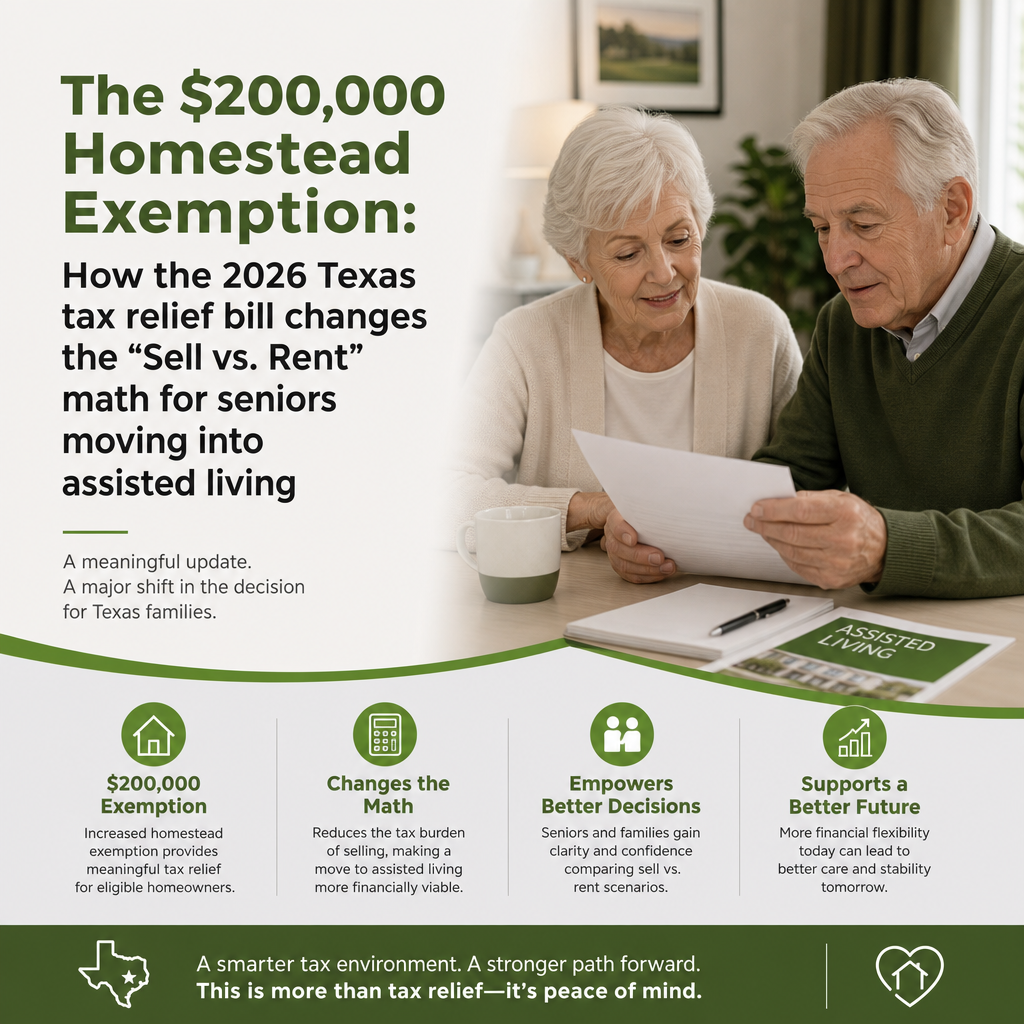
The $200,000 Texas Senior Homestead Exemption 2026: How the New Tax Relief Bill Rewrites the "Sell vs. Rent" Math for Katy Families Moving a Loved One Into Assisted Living
By Ivan Urrego | Last updated: May 2026 | Evergreen Cottages — Katy, TX
1. What Is the Texas Senior Homestead Exemption 2026 — and Why Does $200,000 Matter?
The Texas Senior Homestead Exemption 2026 is the most significant residential property tax relief measure for older Texans in more than two decades. Starting with the 2026 tax year, qualifying homeowners who are 65 or older receive an additional $200,000 exemption on the appraised value of their primary residence — up from the previous $10,000 over-65 school tax exemption that had been in place since the mid-1970s. The measure passed as part of a broader Texas tax relief package and is designed to keep longtime homeowners from being priced out of their own neighborhoods by rising appraisal values across the state.
For families in Katy, TX who are simultaneously managing a loved one's move into an assisted living or memory care community, this law change is not just an interesting headline. It is a concrete variable that can shift thousands of dollars in the annual cost calculation — and it affects whether selling the home quickly or holding it as a rental property makes better financial sense.
What the Exemption Actually Does to Your Tax Bill
A homestead exemption reduces the taxable appraised value of your property, not the tax rate itself. In practical terms: if your Katy home is appraised at $380,000 and you qualify for the $200,000 senior exemption, your property tax is calculated on only $180,000 of value. At the Fort Bend County effective property tax rate of approximately 2.1% (2025 data, Fort Bend Central Appraisal District), that exemption reduces your annual tax bill by roughly $4,200 per year compared to a non-exempt owner paying on the full $380,000.
This Is Different from the Homestead Tax Ceiling (Freeze)
Texas has long offered a school property tax ceiling — commonly called a "freeze" — for homeowners 65 and older, which prevents the school district portion of property taxes from increasing after a qualifying homeowner turns 65. The 2026 exemption is a separate, additive benefit layered on top of the existing freeze. Together, these two provisions make a strong case for carefully evaluating what happens to those benefits when the owner leaves the home to enter a senior living community.
Why Families Moving a Parent Into Senior Care Should Care Immediately
Here is the part most families miss: the $200,000 exemption is tied to the homeowner occupying the property as their primary residence. The moment your parent moves permanently into a memory care community — even a beloved one like Evergreen Cottages in Katy — the residency requirement for the exemption is called into question. Whether the exemption survives depends entirely on what the family does next: sell, rent, or hold. Getting the timing wrong can cost you the benefit — and the thousands in annual savings that come with it.
Key Term Defined: A homestead exemption is a legal provision that reduces the assessed value of a primary residence for property tax purposes. Texas offers multiple stacked exemptions — general, over-65, and disability — but all are conditioned on the property being the owner's principal place of residence on January 1 of the tax year.
2. Who Qualifies: Age, Disability, and Residency Requirements Under the Texas Senior Homestead Exemption 2026
To benefit from the new $200,000 exemption, a homeowner must meet all three eligibility criteria as of January 1 of the applicable tax year: age (65+), Texas residency, and occupancy of the home as their primary residence. Understanding these rules is critical for families who are planning a transition into assisted living, because the timing of the move relative to the tax year calendar determines whether the benefit is captured or lost.
Age Requirement
The homeowner — not the family member — must be at least 65 years of age on or before January 1 of the tax year. If your parent turns 65 on January 2, 2026, they will not qualify until the 2027 tax year. This one-day difference can cost a Katy family over $4,000 in unnecessary property taxes if not tracked carefully.
Residency and Primary Occupancy
The property must serve as the owner's principal place of residence on January 1. Texas law allows for a brief period of absence — for example, a temporary hospital stay or short-term rehabilitation — without automatically forfeiting the exemption. However, a permanent move to a licensed care facility (such as an assisted living or memory care community) that occurs before January 1 will disqualify the property for that tax year unless specific provisions apply.
Importantly, Texas Tax Code Section 11.13(j) provides that a homeowner who is legally or physically unable to occupy their homestead due to health reasons may continue to claim the exemption even if they are residing in a care facility, provided no other person claims a homestead exemption on the property and the owner (or the owner's spouse) does not establish a different homestead. This is a critical provision that many families and even some real estate attorneys overlook.
Disability Qualification as an Alternate Path
Homeowners under 65 who receive Social Security disability benefits may also qualify for the senior exemption structure under a parallel provision. This matters for Katy families with a loved one under 65 living with early-onset Alzheimer's disease or a related dementia — a population the Alzheimer's Association estimates at roughly 5–6% of the total Alzheimer's population in the U.S. (Alzheimer's Association 2025 Facts and Figures).
Application Deadlines
Exemptions must typically be filed with the Fort Bend Central Appraisal District by April 30 of the tax year. Late applications are accepted in some cases up to one year past the deadline but may not be applied retroactively without proper cause documentation. If your parent moved in late 2025 and you are reading this in early 2026, filing immediately is non-negotiable.
| Eligibility Criterion | Requirement | Important Nuance for AL/Memory Care Moves |
|---|---|---|
| Age | 65+ on or before January 1 | One-day rule applies strictly to the tax year calendar |
| Primary Residency | Must be principal residence on Jan. 1 | Health-related absence exception may preserve the exemption (TX Tax Code §11.13(j)) |
| Ownership | Must hold legal title to the property | Trust ownership may require additional documentation |
| No Other Homestead Claim | No other property claimed as homestead | Adult children cannot claim homestead on the property simultaneously |
| Application Filing | By April 30 of the tax year | First-time filers must submit Form 50-114 to Fort Bend CAD |
3. Sell vs. Rent: The Core Financial Decision Families in Katy, TX Face — and How the Texas Senior Homestead Exemption 2026 Reshapes It
When a parent or spouse moves into assisted living or memory care, the family home immediately becomes both a financial asset and an emotional decision point. The choice between selling the home and renting it out is one of the most consequential financial moves a family will make — and the new $200,000 Texas Senior Homestead Exemption changes how that calculation must be run.
The Emotional Weight of This Decision
Before we get into the numbers, it is worth acknowledging something that financial spreadsheets cannot capture: this house is not just an asset. It is where Thanksgiving dinners happened. It is where your parent taught you to drive, or where your children made crayon drawings on the back porch. The decision to sell or keep it carries grief alongside it, and that is completely understandable. But precisely because this decision is so emotionally charged, it deserves a clear-eyed financial analysis — so that your family can make the choice that genuinely honors your loved one's future care, rather than a choice made under financial pressure down the road.
The Traditional Framework: Why Families Usually Sell
Historically, families in Katy who moved a parent into assisted living tended to sell the home quickly for three reasons: (1) they needed the liquidity to fund care immediately, (2) they did not want to manage a rental property while simultaneously managing a care transition, and (3) the property tax burden on a vacant or non-exempt property eroded the rental return. The third reason is where the 2026 exemption changes the equation fundamentally.
Why the $200,000 Exemption Changes the Rent Calculation
Under the old framework, a family keeping a $380,000 Katy home as a rental property after the owner moved to assisted living would lose the homestead exemption — all of it. The property would be reclassified as a non-homestead property, and the full appraised value would become taxable. At Fort Bend County's combined effective rate of approximately 2.1%, that means paying roughly $7,980 per year in property taxes on the full value rather than on the reduced exempted amount. That is $665 per month in property taxes alone — a number that significantly compresses rental income margins.
Under the new law, if the health-absence exception under Texas Tax Code §11.13(j) applies — meaning the owner cannot occupy the home due to a medical condition requiring care facility placement — the $200,000 exemption may be preserved even while the home is unoccupied (but not rented). However, renting the home to a third party is a separate matter that typically does trigger a loss of the homestead status. This is a critical distinction that families must discuss with a Texas-licensed elder law attorney before making any decisions.
Important: Renting the home to a third party generally disqualifies the property from the homestead exemption, regardless of the owner's age or health status. The exception under §11.13(j) applies to unoccupied homes — not to homes generating rental income. Always verify current law with a qualified Texas elder law attorney before acting.
4. The Old Math vs. the New Math: A Side-by-Side Comparison for Katy, TX Homeowners
Numbers make this concrete. The table below illustrates how the Texas Senior Homestead Exemption 2026 changes the financial picture for a representative Katy, TX household — a 74-year-old homeowner with a $380,000 home transitioning into an assisted living community at the area median monthly rate.
Assumptions Used in This Comparison
- Home appraised value: $380,000 (approximate Katy, TX median for a 3-bed home, 2025–2026)
- Fort Bend County effective combined tax rate: ~2.1%
- Pre-2026 over-65 school exemption: $10,000
- 2026 new senior exemption: $200,000
- Assisted living monthly cost: $4,800 (Katy area median, per Genworth 2025 Cost of Care Survey)
| Scenario | Taxable Value | Annual Property Tax | Monthly Tax Cost | Net Monthly Rental Yield (est.)* |
|---|---|---|---|---|
| Pre-2026: Owner in care facility, home retained (no exemption) | $380,000 | $7,980 | $665 | $935 (on $1,600 gross rent) |
| Pre-2026: Over-65 exemption only ($10,000) | $370,000 | $7,770 | $647 | $953 |
| 2026: New $200,000 exemption preserved (unoccupied, §11.13(j)) | $180,000 | $3,780 | $315 | N/A — home must be unoccupied to preserve exemption |
| 2026: Home sold; proceeds invested at 4.5% annually | N/A | $0 | $0 | ~$1,425/month from $380,000 at 4.5% |
*Net yield estimate assumes $1,600/month gross rent, deducting mortgage (if any), insurance ($100/mo), maintenance reserve ($200/mo), and property tax. Actual figures vary. Consult a licensed financial advisor.
What This Table Tells Us
The most striking finding is that the $200,000 exemption — if legitimately preserved under §11.13(j) for a vacant home — reduces annual property taxes by over $4,000 compared to a non-exempt rental. But it also makes clear that an unoccupied home generates no income while continuing to carry insurance, maintenance, and utility costs. The exemption benefit is real, but it is not a substitute for a comprehensive financial plan.
Where the Sell Option Often Wins
For families funding assisted living or memory care entirely from the home's equity, the sell option frequently generates more consistent, predictable income — especially when proceeds are placed into a conservative income-generating portfolio. The Genworth 2025 Cost of Care Survey found that the national median annual cost for assisted living is approximately $64,200 — meaning a $380,000 home, net of selling costs, might fund nearly five years of assisted living at that rate. With the new exemption reducing the tax carrying costs on retention, however, the rental option merits a fresh look.
5. What Katy, TX Real Estate Numbers Mean for the Texas Senior Homestead Exemption 2026 Decision
Katy, Texas is not just any suburb. It is one of the fastest-appreciating residential markets in the greater Houston metro area — and that context matters enormously when your family is deciding whether to sell or retain a senior's home as part of a care-funding strategy.
Katy Home Values and Appreciation Trends
According to data from the Houston Association of Realtors (HAR), the median single-family home price in the Katy area (ZIP codes 77450, 77449, 77494) ranged between $340,000 and $415,000 through 2025, with average appreciation of approximately 4.2% annually over the preceding five-year period. For a homeowner who purchased a home in 2015 for $220,000, that property may now be valued at well over $350,000 — meaning substantial capital gains exposure if sold, but also substantial equity if retained as a rental.
The Rental Market in Katy
Katy's strong employment base — anchored by energy sector employers, the Katy Independent School District, and the growing retail and healthcare corridor along I-10 — supports consistent rental demand. Three-bedroom single-family homes in Katy rented for between $1,550 and $2,100 per month as of early 2026 (Zillow Rental Manager, 2025–2026 Katy market data). After factoring in property taxes, insurance, and maintenance reserves, net cash flow from a $1,700/month rental property in Katy runs approximately $850–$1,100 per month for a mortgage-free homeowner — a meaningful contribution toward an assisted living monthly rate, but not enough to cover it entirely.
Property Tax Appraisal Caps and Katy Values
Texas limits property tax appraisal increases for homesteads to 10% per year — but this cap applies only as long as the homestead exemption is in place. Once a property loses homestead status (because it is rented out or the owner no longer qualifies), the appraisal can reset to full market value, potentially triggering a significant one-time tax increase. In a market like Katy — where appraised values have been running below market value for many longtime homeowners — losing the homestead appraisal cap can be financially devastating.
What Katy's Appreciation Means for the Sell Decision
Families who sell now capture today's appreciated value. But if Katy continues to appreciate at even half its historical rate, a home worth $380,000 today could be worth $440,000+ within three to four years. For families who do not need immediate liquidity to fund care, holding the asset may generate both rental income and capital appreciation — particularly if the care costs can be funded through other means (VA Aid & Attendance, retirement accounts, or bridge loans).
Katy, TX Specific: The Fort Bend Central Appraisal District (FBCAD) handles all property tax filings for most Katy area homes. Homes in the northern Katy ZIP codes (77449) may fall under Harris County Appraisal District (HCAD) jurisdiction. Confirm your county before filing any exemption paperwork, as the forms and deadlines differ slightly between the two appraisal districts.
6. Keeping the Home and Renting It Out: Pros, Cons, and Tax Implications Under the Texas Senior Homestead Exemption 2026
Renting out your loved one's home while they live in assisted living is a strategy that can work — but only if the family goes in with clear eyes about the trade-offs. The new Texas Senior Homestead Exemption 2026 adds a new variable to this analysis that families and their advisors must address directly.
The Critical Rule: Renting Out the Home Disqualifies the Homestead Exemption
This point cannot be overstated: if the family rents out the senior's home to a third party, the property ceases to qualify as a homestead under Texas law. This means the $200,000 exemption — and the school tax freeze — are both lost. The property will be taxed at its full appraised value beginning the year it is rented. For a $380,000 Katy home, that translates to approximately $7,980/year in property taxes rather than $3,780/year — a $4,200/year difference that must be factored into every rental income projection.
The §11.13(j) Exception: What It Covers and What It Does Not
Texas Tax Code Section 11.13(j) allows a homeowner who is absent from the homestead for health reasons — including residence in a care facility — to retain the exemption if: (1) the owner or owner's spouse has not established a different homestead; (2) the property is not used for purposes other than a homestead; and (3) the owner intends to return. Crucially, clause (2) almost certainly excludes rental use. If you are renting the home to generate income, you are using it for a purpose beyond a homestead, and the exemption will not survive a challenge by the appraisal district.
Pros of Renting (Exemption Loss Acknowledged)
- Ongoing cash flow: $850–$1,100/month net (after taxes and expenses) in the Katy market helps offset monthly care costs
- Preserves ownership: Family retains the asset and any future appreciation
- Flexibility to sell later: Families who are unsure of the long-term care timeline can generate income now and sell when the time is right
- Avoids capital gains pressure: Deferring the sale may allow strategic timing around tax years
Cons of Renting
- Loss of $200,000 homestead exemption: $4,200+/year tax increase immediately
- Loss of appraisal cap: Katy home values can reset to full market appraisal
- Landlord responsibilities: Property management adds stress during an already overwhelming family caregiving period
- Medicaid complications: Rental income counts as a resource for Medicaid eligibility purposes and must be reported
- Rental income is taxable: Net rental income is subject to federal income tax and may affect Medicare premium tiers (IRMAA)
| Factor | Rent the Home | Sell the Home | Hold Vacant (§11.13(j)) |
|---|---|---|---|
| Monthly cash flow | $850–$1,100 | ~$1,425 (from invested proceeds) | Negative (carrying costs only) |
| Homestead exemption | Lost | N/A | Potentially preserved |
| Property tax annual cost | ~$7,980 | $0 | ~$3,780 |
| Asset appreciation | Yes | Foregone after sale | Yes |
| Medicaid impact | Rental income counted | Proceeds may count; plan carefully | Home may be an exempt asset |
| Management burden | High | None | Low |
7. Selling the Home: Capital Gains, Step-Up Basis, and How to Protect the Proceeds for Senior Care
For many Katy families, selling the home is ultimately the right move — it converts the asset to liquid funds that can be applied directly to memory care or assisted living costs without the complications of landlord responsibilities or Medicaid rental income reporting. But selling a home that has appreciated significantly comes with its own tax considerations that families must understand before signing anything.
The Capital Gains Exclusion: $250,000 / $500,000
Under IRS Section 121, a taxpayer who has owned and lived in their home as a primary residence for at least two of the five years preceding the sale may exclude up to $250,000 in capital gains ($500,000 for married couples filing jointly). For most senior homeowners in Katy who have lived in their homes for a decade or more, this exclusion is enormous — it means a home purchased for $180,000 and sold for $400,000 generates $220,000 in gain, all of which falls under the $250,000 exclusion and is therefore federally tax-free.
Here is the timing risk: if your parent moves into assisted living and the home sits unoccupied for more than three years before being sold, the homeowner may no longer meet the "lived in" requirement — and the gains above the exclusion threshold become taxable at long-term capital gains rates (0%, 15%, or 20% depending on income). For large gains, this can be a significant tax liability. Families should not wait indefinitely to decide.
The Step-Up in Basis: A Critical Estate Planning Tool
Families considering holding the home until the senior passes away should be aware of the stepped-up basis rule under federal tax law. When a property owner dies, the cost basis of the home is "stepped up" to the fair market value at the date of death — effectively erasing the lifetime appreciation for capital gains purposes. For a parent who purchased a Katy home in 1990 for $85,000 and whose estate reflects a value of $390,000 at death, the inheriting children receive a stepped-up basis of $390,000 — meaning if they sell for $390,000, they owe zero capital gains tax.
This can make holding the home (rather than selling during the parent's lifetime) extraordinarily advantageous from a tax perspective — but only if the family has sufficient other funds to pay for care in the meantime. Do not sacrifice your loved one's care quality to preserve a step-up basis benefit. These are not either/or decisions, but they require careful sequencing with a CPA and estate planning attorney.
Protecting the Proceeds: Care Funding Strategies After the Sale
Once a Katy home is sold, the net proceeds (after paying off any mortgage, closing costs, and commissions) need to be managed with the cost of care in mind. Financial advisors who specialize in elder care often recommend placing proceeds in a combination of:
- A high-yield savings or money market account for near-term care costs (0–12 months)
- A short-term CD ladder or Treasury bills for medium-term liquidity (1–3 years)
- A conservatively managed investment portfolio for longer-term appreciation to pace care cost inflation
Some families also convert home sale proceeds into a Medicaid-compliant annuity if Medicaid eligibility is being pursued — a strategy that requires careful coordination with a Texas elder law attorney, as the rules are strict and the penalties for improper transfers are severe.
8. How the Home Factors Into Medicaid Eligibility and the 5-Year Look-Back Rule
Medicaid is frequently the long-term care funding option that families in Katy eventually turn to — particularly for memory care and dementia care that can extend for five to ten years or more. Understanding how the family home interacts with Medicaid eligibility rules is essential, and the Texas Senior Homestead Exemption 2026 touches on this in ways that families need to understand.
The Home as an Exempt Asset Under Medicaid
Under Texas Medicaid rules, the primary residence is treated as an exempt asset — it does not count against the resource limit for Medicaid eligibility — as long as the applicant, the applicant's spouse, or a qualifying dependent still lives in the home, OR the applicant intends to return home. Critically, the intent-to-return standard does not require that returning be medically likely — only that the applicant expresses the intent. This means a parent living in memory care who sincerely wishes to return home someday can often preserve both the homestead exemption and the Medicaid home exemption simultaneously.
However, the Texas Health and Human Services Commission (HHSC) will pursue Medicaid estate recovery after the recipient's death — meaning the state may file a claim against the home's value in the estate to recoup what Medicaid paid for care. Families who plan on inheriting the home should be aware of this and work with an elder law attorney to structure the estate accordingly.
The 5-Year Look-Back Period
Texas Medicaid for long-term care applies a 60-month (5-year) look-back period to all asset transfers made by the applicant before applying. Any asset — including real estate — transferred for less than fair market value within this window can trigger a penalty period during which Medicaid will not pay for care. This means families cannot simply deed the home to an adult child to protect it from estate recovery without facing potentially devastating penalty periods.
The 5-year look-back makes early planning paramount. According to LeadingAge 2024 advocacy data, the average Medicaid planning engagement begins only 14 months before a care transition — far too late for most effective strategies. If you are reading this and a loved one's condition is progressing, now is the moment to engage a Texas elder law attorney, not after the move into care.
How the $200,000 Exemption Interacts With Medicaid
The new $200,000 homestead exemption does not directly affect Medicaid eligibility rules — the home remains a potentially exempt asset regardless of the tax exemption's dollar value. However, the exemption does affect the net carrying cost of holding the home during the Medicaid spend-down period. A family that needs to run down assets to qualify for Medicaid has more flexibility to hold the home (as an exempt asset) at a lower tax cost under the new exemption, rather than being forced to sell due to high ongoing property tax burden.
Bottom Line on Medicaid and the Home: The home is generally protected during the owner's lifetime for Medicaid purposes — but subject to estate recovery after death. The 5-year look-back punishes transfers. And the new $200,000 exemption reduces the carrying cost of legitimately retaining the home as an exempt asset during the qualification process.
9. VA Benefits, the Texas Senior Homestead Exemption 2026, and Paying for Assisted Living in Katy, TX
For the significant number of Katy-area seniors who served in the U.S. Armed Forces, the VA Aid & Attendance benefit can dramatically change the financial landscape — and it interacts with the homestead exemption decision in important ways. This section is for families of veterans and surviving spouses navigating the care funding question.
What Is the VA Aid & Attendance Benefit?
The VA Aid & Attendance benefit (formally part of the VA Improved Pension) provides a monthly cash benefit to qualifying veterans — or their surviving spouses — who require assistance with daily activities. In 2026, the maximum monthly benefit is approximately $2,727 for a veteran with a dependent spouse, $2,295 for a single veteran, and $1,478 for a surviving spouse (VA Office of Management, 2026 rate tables). This benefit is paid directly to the family and can be used toward assisted living, memory care, or dementia care costs at any licensed community, including Evergreen Cottages in Katy.
How Aid & Attendance Affects the Home Ownership Decision
Unlike Medicaid, the VA Aid & Attendance benefit does not have a formal look-back period (though the VA added a 3-year look-back for net worth purposes in 2018 for transfers made after October 18, 2018). The home is generally treated as an exempt asset in VA benefit calculations as long as it is the veteran's primary residence or the surviving spouse's primary residence. Renting or selling the home may affect the net worth calculation if proceeds significantly exceed the VA's net worth threshold (approximately $159,240 in 2026).
Stacking VA Benefits With the Homestead Exemption
Here is a powerful combination many Katy families do not know about: a qualifying veteran who retains their home under the §11.13(j) health-absence exception can simultaneously receive VA Aid & Attendance benefits and preserve the $200,000 homestead exemption on the unoccupied primary residence. This is one of the rare scenarios where the "hold vacant" option makes strong financial sense — receiving VA monthly benefits to pay for care while maintaining the home's full appraised value appreciation and reduced property tax burden.
Texas Additional Veterans Exemptions
Texas also offers additional property tax exemptions for disabled veterans that are entirely separate from the over-65 senior homestead exemption. A veteran rated at 100% service-connected disability is eligible for a complete property tax exemption on their homestead — a $7,980+/year benefit at Katy area values. Veterans with lower disability ratings (10%–90%) receive partial exemptions. These benefits are stackable with the senior homestead exemption in some circumstances and should be evaluated by every veteran's family as part of the care funding strategy.
10. What Assisted Living, Memory Care, and Dementia Care Actually Cost in Katy, TX — and How the Home Sale Fits the Timeline
Before you can determine how much home equity you need to deploy for care, you need an accurate picture of what care costs in Katy. These numbers are specific, real, and — in many cases — more manageable than families initially fear, especially when the right combination of funding sources is assembled.
Katy, TX Care Cost Benchmarks (2025–2026)
| Care Type | Monthly Cost Range (Katy Area) | Annual Cost Estimate | Notes |
|---|---|---|---|
| Assisted Living (shared) | $3,200–$4,500 | $38,400–$54,000 | All-inclusive communities vs. à la carte pricing varies |
| Assisted Living (private) | $4,200–$5,800 | $50,400–$69,600 | Higher level of privacy; typically preferred by families |
| Memory Care | $4,800–$6,500 | $57,600–$78,000 | Includes specialized dementia programming and secured environments |
| Dementia/Alzheimer's Care | $5,200–$7,000 | $62,400–$84,000 | Advanced behavioral support and clinical oversight |
| Respite Care (short-term) | $175–$250/day | N/A (short-term) | Typically 7–30 day stays; used for caregiver relief |
Sources: Genworth Cost of Care Survey 2025; NIC MAP Data; Evergreen Cottages community rate data (2025–2026).
How Long Does Care Typically Last?
The national median length of stay in an assisted living community is approximately 22 months, according to the 2025 NIC Consumer Research Report. For memory care specifically, the duration is considerably longer: the Alzheimer's Association 2025 Facts and Figures report notes that the average person lives 4 to 8 years after an Alzheimer's diagnosis, with the later years typically requiring residential memory care. At $5,500/month for memory care, a 6-year care journey totals approximately $396,000 — a figure that puts the $380,000 Katy home squarely in the range of fully funding the care needed.
What Makes Evergreen Cottages Different in Katy
Evergreen Cottages in Katy, TX is a licensed residential care community offering Memory Care, Assisted Living, Dementia Care, Alzheimer's Care, and Respite Care. Unlike large institutional communities, Evergreen Cottages operates on a small, home-like model — which research from LeadingAge and the NIC consistently links to lower stress, better behavioral outcomes for dementia patients, and higher family satisfaction scores. Our
Related Post