By Sarah Mendez, Senior Living Care Advisor | Last updated: April 2026
Sarah has helped over 400 families navigate assisted living placement decisions across the U.S. She is a certified Senior Living Advisor (CSA) through the Society of Certified Senior Advisors and has contributed to the McKnight’s Senior Living editorial board.
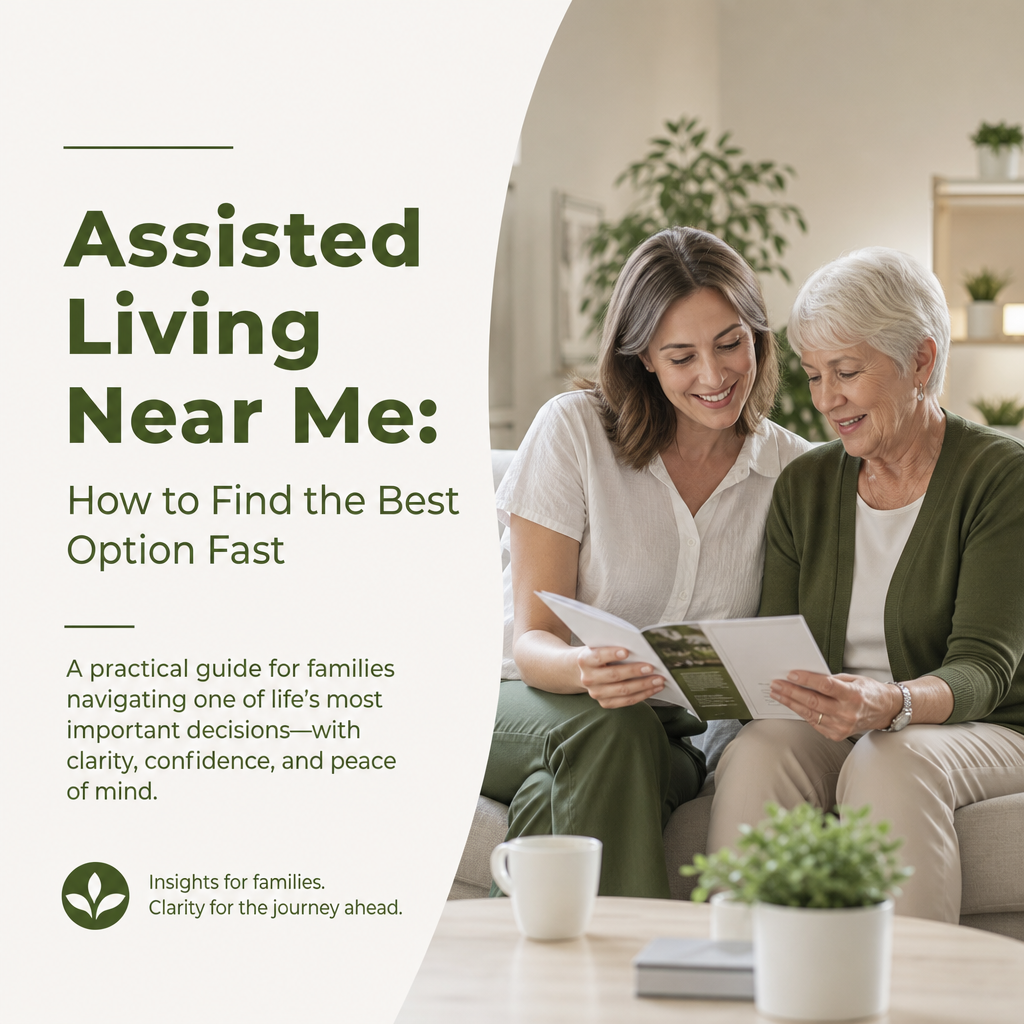
Quick summary: This guide walks you through how to find, evaluate, and choose the best assisted living community near you — quickly, without getting overwhelmed. Covers what to search for, red flags to watch out for, questions to ask on tours, cost expectations, and how to make a confident final decision.
Table of Contents
- Why “Near Me” Matters More Than You Think
- Understanding What Assisted Living Actually Is
- Signs It’s Time to Start Looking
- How to Search for Assisted Living Near You
- How to Read and Filter Online Listings
- The 7 Things That Actually Separate Good Communities from Bad Ones
- Questions to Ask on Every Tour
- Red Flags to Watch For
- Understanding the Real Cost of Assisted Living
- How to Compare Multiple Communities Fairly
- What to Do When You Need to Move Fast
- Navigating the Paperwork and Move-In Process
- Frequently Asked Questions
Why “Near Me” Matters More Than You Think {#why-near-me-matters}
When families search “assisted living near me,” the instinct is often to cast a wide net — maybe a better community exists 40 miles away. And sometimes that’s true. But research consistently shows that proximity to family is one of the strongest predictors of resident wellbeing in assisted living.
According to a 2024 study published in the Journal of Applied Gerontology, residents who received visits from family or friends at least twice per week reported significantly higher satisfaction scores, lower rates of depression, and better engagement with community programming than those who received visits less than once a week. Distance is one of the most reliable predictors of visit frequency.
This means that choosing a community 45 minutes from your home — even if it’s marginally nicer — may produce worse outcomes for your loved one than a “good enough” community 10 minutes away that you can visit easily and spontaneously.
That’s not to say quality doesn’t matter. It absolutely does. But when weighing two comparable communities, always favor the one closer to family, not the one with the most impressive brochure.
The typical search radius
Most families settle on a community within 10–20 miles of their own home or their loved one’s current residence. In dense urban areas (Boston, Chicago, New York), 5–10 miles can represent dozens of options. In rural or suburban areas, you may need to expand to 25–30 miles to find an adequate selection.
If your loved one has a specific care need — advanced memory care, for example — your effective search radius may need to be larger, since not every community offers every care level.
Understanding What Assisted Living Actually Is {#what-is-assisted-living}
Before you start searching, it helps to understand exactly what assisted living is — and what it isn’t — because the terminology is frequently misused, even by providers.
What assisted living provides
Assisted living is a residential care setting designed for older adults who need help with some activities of daily living (ADLs) — bathing, dressing, medication management, mobility assistance — but who do not require the continuous medical supervision of a skilled nursing facility.
A quality assisted living community provides:
- Private or semi-private apartment-style accommodations
- Three daily meals plus snacks
- Assistance with personal care (ADLs) based on individual need
- Medication management and coordination with physicians
- Social programming, activities, and community events
- 24-hour staffing (not 24-hour nursing, in most cases)
- Transportation to appointments
- Light housekeeping and laundry services
What assisted living does not provide
Assisted living is not a nursing home. It does not provide the level of skilled nursing care required for post-surgical recovery, wound care management, IV therapy, or complex medical conditions that require daily physician oversight. If your loved one needs those services, you are looking at a skilled nursing facility (SNF) or a continuing care retirement community (CCRC) with a skilled nursing wing.
The spectrum of care
Senior living is a spectrum, not a binary:
| Care level | Who it’s for | Key features |
|---|---|---|
| Independent living | Active seniors needing little or no daily help | Social amenities, convenience services, no ADL care |
| Assisted living | Seniors needing help with 1–3 ADLs | Personal care, medication management, 24/7 staff |
| Memory care | Seniors with dementia or Alzheimer’s | Secured environment, dementia-specialized programming |
| Skilled nursing / rehab | Post-acute recovery, complex medical needs | RN/LPN on staff, physician oversight |
| CCRC / life plan community | Seniors wanting a single community for all future needs | Full continuum on one campus |
Understanding where your loved one falls on this spectrum before you begin your search will save you significant time and prevent you from touring communities that can’t actually meet their needs.
Signs It’s Time to Start Looking {#signs-its-time}
One of the most common things families say after a successful placement is: “I wish we’d started looking six months earlier.” The urgency of a crisis — a fall, a hospitalization, a rapid cognitive decline — often forces decisions that might have been made more thoughtfully with a little runway.
Here are the signs that the assisted living conversation should begin now, not later.
Physical safety signals
- Falls that are becoming more frequent, even if they haven’t caused serious injury yet
- Difficulty navigating stairs, the bathroom, or moving safely around the home
- A kitchen that isn’t being used safely (burned pots, expired food, missed meals)
- Driving that family members are no longer comfortable with
Health and medication signals
- Medications that are being missed, doubled, or taken incorrectly
- Chronic conditions (diabetes, heart disease, COPD) that are becoming harder to self-manage
- Unplanned weight loss or poor nutrition
- Increasing frequency of ER visits or hospitalizations
Cognitive and social signals
- Confusion about time, place, or familiar people that is new or worsening
- Withdrawal from social activities and hobbies that were previously important
- Increasing anxiety when left alone
- A caregiver — spouse, child, sibling — who is visibly exhausted or burnt out
The caregiver burnout signal
Caregiver burnout is real and serious. According to the National Alliance for Caregiving’s 2025 report, 40% of family caregivers describe their situation as “highly stressful,” and caregiver stress has measurable negative health effects on the caregiver. When the caregiver’s own health and quality of life are at risk, the conversation about assisted living is not optional — it is urgent.
How to Search for Assisted Living Near You {#how-to-search}
Start with Google
A direct Google search for “assisted living [your city]” or “assisted living near me” (when searching from your phone) is still the fastest starting point. Google’s local results will show communities with ratings, addresses, and in many cases photos. The local 3-pack (the map listing with three highlighted results) pulls from Google Business Profiles, which include reviews you can read immediately.
Search variations worth trying:
- “Assisted living [city name]”
- “Memory care near [zip code]”
- “Senior living communities [neighborhood]”
- “Affordable assisted living [city]”
- “Assisted living with availability [city]”
Use state licensing databases
Every state maintains a database of licensed assisted living facilities, which is publicly accessible and more complete than any private aggregator. These databases also include inspection reports, citation history, and in some states, staffing data.
How to find yours: Search “[your state] assisted living licensing database” or visit your state’s Department of Health or Department of Aging website. In most states, this data is free and updated regularly.
This is a step most families skip — and it’s one of the most valuable things you can do early in the search process.
Use aggregator sites — with appropriate skepticism
Sites like A Place for Mom, Caring.com, and SeniorAdvisor aggregate listings and provide comparison tools. They can be useful for building an initial list quickly. However, be aware that these sites earn referral fees when you move into a partnered community — which means their recommendations are not purely objective. They may not surface smaller, independent communities that don’t participate in their referral networks.
Use aggregators to generate your initial list. Then verify each community independently.
Ask your loved one’s doctor
Primary care physicians and geriatricians often have firsthand experience with local communities based on patient placements and care coordination. A physician’s informal recommendation carries real signal — they see the results of placements and hear from families about their experiences.
Ask neighbors, friends, and local social workers
Word of mouth within a community is often the best source of honest intelligence. Hospital discharge planners and social workers in particular see a wide range of local options and are often forthcoming about which communities they see strong outcomes from.
How to Read and Filter Online Listings {#reading-listings}
Once you have a list of candidates, you need to filter quickly. Here’s how to evaluate an online listing in under five minutes.
What to look at on Google listings
Star rating: A rating below 4.0 warrants caution. More importantly, read the actual reviews — look for patterns in both positives and negatives. Ignore single-incident complaints but take seriously any reviews that describe staffing problems, poor communication from management, or unresolved safety concerns.
Response to negative reviews: How management responds to critical reviews tells you a great deal about the culture. Defensive, dismissive responses are a warning sign. Thoughtful, accountable responses suggest good leadership.
Photo recency: Look for photos uploaded in the last 12–18 months. Outdated photos may not reflect current conditions.
What to look at on the community’s website
Pricing transparency: Communities that publish at least a starting price or price range signal openness. Communities that hide all pricing information are typically more expensive and may use high-pressure sales tactics.
Staffing information: Does the site describe their staff-to-resident ratios? Do they mention staff tenure or training? This information should be verifiable when you tour.
Care specializations: If your loved one needs memory care, look for specific, detailed information about their memory care programming — not just a checkbox that says “memory care available.”
What to look at in state licensing records
Pull the inspection report for any community you are seriously considering. You are looking for:
- Deficiencies (citations from inspectors): Some minor deficiencies are common and not alarming. Multiple deficiencies in the same category (medication management, resident safety, staffing) in consecutive inspections is a serious concern.
- Substantiated complaints: Look for patterns, not isolated incidents.
- Enforcement actions: Fines, suspensions, or license conditions are significant red flags.
The 7 Things That Actually Separate Good Communities from Bad Ones {#what-separates-good-from-bad}
After touring hundreds of communities, the factors that most reliably predict resident quality of life are not the ones in the brochure.
1. Staff tenure and turnover rate
Ask directly: “What is your annual staff turnover rate?” The national average for assisted living staff turnover is approximately 52% per year, according to the 2025 American Health Care Association workforce survey. Communities below 30% turnover have meaningfully more stable, experienced caregiving teams. High turnover means residents constantly adjust to new faces — which is disorienting, especially for those with cognitive decline.
2. Staff-to-resident ratio on nights and weekends
Many communities staff impressively during business hours when tours happen. Ask specifically about the overnight ratio and the weekend ratio. A community with one caregiver for every 20 residents overnight is very different from one with a 1:10 ratio.
3. How conflicts and complaints are handled
Ask the executive director: “Can you tell me about a situation where a family had a concern, and how your team handled it?” A good leader will have a specific, honest answer. A vague or defensive answer is informative.
4. The activity calendar — and actual participation rates
A rich activity calendar in the lobby means little if residents aren’t participating. During your tour, note whether common spaces are being used. Ask staff what activities residents seem to genuinely enjoy. Look for programming that goes beyond bingo — meaningful engagement, fitness, arts, intergenerational programs.
5. How residents and staff interact
This is observable. During your tour, watch how staff speak to residents. Are they addressing residents by name? Are residents acknowledged when staff pass by? Warmth and dignity in small interactions are the most reliable signal of culture.
6. The dining experience
Request a meal during your tour. Assisted living communities that are proud of their dining are almost always happy to have you join a meal. The quality, variety, and social environment of dining is consistently ranked by residents as one of the most important factors in their satisfaction.
7. The executive director’s engagement
The ED sets the culture. A director who knows residents by name, is present and accessible, and communicates proactively with families runs a very different community than one who is rarely visible. Ask how long they have been in the role — high ED turnover is often a precursor to broader operational problems.
Questions to Ask on Every Tour {#tour-questions}
Come prepared. A 60-minute tour goes by quickly. These questions surface the most important information efficiently.
About staffing and care
- What is your current staff-to-resident ratio during the day? At night? On weekends?
- What is your annual staff turnover rate?
- How are care plans developed, and how often are they updated?
- What happens if my loved one’s care needs increase — can they remain here?
- Who is responsible for coordinating with outside physicians and specialists?
About safety and operations
- What is your emergency response protocol? What happens when a resident falls?
- How do you handle a resident with wandering behaviors?
- What security measures are in place?
- What is your protocol when a resident needs hospitalization?
- How do you communicate with families — and how quickly should we expect a response?
About community life
- What does a typical day look like for a resident?
- What activities are available, and how are residents encouraged to participate?
- How do you handle residents who are more introverted or resistant to group activities?
- Is there outdoor space, and can residents access it independently?
About costs and contracts
- What is included in the base monthly fee?
- What services are billed as add-ons, and what do those typically cost?
- How often do rates increase, and what is your average annual increase?
- What is your move-out policy if a resident’s needs exceed what you can provide?
- Is there a community fee or deposit, and is it refundable?
Red Flags to Watch For {#red-flags}
During the tour
Staff avoiding eye contact with residents or speaking about them in the third person while they’re present. This signals a culture that doesn’t center resident dignity.
The tour is rushed or you’re discouraged from visiting certain areas. A confident, well-run community will let you walk anywhere. Restrictions are concerning.
Odor. A persistent urine smell in common areas or hallways is a sign of understaffing and inadequate hygiene management — not something that’s just “part of the territory.”
High-pressure sales tactics. Language like “this unit won’t be available tomorrow” or “we need a deposit today to hold your spot” before you’ve had adequate time to evaluate the community is a red flag. Ethical communities understand that this is a major decision.
Staff who seem harried, unhappy, or disengaged. Staff affect is a proxy for culture. If the team seems stressed or checked out, residents feel it.
In the paperwork
Vague contract language around care levels and cost escalations. If the contract doesn’t clearly define what care is included at base rate and what triggers additional charges, ask for clarification in writing before signing.
Arbitration clauses that limit your legal rights. Some assisted living contracts include clauses that waive your right to sue in favor of private arbitration. Understand what you’re agreeing to.
No clear move-out policy. If the contract doesn’t specify the process and timeline for involuntary discharge (situations where the community determines they can no longer meet a resident’s needs), ask before signing.
Understanding the Real Cost of Assisted Living {#cost-breakdown}
Cost is one of the most stressful parts of this process, and it’s often obscured by vague pricing on community websites. Here is what you actually need to know.
National averages in 2026
According to the 2025 Genworth Cost of Care Survey, the national median monthly cost for assisted living is approximately $5,350/month, or roughly $64,000/year. However, this varies significantly by geography:
| Region | Median monthly cost |
|---|---|
| Northeast (MA, NY, CT) | $6,200–$8,500 |
| West Coast (CA, WA, OR) | $5,800–$8,000 |
| Midwest (IL, OH, MI) | $4,200–$5,800 |
| South (TX, FL, GA) | $3,800–$5,500 |
| Rural markets | $3,000–$4,500 |
Memory care is typically 20–40% more expensive than standard assisted living due to the specialized staffing and programming required.
What’s usually included in the base rate
Most assisted living communities include in their base rate: apartment (private or semi-private), three meals daily, activities and programming, basic housekeeping and laundry, and general supervision and wellness checks.
What’s typically billed as add-ons
This is where costs can escalate significantly. Common add-on charges include:
- Personal care assistance (bathing, dressing, grooming) — often tiered by level of help needed
- Medication management — typically $200–$600/month
- Incontinence care
- Transportation to medical appointments
- Physical, occupational, or speech therapy (usually billed to insurance)
- Private phone line or cable
When comparing communities, always request their full add-on fee schedule, not just the base rate. The community with the lowest base rate is not necessarily the most affordable once care costs are calculated.
How assisted living is paid for
Assisted living is primarily a private-pay expense. Unlike skilled nursing facilities, most assisted living is not covered by Medicare (which covers only short-term skilled nursing and rehabilitation).
Private pay / personal savings: The most common funding source.
Long-term care insurance: If your loved one has a policy, review the benefit triggers and daily benefit amount. Many policies cover assisted living.
Veterans benefits: The VA Aid & Attendance benefit can provide $1,200–$2,200/month for eligible veterans and surviving spouses to help offset assisted living costs. This benefit is underutilized — approximately 30% of eligible veterans and spouses are not aware of it or haven’t applied.
Medicaid: Medicaid coverage for assisted living varies significantly by state. Some states offer Medicaid waiver programs that help cover assisted living for eligible low-income seniors. Others do not. Contact your state’s Department of Aging for specifics.
Bridge loans and life insurance conversion: Several financial products exist to help bridge the gap between when care is needed and when other assets or benefits become available. Consult a senior living financial advisor (not a general financial planner) for guidance.
How to Compare Multiple Communities Fairly {#comparing-communities}
After touring two or three communities, it’s easy to confuse impressions. Use a structured comparison to cut through the fog.
Build a simple scoring grid
Rate each community you tour on these dimensions, using a 1–5 scale:
| Factor | Community A | Community B | Community C |
|---|---|---|---|
| Proximity to family | |||
| Staff warmth observed on tour | |||
| Physical environment / cleanliness | |||
| Dining quality (if observed) | |||
| Activity programming | |||
| Transparency of pricing | |||
| Response to inspection/review history | |||
| Gut feeling / overall impression | |||
| Total |
This grid doesn’t make the decision — you do. But it forces you to evaluate each community on the same criteria rather than defaulting to whichever one you toured most recently.
Involve your loved one wherever possible
If cognitive capacity allows, involve your loved one in the touring and decision process. Research consistently shows that residents who feel they participated in the choice of their community adjust faster and report higher satisfaction than those for whom the decision was made entirely by family members.
Even if the final decision ultimately rests with you, asking questions like “What did you think of the dining room?” or “Did you like the woman who showed us around?” gives your loved one agency and dignity in a process that can otherwise feel entirely out of their control.
What to Do When You Need to Move Fast {#moving-fast}
Sometimes the search happens under crisis conditions — after a fall, a hospitalization, or a sudden cognitive event that makes the current living situation untenable. Here’s how to move effectively without making a decision you’ll regret.
Set a realistic minimum bar
When time is short, you cannot do a 6-week thorough search. Establish your non-negotiables (geographic radius, care level required, hard budget ceiling) and make decisions within those constraints. A community that meets your minimum bar and has availability is better than waiting indefinitely for the “perfect” option.
Use a hospital social worker
If the trigger for your search is hospitalization, the hospital social worker is your most valuable resource. They maintain active relationships with local communities, know which ones have current availability, and can facilitate a transition directly from hospital to assisted living. Do not leave the hospital without asking to speak with a social worker.
Ask about respite care as a bridge
Some assisted living communities offer short-term respite stays — typically 2–4 weeks — which allow a trial period without a long-term commitment. This can be a powerful tool when you need to move quickly but aren’t confident in your choice. A respite stay gives your loved one time to experience the community while you continue evaluating more thoroughly.
Don’t sign a long-term contract under pressure
Even under time pressure, never sign a contract that locks you in for more than 30 days without an adequate exit clause. Month-to-month agreements are standard in assisted living. If a community is pressuring you toward a long-term lease in exchange for reduced pricing during a crisis, be cautious.
Navigating the Paperwork and Move-In Process {#move-in-process}
Pre-admission assessment
Before move-in, the community will conduct a care assessment — typically a structured interview and medical records review — to determine the level of care your loved one needs and which care tier they fall into. Be honest and complete in this assessment. Understating care needs may result in inadequate support; overstating them may result in unnecessary charges.
What to bring to move-in
Most communities will provide a specific list, but commonly required items include:
- Photo ID and Social Security card
- Medicare and insurance cards
- List of current medications with dosages
- Physician contact information
- Advance directive / healthcare proxy documents (critical — do not skip this)
- Power of attorney documentation if applicable
- A signed physician’s statement or health examination (typically within 30–90 days)
Setting up the apartment
Bring meaningful personal items — photographs, a familiar chair, familiar bedding, personal décor. The research on adjustment and wellbeing in assisted living consistently shows that personalizing the living space is one of the most impactful things families can do in the first 30 days to help a new resident feel at home.
The first 30 days
The first month in assisted living is typically the hardest for both the resident and the family. Adjustment is normal. Most residents experience a period of grief, disorientation, or resistance before settling in — typically 4–8 weeks. Frequent short visits from family during this period are more beneficial than infrequent long ones. Consistency and routine help.
Establish early communication with the care team. Introduce yourself to the direct care staff, not just the director. The CNAs and caregivers who interact with your loved one daily are your most important ongoing relationship in the community.
Frequently Asked Questions {#faq}
How long does finding an assisted living community usually take? For families with adequate runway (no acute crisis), a thorough search typically takes 4–8 weeks from initial research to signed agreement. Crisis situations can be resolved in 3–7 days with the right support, though the decision-making process is necessarily compressed.
What is the difference between assisted living and a nursing home? Assisted living serves seniors who need help with daily activities but not continuous skilled nursing care. Nursing homes (skilled nursing facilities) provide 24-hour medical supervision, typically for people recovering from surgery, illness, or managing complex medical conditions. Costs and regulatory requirements differ significantly.
Can my loved one bring their pet? Many assisted living communities are pet-friendly, though policies vary. Ask specifically about pet size limits, breed restrictions, and what happens if the resident can no longer care for the pet independently. Confirm the policy in writing.
What if my loved one refuses to consider assisted living? Resistance is extremely common and rarely permanent. Give it time. In many cases, families find that a single tour — especially when a loved one sees peers their own age living actively and engaged — changes the conversation significantly. Working with a geriatric care manager or social worker can also help facilitate conversations that feel less confrontational.
What happens if the community can no longer meet my loved one’s needs? Most assisted living communities can accommodate moderate increases in care needs over time. However, if a resident requires a level of care beyond the community’s licensure or capacity (typically late-stage dementia or a complex medical condition), they may be asked to transition to a higher level of care. Understand this policy before move-in and confirm what the process looks like in your contract.
Is it okay to visit unannounced after move-in? Absolutely — and you should. Reputable assisted living communities welcome unannounced family visits at any hour. A community that discourages unannounced visits is waving a red flag.
Conclusion
Finding the right assisted living community near you is one of the most meaningful decisions you’ll make for someone you love. It’s also one of the most stressful — made harder by urgency, by the emotional weight of the situation, and by an industry where it can be difficult to separate genuine quality from marketing polish.
The families who navigate this process most successfully share a few things in common: they start earlier than they think they need to, they look past the brochure to staffing data and inspection records, they involve their loved one wherever possible, and they trust what they observe on tours more than what they read on websites.
The right community exists near you. It has warm, experienced staff, a culture your loved one will settle into, and a team that will become an extension of your family. Take the time to find it — or act fast with a clear framework if time isn’t on your side.
You’ve got this.
About the author: Sarah Mendez is a Certified Senior Advisor (CSA) and senior living placement consultant who has guided more than 400 families through the assisted living search process across the U.S. She specializes in helping families make fast, confident decisions in high-pressure situations without sacrificing quality. For guidance specific to your situation, visit www.evergreencottages.com
Sources: Journal of Applied Gerontology, 2024; National Alliance for Caregiving 2025 Caregiver Report; American Health Care Association 2025 Workforce Survey; Genworth Cost of Care Survey 2025; VA Aid & Attendance benefit eligibility data, U.S. Department of Veterans Affairs 2025.