
Senior Living Apartments: Who Knows Your Name?
By Ivan Urrego | Last updated: May 2026
Ivan Urrego is a professional copywriter specializing in senior care with contributions recognized by Argentum and MALA. He has spent more than a decade helping families understand the real differences between care settings — not just the floor plans.
When families search for senior living apartments in Katy, TX, they're really asking a deeper question: will someone there actually know my mom? This guide walks through what "apartment," "community," and "cottage" actually mean, what a low caregiver ratio feels like on an ordinary Tuesday, and the seven questions every family should ask before choosing a community.
Table of Contents
- The question behind every 'senior living apartments near me' search
- Apartment, community or cottage: what the words actually mean
- Who knows your name: what a 1-to-4 caregiver ratio looks like on a Tuesday
- Sixteen people, one table: meals and daily routines in a cottage
- When needs change: how care follows you under one roof
- A Veterans Day morning at Bridgewater, Jasmine and Magnolia
- Seven questions to ask on any senior living tour
- FAQ: senior living apartments in Katy, TX
- Closing thoughts
The question behind every 'senior living apartments near me' search
Behind every search for senior living apartments near me is a quieter, more urgent question: who is going to notice if Mom has a bad night? The word "apartment" promises independence and privacy. What it doesn't automatically promise is relationship — and that gap is where most family anxiety lives.
What families are really weighing
The National Investment Center for Seniors Housing & Care (NIC) 2025 Consumer Research Report found that the top three concerns families bring to their first senior care conversation are safety, loneliness, and the fear that a loved one will become "just a number." Cost ranks fourth. That ordering matters: it means families aren't primarily shopping for square footage; they're shopping for assurance that someone cares.
Why the word "apartment" can mislead
Traditional apartment living implies self-sufficiency. When a 200-unit building markets itself as a "senior living apartment community," the word apartment still carries those connotations — your own kitchen, your own schedule, neighbors you may or may not ever meet. That's a fine model for a fully independent senior. It's a very different picture from what a family managing early memory loss or daily medication needs is actually looking for.
The right question isn't "what size is the apartment?" It's "how many caregivers are on the floor at 2 a.m., and do they know my loved one's name?"
Apartment, community or cottage: what the words actually mean
The senior living industry uses these three words loosely, and that creates genuine confusion for families doing honest research. Here is what each typically means in practice.
Senior apartments
Age-restricted housing (usually 55+) where residents live independently. Staff may handle maintenance; they typically don't provide personal care. These suit seniors who need no assistance with daily activities.
Senior living communities
A broad umbrella covering independent living, assisted living, and memory care — sometimes all on one campus. Size varies enormously, from 30 residents to 300. The larger the community, the more variable the staff-to-resident contact tends to be.
Residential care cottages
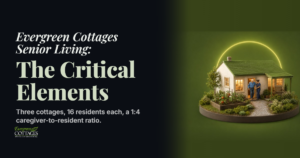
Small, licensed homes — usually 10 to 16 residents — where caregivers work in a true home setting. This is the model Evergreen Cottages uses. The Texas Health and Human Services Commission licenses these as Type B Assisted Living Facilities, meaning they meet rigorous state standards while maintaining a household scale that makes genuine personal care possible.
| Setting | Typical Size | Personal Care | Who Knows Your Name? |
|---|---|---|---|
| Senior apartment | 50–300 units | None or minimal | Maybe a front-desk staff |
| Large ALF/community | 60–200 residents | Scheduled assistance | Some caregivers, some shift |
| Residential cottage | 10–16 residents | 24/7 personal care | Every caregiver, every day |
Who knows your name: what a 1-to-4 caregiver ratio looks like on a Tuesday
A 1-to-4 caregiver-to-resident ratio means that on any given shift, one dedicated caregiver is responsible for four people — not forty. That ratio changes everything about what daily care feels like.
What the numbers mean in practice
The American Health Care Association estimates the national median caregiver ratio in large assisted living facilities runs between 1:8 and 1:12 during daytime hours and can stretch to 1:20 overnight. At that scale, caregivers are triaging needs, not building relationships. At Evergreen Cottages, our cottage model keeps the ratio at or near 1:4, which means caregivers finish morning rounds and still have time to sit down for coffee with a resident who wants to talk.
What Tuesday actually looks like
By 7 a.m., your loved one's primary caregiver already knows whether she slept well, what she asked for at breakfast, and that she prefers her eggs soft-scrambled. That's not a note in a chart — it's observed, firsthand knowledge that accumulates over weeks and months. According to LeadingAge, consistent caregiver assignment is one of the strongest predictors of resident emotional well-being and family satisfaction in long-term care settings.
The overnight question families forget to ask
Most families tour during the day. Ask specifically about overnight staffing. In a cottage setting, caregivers are awake and present — not on-call from a distant station. That matters most when your loved one wakes disoriented at 3 a.m.
Sixteen people, one table: meals and daily routines in a cottage
Shared meals at a cottage aren't a cafeteria service — they're the organizing rhythm of the day, and they produce something large communities rarely can: a genuine sense of family.
Why mealtimes matter more than the menu
The Alzheimer's Association 2025 Facts and Figures report notes that disrupted eating routines are among the earliest and most distressing changes for people living with dementia. Familiar faces, familiar smells, and a consistent seat at a familiar table reduce agitation measurably. When sixteen people share one dining room and the same two caregivers serve every meal, meals become an anchor — not an event to endure.
Routine as therapy
Cognitive research consistently shows that predictable daily structure reduces anxiety and confusion in people with Alzheimer's and related dementias. At Evergreen Cottages, the morning routine — wake-up, personal hygiene, breakfast, activity — follows a consistent pattern that residents internalize even when verbal memory is compromised. The body remembers what the mind cannot always retrieve.
What "home-cooked" means here
Meals in our cottages are prepared on-site, in the cottage kitchen. Residents often smell lunch being made while they're doing a morning activity. That sensory continuity — the scent of soup, the sound of a familiar voice from the kitchen — is not a small thing. It is how belonging gets built, one ordinary morning at a time.
When needs change: how care follows you under one roof
One of the most painful moments in senior care happens when a community tells a family, "We can no longer meet her needs." The right senior living setting is one where the care level rises with the need — without requiring a move.
The spectrum Evergreen Cottages covers
Evergreen Cottages provides Assisted Living, Memory Care, Alzheimer's Care, and Dementia Care. These aren't separate campuses requiring a disorienting transition — they're levels of care delivered within the same cottage environment by the same familiar caregivers. For a resident whose needs shift from assisted living support to dedicated memory care, the faces in the hallway stay the same.
Why continuity matters for dementia
Disorientation from a physical move is one of the documented risk factors for accelerated cognitive decline in people with Alzheimer's disease. The Alzheimer's Association recommends minimizing environmental changes and preserving relationships with familiar caregivers wherever possible. A cottage model that spans care levels honors that guidance in a way that a traditional placement-and-transfer model cannot.
Care plans that adapt without drama
When a resident's needs increase, our team updates the individual care plan in consultation with the family — not with a discharge notice. Families report that this continuity is the single feature they most valued in retrospect, even if it wasn't the first thing they looked for during the initial search.
A Veterans Day morning at Bridgewater, Jasmine and Magnolia
Picture a Veterans Day morning in one of our three cottages. This isn't hypothetical — it's the kind of moment that happens when care is delivered at human scale.
Three cottages, three personalities
Bridgewater Cottage, Jasmine Cottage, and Magnolia Cottage each house a small group of residents with their own culture, inside jokes, and shared routines. On Veterans Day, the team decorates early. A caregiver who knows that Mr. Harold served in the Army reserves pins a small flag near his place at the breakfast table before he wakes up. Nobody scheduled that. It happened because she knows him.
The ceremony that fits in a living room
There's no auditorium, no PA announcement, no program handed to 150 people who may or may not feel present. There's a living room, a few chairs, a recording of "Taps," and a conversation where every veteran in the room gets called by name and thanked by someone who means it. That intimacy is not a limitation of the cottage model — it is its defining strength.
Why this matters beyond the holiday
Identity-affirming moments — being recognized for who you were, not just managed for what you need today — are central to quality dementia care. Research from LeadingAge confirms that residents in person-centered care environments show lower rates of depression and behavioral symptoms than those in task-centered models. Veterans Day is one morning. The recognition it represents should happen every morning.
Seven questions to ask on any senior living tour
Walking into a beautifully staged building can feel reassuring — and misleading. These seven questions cut through the presentation to the daily reality your loved one will actually experience.
Questions about staffing
- What is your caregiver-to-resident ratio during the day — and overnight? Ask for a specific number, not a policy statement.
- How consistent is caregiver assignment? Does your loved one see the same faces daily, or does staffing rotate constantly?
- What is your staff turnover rate? High turnover in senior care is a leading indicator of poor resident experience. The industry average hovers near 55% annually (ALFA); a well-run cottage can do significantly better.
Questions about care
- What happens if my loved one's needs increase? Can care levels adjust in place, or will she need to move again?
- How are families kept informed? Ask how often the team communicates proactively — not just when something goes wrong.
Questions about environment
- Can I visit unannounced? The answer to this question tells you everything about how confident the community is in its day-to-day care.
- What does a typical Tuesday afternoon look like? Not an activity calendar — an honest description of the rhythms of an ordinary day.
FAQ: senior living apartments in Katy, TX
What is the difference between senior living apartments and assisted living?
Senior apartments are age-restricted housing for independent older adults — no personal care is included. Assisted living provides hands-on help with daily activities like bathing, medication, and meals. If your loved one needs any daily assistance, a licensed assisted living or memory care community is the appropriate level of care.
Are senior living communities in Katy regulated by the state?
Yes. Texas Health and Human Services licenses and inspects assisted living and memory care communities on a regular cycle. Evergreen Cottages holds an active Type B Assisted Living Facility license. You can verify any community's license status on the HHSC website before you tour.
How much do senior living communities typically cost compared to home care?
In the greater Houston area, full-time home care for a person with dementia often exceeds $6,000–$8,000 per month once 24-hour coverage is factored in. Residential memory care in a cottage setting is frequently comparable in cost while providing around-the-clock supervision, meals, activities, and clinical oversight that home care cannot replicate at that price point.
What memory care services are included at Evergreen Cottages?
Our memory care includes 24/7 dementia-trained caregiver support, individualized care plans, structured daily activities, three home-cooked meals and snacks, medication management, secure outdoor spaces, and consistent caregiver assignment — all within a small, home-like cottage environment designed to reduce anxiety and support dignity.
Can a resident move from assisted living to memory care at Evergreen Cottages without leaving the community?
Yes. Because Evergreen Cottages provides both assisted living and memory care under the same roof and within the same cottage culture, care levels can be adjusted as needs change without requiring a disorienting physical relocation. Familiar caregivers and familiar surroundings stay constant — which matters enormously for residents living with cognitive changes.
How do I start the process of placing a loved one in a senior living community?
Start with a no-pressure tour. Bring your list of questions, observe a mealtime if possible, and meet the caregivers — not just the director. At Evergreen Cottages, we welcome families at any stage of their research. You don't have to have a decision made to walk through the door.
The name on the door is a start. The name they know is everything.
When you search for senior living apartments, you're searching for more than a place to live. You're searching for a place where your loved one will be seen — by name, by history, by all the small things that make them who they are.
Large buildings can be beautiful. But beauty doesn't answer the overnight call. It doesn't remember that your father takes his coffee black, or that your mother lights up when someone plays Patsy Cline. Those things happen when caregivers have the time and the consistency to learn them.
At Evergreen Cottages, sixteen people share a home. Every caregiver knows every resident. That's not a marketing promise — it's the natural result of a model built small on purpose.
If you're somewhere in the middle of this decision — not quite ready, not quite sure — a tour is a good next step. Come see what a Tuesday looks like here. Ask us anything. We'll introduce you by name.
Explore Evergreen Cottages
Found this helpful? Share it with someone who needs it.
Ivan Urrego — Professional Copywriter, Senior Living Industry
Ivan is an award-winning contributor to Argentum, MALA, and other leading senior living associations, with more than a decade of experience translating complex care decisions into clear, compassionate guidance for families. He writes exclusively for Evergreen Cottages, bringing a deep understanding of memory care, dementia, and the emotional journey every family navigates when choosing senior care for a loved one.
Sources
- National Investment Center for Seniors Housing & Care (NIC). 2025 Consumer Research Report. nic.org
- Alzheimer's Association. 2025 Alzheimer's Disease Facts and Figures. alz.org
- American Health Care Association / National Center for Assisted Living (AHCA/NCAL). Staffing Benchmarks in Assisted Living. ahcancal.org
- LeadingAge. Person-Centered Care Outcomes in Long-Term Services and Supports. leadingage.org
- Texas Health and Human Services Commission (HHSC). Assisted Living Facility Licensing Standards — Type B. hhs.texas.gov
- Assisted Living Federation of America (ALFA). Senior Living Annual Staff Turnover Data. alfa.org