
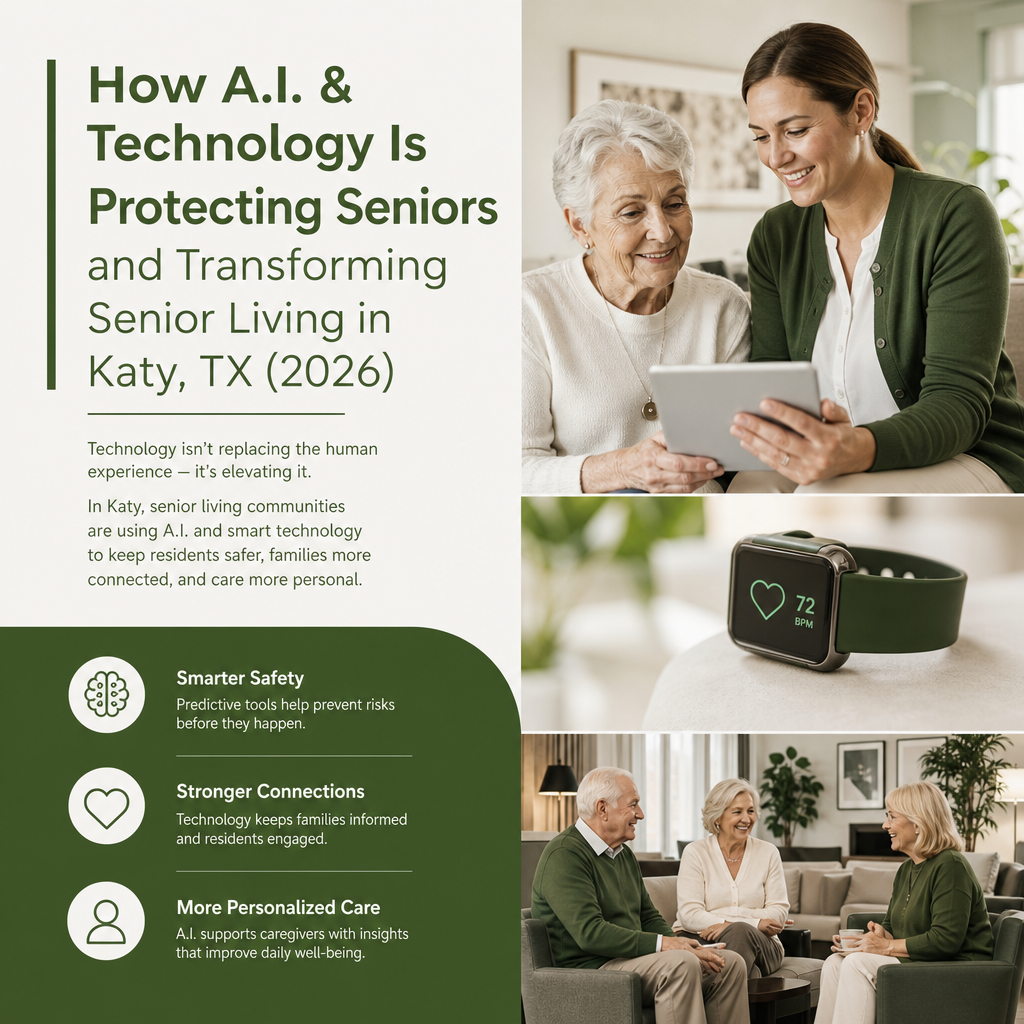
How A.I. & Technology Is Protecting Seniors and Transforming Senior Living in Katy, TX (2026)
By Ivan Urrego | Last updated: May 2026
1. Why A.I. & Technology Matters for Seniors Right Now
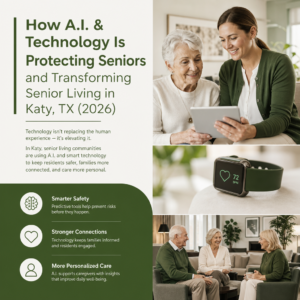
A.I. & technology on seniors is arriving at a critical moment. The U.S. is facing a dual crisis: a rapidly aging population and a nationwide caregiver shortage that shows no signs of easing. According to the National Investment Center for Seniors Housing & Care (NIC) 2025 Consumer Research Report, demand for senior housing is projected to outpace supply through 2030, with memory care and assisted living facing the sharpest gaps. Technology is not replacing human care — it is filling cracks that would otherwise leave vulnerable older adults unprotected.
The Numbers Behind the Shift
By 2025, more than 6.7 million Americans were living with Alzheimer's disease, according to the Alzheimer's Association 2025 Facts and Figures report. In the greater Houston suburbs — including Katy, TX — the senior population has grown significantly as families relocate or age in place. That growth demands smarter systems.
From Buzzword to Bedside
A few years ago, "senior tech" meant a medical alert button worn around the neck. Today it encompasses predictive analytics, voice-activated companions, AI-driven care planning, and sensor networks that detect health changes before a crisis occurs. For families researching care options in Katy, understanding this landscape helps you ask the right questions when touring communities.
2. Smart Fall Detection & Emergency Response
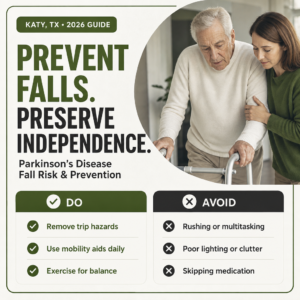
Falls are the leading cause of injury-related death among adults 65 and older. A.I.-powered fall detection removes the terrifying gap between a fall and a response — especially at night when traditional oversight is limited.
How Modern Systems Work
Unlike older pendant alarms that required a resident to press a button, today's AI fall detection uses ceiling-mounted sensors, floor pressure mats, and computer vision to recognize a fall pattern automatically and immediately alert staff. No button press required — critical for residents with dementia who may not remember or be able to activate a traditional alert.
Radar & Passive Sensing
Leading systems now use millimeter-wave radar — the same technology in automotive safety systems — to monitor room occupancy and movement without cameras, preserving resident privacy. The system learns each resident's normal movement patterns and flags anomalies. According to LeadingAge, communities piloting passive radar fall detection have reported response time reductions of up to 40% compared to traditional call-light systems.
What This Means in Katy, TX
In small, home-like communities such as Evergreen Cottages, fall detection technology integrates seamlessly into the cottage environment without feeling clinical. Families gain peace of mind knowing their loved one is monitored 24 hours a day — even during the overnight hours when staffing is naturally leaner.
| Technology Type | How It Works | Privacy Level |
|---|---|---|
| Pendant Alarm | Resident presses button manually | High |
| Camera-Based AI | Visual pattern recognition | Moderate |
| Radar/Passive Sensor | Motion wave detection, no images | Very High |
| Floor Pressure Mat | Detects weight change at bed/floor | High |
3. AI-Powered Medication Management
Medication errors are among the most preventable — and most dangerous — risks for seniors. A.I. & technology on seniors in the medication space is delivering measurable, documented results.
Automated Dispensing Systems
Smart medication dispensers use AI to organize, sort, and dispense the correct dose at the correct time — and immediately alert caregivers if a dose is missed. For residents managing five or more daily medications (common in assisted living populations), this closes a dangerous gap. The American Senior Housing Association (ALFA) has noted that automated dispensing reduces medication errors by up to 85% in communities where it is consistently used.
Cross-Referencing Drug Interactions
AI pharmacy integration can cross-reference a resident's full medication list in real time, flagging dangerous drug interactions before a prescription is filled. In memory care specifically — where residents often cannot self-report side effects — this layer of protection is invaluable.
Why Families Should Ask About This
When you tour any senior community in Katy, TX, ask directly: "How do you manage medication administration, and what technology supports your process?" The answer reveals a great deal about how seriously a community takes resident safety at the clinical level.
4. Technology Designed for Memory Care & Dementia in Katy, TX
A.I. & technology on seniors living with Alzheimer's and dementia requires a uniquely thoughtful approach. The goal is never to overwhelm — it is to calm, orient, and reconnect.
Reminiscence Therapy Platforms
Digital platforms like music therapy apps and personalized memory stations use AI to curate content — songs, photos, video clips — from a resident's era and personal history. Research cited by the Alzheimer's Association 2025 Facts and Figures supports music-based interventions for reducing agitation and improving mood in moderate-to-advanced dementia. At Evergreen Cottages, this kind of music therapy approach is woven into daily programming.
Wandering Prevention & GPS Tracking
Wandering affects approximately 60% of people with dementia at some point during the disease. Smart door sensors, geofencing wristbands, and real-time location systems allow staff to respond before a resident reaches an unsafe area — not after. This is especially relevant in the Katy, TX climate, where summer heat creates a life-threatening outdoor risk within minutes.
Cognitive Engagement Technology
Tablet-based cognitive games calibrated to a resident's ability level help maintain neural pathways longer and provide meaningful stimulation without frustration. AI adjusts difficulty in real time based on performance — something no static activity book can match.
5. Wearables & Remote Health Monitoring for Seniors
Wearable health technology has matured dramatically. Today's senior-focused wearables do far more than count steps — they provide continuous, clinical-grade data that supports proactive intervention.
What Today's Wearables Measure
- Heart rate variability and irregular rhythm detection (AFib alerts)
- Blood oxygen saturation (SpO₂)
- Sleep quality and duration
- Skin temperature trends
- Activity levels and gait analysis
Predictive Health Alerts
The real power of AI in wearables is prediction. By analyzing trends over days and weeks, AI can flag early warning signs — a subtle drop in activity, disrupted sleep patterns, or slight changes in heart rate — that often precede a urinary tract infection, fall, or cardiac event by 48 to 72 hours. For a deeper look at UTIs specifically, see our guide on understanding and managing UTIs in seniors.
Design Matters for Seniors with Dementia
For residents who cannot manage a smartwatch, passive wearables — soft-banded or embedded in a familiar watch design — reduce resistance and improve compliance. The best communities work with families to choose wearables that fit the resident's personality, not just the technology spec sheet.
7. How A.I. & Technology Supports Caregivers & Staff Quality
Better technology makes better caregivers. When staff spend less time on administrative tasks and manual documentation, they have more time for the human-centered care that no algorithm can provide.
Electronic Health Records & AI Documentation
Modern EHR systems with AI-assisted note completion dramatically reduce the time caregivers spend on documentation. A caregiver who spends 90 minutes less per shift on paperwork has 90 more minutes at a resident's side. According to LeadingAge, communities using AI-assisted documentation report measurably higher staff satisfaction scores — which correlates directly with lower turnover and better resident outcomes.
Predictive Staffing Models
AI scheduling tools analyze historical patterns — resident acuity changes, seasonal health trends, call-out rates — to predict staffing needs in advance. This means the community is never caught understaffed during a demanding shift, protecting both residents and the staff who care for them.
Training & Competency Tracking
AI-powered training platforms deliver personalized learning modules to caregivers based on skill gaps identified through performance data. In dementia care especially, ongoing education is not optional — it is the difference between a resident who feels understood and one who feels frightened. Our care team at Evergreen Cottages is trained with this philosophy at its core.
8. Facility Safety, Wandering Prevention & Smart Environments
A.I. & technology on seniors intersects with physical space design in increasingly sophisticated ways. The building itself can become a safety tool.
Smart Door & Access Systems
Keypad and fob systems at community exits — integrated with resident identification badges — alert staff the moment a memory care resident approaches an unsecured exit. The system distinguishes residents from staff and visitors without requiring human oversight at every door. In Texas summers that regularly exceed 100°F, preventing a wandering incident is a literal life-or-death function.
Lighting & Circadian Technology
Smart lighting systems that gradually shift in brightness and color temperature throughout the day support residents' natural circadian rhythms — particularly important for reducing sundowning behaviors in dementia residents. Tunable LED systems that mimic natural daylight have shown promise in clinical settings for reducing evening agitation.
Environmental Sensors & Air Quality
Indoor air quality sensors monitor CO₂ levels, humidity, and allergens — factors that directly affect respiratory health, sleep quality, and cognitive clarity in older adults. Automated HVAC adjustments keep conditions optimal without requiring manual intervention, relevant in Katy's notoriously humid Gulf Coast climate.
9. AI in Nutrition Planning & Dining for Seniors
Nutrition is a foundational pillar of cognitive health and physical resilience in older adults — and AI is making it more precise than ever before.
Personalized Meal Planning
AI nutrition platforms integrate a resident's medical diagnoses, lab values, allergies, religious preferences, and texture requirements (critical for residents with dysphagia) to generate meal plans that are both medically appropriate and genuinely enjoyable. This is especially meaningful for residents with Alzheimer's, who may resist eating — see our guide on the best diets for dementia and Alzheimer's patients.
Hydration Monitoring
Dehydration is one of the leading triggers of UTIs, falls, and confusion in seniors. Smart water pitchers and intake-tracking wristbands alert staff when a resident's fluid intake drops below their daily target. In Katy's extreme summer heat, proactive hydration monitoring is not optional — it is essential. Read more in our complete hydration guide for Katy families.
Waste Reduction & Preference Learning
AI dining systems track which meals are eaten versus left on the plate, identifying food preferences over time and reducing waste. This data loop means meals become more personalized — and more eaten — with every passing week, directly improving nutritional outcomes.
10. Keeping Katy Families Connected Through Technology
One of the most underappreciated applications of A.I. & technology on seniors is the bridge it builds between residents and their families — especially when distance or busy schedules make daily visits difficult.
Family Portal & Real-Time Updates
Modern family portal apps allow adult children to view care notes, medication logs, activity participation, and mood observations in real time from their phone or laptop. Rather than waiting for a weekly phone call, families can see at 9 a.m. on a Tuesday that mom joined the morning exercise group and ate a full breakfast. That kind of transparency is transformative for family peace of mind.
Virtual Family Meetings
AI-assisted care planning platforms facilitate structured virtual family meetings where care teams share updates, adjust care plans, and answer questions — with AI-generated summaries available afterward for family members who could not attend live. For Katy families with siblings spread across Texas or the country, this eliminates the logistical barrier to staying genuinely informed.
Transparency Builds Trust
The NIC 2025 Consumer Research Report found that family communication quality is among the most heavily weighted factors in overall satisfaction ratings for senior communities. Technology does not replace those conversations — it makes them richer, more frequent, and more grounded in real data. Our Family Resources section is built on this same commitment to transparency.
11. Risks, Ethics & What Families Should Watch For
Not all technology in senior living is beneficial — and not all claims made by communities are equal. A.I. & technology on seniors deserves careful, critical evaluation alongside its genuine promise.
Privacy & Data Security
Wearables, sensors, and health platforms collect deeply personal data. Families should ask every community they consider: Who owns the resident's data? How is it stored? Is it ever sold or shared with third parties? These are not paranoid questions — they are responsible ones. Look for communities that use HIPAA-compliant platforms and have transparent data governance policies.
The Risk of Over-Reliance
Technology should never be used as a staffing substitute. A community that uses fall detection sensors as a reason to thin overnight staffing is not leveraging technology well — it is cutting corners. LeadingAge and ALFA both emphasize that technology augments human care; it does not replace it. When touring communities, watch for whether technology is framed as an enhancement or an excuse.
Digital Equity & Resident Comfort
Not every senior is comfortable with technology — and comfort should never be forced. The best communities introduce tech tools gradually, with staff support, and always maintain a non-tech alternative. A resident who refuses a voice assistant should never feel penalized or excluded from quality care.
12. Frequently Asked Questions: A.I. & Technology in Senior Living
Does AI technology in senior living replace human caregivers?
No — and it should not. A.I. & technology on seniors functions as a support layer that allows caregivers to focus more time on direct, compassionate interaction. According to LeadingAge, the communities seeing the best outcomes use technology to reduce administrative burden, not headcount at the bedside.
Is my loved one's health data private in an AI-enabled community?
It should be. Reputable senior communities use HIPAA-compliant platforms and have clear data ownership policies. Always ask who owns the data, how it is stored, and whether it is ever shared outside the care team. Don't accept vague answers — this is protected health information.
What technology is most important for Alzheimer's and dementia residents specifically?
Wandering prevention systems, circadian lighting, reminiscence therapy platforms, and passive fall detection are the highest-impact technologies for memory care. These address the most common risks — wandering, falls, agitation, and isolation — without requiring the resident to understand or operate the technology themselves.
Do Katy, TX assisted living communities use these technologies?
Adoption varies widely. The best way to assess a community's commitment to technology is to ask specific questions during your tour — not just whether they "use technology," but which systems they use, how staff are trained, and how families are kept informed. Evergreen Cottages prioritizes evidence-based tools that directly improve resident outcomes.
Will my loved one be overwhelmed by all this technology?
Most senior-focused technology is designed to be invisible to the resident — operating in the background through sensors, smart environments, and staff-facing dashboards. Resident-facing tools like tablet programs or voice assistants are introduced gradually and always remain optional, with traditional alternatives always available.
How does technology affect the cost of assisted living in Katy, TX?
Some technology tools are included in standard monthly fees; others may be offered as add-ons. The more important question is the value equation — communities using predictive health technology often prevent costly hospitalizations and emergency interventions, which can reduce overall family expenditure significantly over time. See our cost guide for Katy, TX.
13. What Matters Most: Technology Serves People, Not the Reverse
If you have been researching care options for an aging parent or loved one in Katy, TX, you already know how overwhelming this process can feel. The addition of AI and technology to the conversation can make it feel even more complex. But here is the truth that every piece of technology in this article points toward: the goal has never changed. The goal is that your loved one is safe, known, and dignified — every single day.
A.I. & technology on seniors, when thoughtfully implemented, is the most powerful ally that goal has ever had. It does not replace the caregiver who knows your mother's favorite song or the staff member who notices she seems quieter than usual this morning. It gives those people better tools, better information, and more time to simply be present.
At Evergreen Cottages in Katy, TX, we believe technology and humanity are not in competition. They work together — and the residents in our care deserve both. Our assisted living, memory care, Alzheimer's care, and dementia care programs are built on this belief, reinforced by the training of our team, the design of our community, and the daily rhythm of life within our cottages.
If you are ready to see what personalized, technology-supported senior care looks like in person, we would love to show you. Come walk through our doors. Meet our team. See how the smallest details — and the most thoughtful innovations — add up to a life well-lived.
Explore Evergreen Cottages
Found this helpful? Share it with someone who needs it.
✓ Link copied to clipboard!
Ivan Urrego — Senior Living Copywriter
Ivan Urrego is a professional copywriter and award-winning contributor to Argentum, MALA, and other leading senior living associations, with over a decade of experience helping families understand complex care decisions. He writes exclusively for Evergreen Cottages in Katy, TX, specializing in assisted living, memory care, Alzheimer's care, and dementia care topics that guide families from confusion to clarity.
Sources
- Alzheimer's Association. 2025 Alzheimer's Disease Facts and Figures. alz.org. Cited for disease prevalence, wandering statistics, and music therapy evidence.
- National Investment Center for Seniors Housing & Care (NIC). 2025 Consumer Research Report. nic.org. Cited for supply-demand projections, family satisfaction drivers, and social engagement research.
- LeadingAge. Technology in Senior Living: Trends and Outcomes. leadingage.org. Cited for fall detection response time reductions, AI documentation impact on staff satisfaction, and training platform data.
- American Senior Housing Association (ALFA). Medication Safety in Senior Communities. alfa.org. Cited for automated dispensing error reduction statistics.
- Centers for Disease Control and Prevention (CDC). Older Adult Fall Data. cdc.gov. Cited as foundational source for falls as the leading injury-related cause of death in adults 65+.
- AARP Public Policy Institute. Technology and Aging: 2024–2025 Update. aarp.org. Cited for wearable health monitoring trends and digital equity considerations in senior care settings.

6. Combating Isolation: A.I. Companions & Digital Connection
Loneliness is a clinical risk factor for older adults — not just an emotional one. A.I. & technology on seniors in the social connection space is tackling one of the most underreported crises in senior care.
AI Companion Robots and Voice Assistants
Conversational AI companions — ranging from voice assistants like Amazon Echo Show to specialized robotic companions like PARO (a therapeutic robotic seal used in memory care) — provide on-demand interaction that reduces anxiety and loneliness between staff visits. These tools are most effective as supplements to human connection, not substitutes.
Video Calling Made Simple
One-touch video calling devices designed for seniors with limited tech experience allow families in the greater Houston area — or across the country — to stay visually connected with loved ones. For families in Katy who work long hours or have young children at home, these tools preserve the relationship regardless of physical distance. Learn more about how loneliness affects seniors and what community living can do to counteract it.
The Evidence on Isolation
The NIC 2025 Consumer Research Report found that social engagement is among the top three factors families cite when evaluating senior living communities — ranking alongside safety and care quality. Technology that facilitates connection is not a luxury feature; it is a care feature.