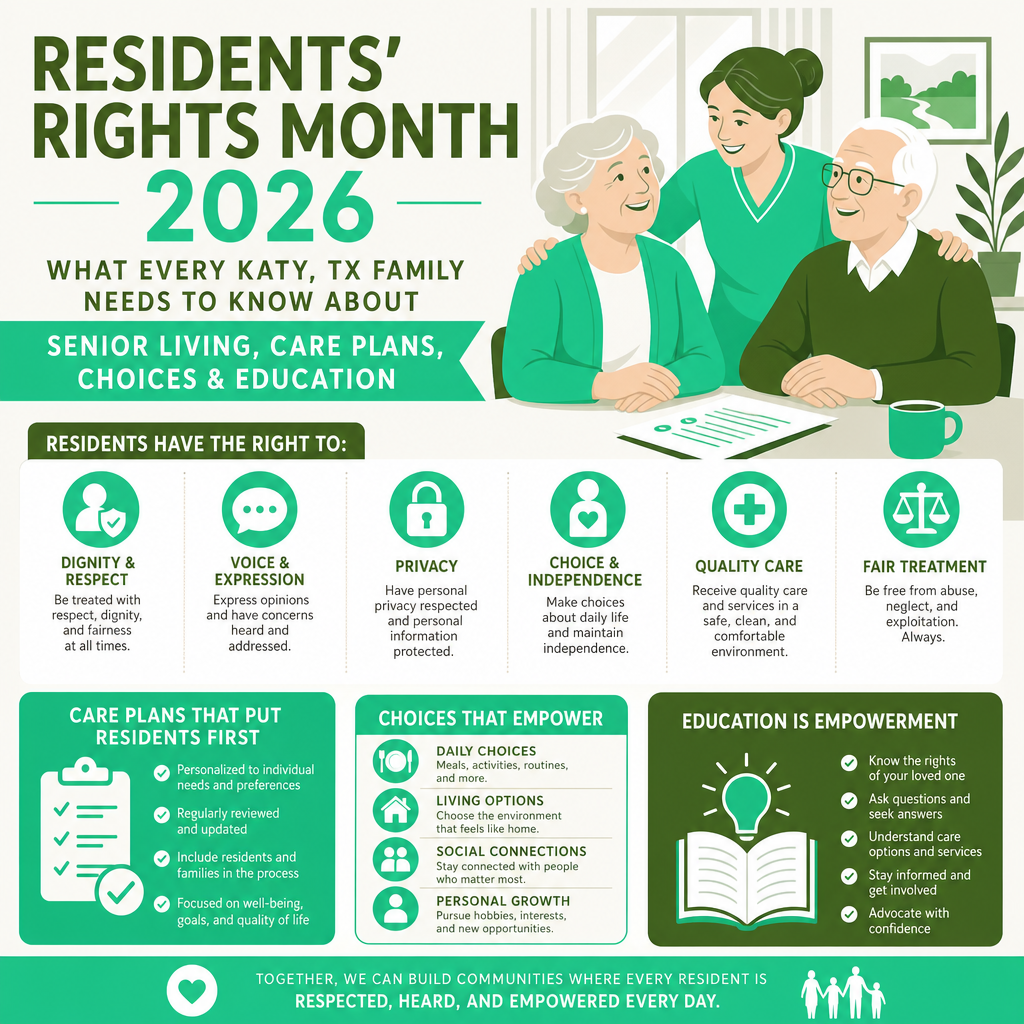
Residents' Rights Month 2026: What Every Katy, TX Family Needs to Know About Senior Living, Care Plans, Choices & Education
By Ivan Urrego | Last updated: May 2026 | Evergreen Cottages Blog
📋 Table of Contents
- What Is Residents' Rights Month?
- History and Legal Foundation of Residents' Rights
- Core Rights Every Senior Holds in Senior Living
- Care Plans and Resident Choices: What Families Must Know
- Education and Awareness in October: How Communities Participate
- The Ombudsman Program in Texas
- How to Advocate for Your Loved One in a Katy, TX Community
- Residents' Rights and Memory Care: Special Considerations
- Red Flags to Watch For in Any Senior Living Community
- How Evergreen Cottages Upholds Residents' Rights Every Day
- Questions to Ask on a Tour About Residents' Rights
- Frequently Asked Questions
- Conclusion: Rights Are Not a Formality — They Are a Promise
1. What Is Residents' Rights Month?
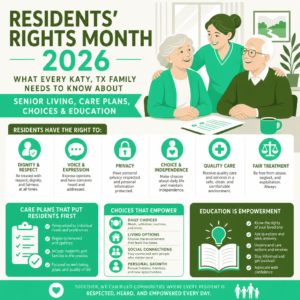
Residents' Rights Month is a nationally recognized awareness campaign held every October to honor and promote the rights of older adults and people with disabilities living in long-term care settings — including assisted living, memory care, and skilled nursing facilities.
Organized by the National Consumer Voice for Quality Long-Term Care (Consumer Voice), the campaign reminds families, staff, and policymakers that every resident retains fundamental rights regardless of age, diagnosis, or level of care. The 2026 theme continues to center on education, empowerment, and dignity — three pillars that should define the experience inside any quality senior living community.
Why October Matters for Senior Living Awareness
October serves as a dedicated month for conversations that often get delayed: What rights does my parent actually have? Who speaks up for them if something goes wrong? How much say do they get in their own daily routine? These conversations should not wait. Awareness campaigns in October create structured opportunities — events, trainings, and family meetings — that bring these questions to the surface.
Who Participates in This Campaign?
Ombudsmen programs, senior living communities, advocacy groups, families, and state agencies all participate. In Texas, the Department of Aging and Disability Services (DADS), now integrated into the Health and Human Services Commission (HHSC), supports awareness efforts statewide — including communities in the greater Houston and Katy area.
2. History and Legal Foundation of Residents' Rights
Residents' rights in long-term care have a clear legal foundation rooted in federal and state law. Understanding that history helps families know these protections are not optional — they are legally enforceable.
The Nursing Home Reform Act of 1987
The federal Nursing Home Reform Act, part of the Omnibus Budget Reconciliation Act (OBRA) of 1987, established the first comprehensive residents' rights requirements for nursing homes receiving Medicare and Medicaid funding. It mandated that residents receive care that maintains or improves their quality of life, and that they retain the right to make personal choices about daily activities, schedules, and healthcare decisions.
Texas State Regulations for Assisted Living
In Texas, assisted living communities — including those serving seniors in Katy, TX — are governed by the Texas Health and Safety Code and administrative rules enforced by HHSC. These rules require that residents be informed of their rights upon admission and that communities maintain written documentation of each resident's care plan, preferences, and consent. (Texas Health and Human Services Commission, 2025)
Evolution Through Advocacy
Decades of advocacy by organizations like Consumer Voice, LeadingAge, and ALFA (now Argentum) have expanded residents' rights beyond basic legal minimums to include concepts like person-centered care — where the resident, not the institution, drives decisions. This evolution is reflected in the care philosophy you should expect from any reputable senior living community in Katy, TX.
3. Core Rights Every Senior Holds in Senior Living
Every resident of a licensed senior living community holds a defined set of rights. Knowing them is the first step to ensuring they are honored.
| Right | What It Means in Practice |
|---|---|
| Dignity & Respect | Staff must address residents by preferred name; care is delivered without ridicule or humiliation. |
| Privacy | Personal space, mail, phone calls, and medical records are confidential. |
| Self-Determination | Residents direct their own daily routines, activities, and healthcare choices. |
| Informed Consent | No treatment or procedure may be performed without the resident's knowledge and agreement. |
| Freedom from Abuse | Physical, verbal, emotional, financial, and sexual abuse are prohibited and reportable. |
| Grievance Process | Residents and families may raise concerns without fear of retaliation. |
| Visitation | Family and designated representatives may visit at reasonable hours. |
| Financial Transparency | Residents receive clear accounting of any funds managed on their behalf. |
Rights That Surprise Families Most
Many families do not realize that residents have the right to refuse medication, choose their own physician, and even discharge themselves from a community. These rights persist even when a loved one has cognitive decline, though advance directives and legal guardianship may modify how they are exercised.
4. Care Plans and Resident Choices: What Families Must Know
A care plan is a legally required, individualized written document that outlines a resident's health needs, preferences, goals, and the services the community will provide. It is not a formality — it is your loved one's blueprint for daily life.
Who Is Involved in Building a Care Plan?
Federal and Texas state regulations require that the resident — and, when appropriate, the family — participates in developing and reviewing the care plan. Care plan meetings typically occur at admission, after any significant change in condition, and at least annually. (Texas HHSC Assisted Living Regulations, 2025)
What a Strong Care Plan Includes
- Medical diagnoses and current medications
- Documented personal preferences (wake time, meal choices, activity interests)
- Short- and long-term care goals set by or with the resident
- Staff responsibilities and frequency of assistance
- Family communication preferences
- Emergency and advance directive information
Choices That Belong to Your Loved One
Residents have the right to choose when they wake up, what they eat (within dietary guidelines), which activities they attend, and how they spend their private time. According to the NIC 2025 Consumer Research Report, 78% of senior living residents who report high satisfaction cite "feeling in control of my daily routine" as a top factor. Choices, however small, are not trivial — they are therapeutic and dignity-affirming.
"Who on the care team is responsible for updating this plan when my loved one's preferences change — and how will we be notified?"
5. Education and Awareness in October: How Communities Participate
October's Residents' Rights Month awareness campaign translates into real educational activities inside senior living communities. Quality communities treat this month as a structured commitment, not a passive acknowledgment.
Common October Awareness Activities
- Posting the Residents' Rights Bill of Rights in common areas
- Hosting family town halls or Q&A sessions with leadership
- Distributing written rights summaries in plain, accessible language
- Staff training refreshers on dignity, consent, and grievance procedures
- Inviting the local ombudsman to speak with residents and families
- Resident-led discussions about what they wish staff understood better
Education as an Ongoing Practice
The strongest communities do not limit rights education to one month. According to LeadingAge's 2025 Quality Care Framework, providers that integrate rights training into monthly staff meetings and quarterly family communications report significantly lower complaint rates and higher family trust scores. Education is not a poster on the wall — it is a culture built conversation by conversation.
How Families Can Engage in October
Use October as a natural prompt to schedule a care plan review, meet your loved one's ombudsman, and ask directly: "Have there been any grievances filed this quarter, and how were they resolved?" This kind of informed family engagement measurably improves resident outcomes.
6. The Ombudsman Program in Texas
A long-term care ombudsman is a trained, independent advocate who investigates complaints and works to resolve problems affecting residents in licensed senior living communities — completely free of charge.
What Texas Ombudsmen Do
In Texas, the Long-Term Care Ombudsman Program is administered through the Texas HHSC and operates through a network of regional programs, including those serving the greater Houston and Katy area. Ombudsmen can investigate complaints about care quality, resident rights violations, discharge issues, and billing concerns. They are bound by confidentiality and act solely on behalf of the resident. (Texas HHSC Long-Term Care Ombudsman Program, 2025)
How to Contact Your Local Ombudsman
Families in Katy, TX can reach the Texas Long-Term Care Ombudsman by calling the statewide helpline at 1-800-252-2412. You can also file a complaint online through the Texas HHSC portal. Any resident or family member may initiate contact — you do not need permission from the community to do so.
Ombudsmen Are Not the Enemy of Good Communities
Quality senior living communities welcome ombudsman involvement. Regular visits from an ombudsman signal transparency and accountability. If a community discourages contact with the ombudsman, that is itself a red flag worth noting.
7. How to Advocate for Your Loved One in a Katy, TX Community
Family advocacy is one of the most powerful tools for ensuring your loved one's rights are honored daily — not just on paper. Effective advocacy is calm, informed, and consistent.
Build Relationships with Direct Care Staff
The certified nursing aides and caregivers who interact with your loved one daily are the frontline of rights protection. Learn their names. Thank them genuinely. When you have a concern, bring it to them first before escalating — most issues are resolved at this level and doing so builds trust in both directions.
Document Everything
Keep a simple log: dates, observations, staff interactions, and any changes in your loved one's condition or mood. This documentation becomes invaluable if a concern escalates to a formal grievance or ombudsman complaint. Photos of the living environment, if concerning, are also appropriate to preserve.
Attend Every Care Plan Meeting
Federal and Texas regulations give families the right to participate in care plan meetings. Never waive that right. Arrive with written questions. Ask about changes since the last meeting, upcoming transitions, and how your loved one's preferences have been incorporated into daily scheduling. According to Argentum's 2025 State of Senior Living Report, families who attend at least two care plan meetings per year report 34% higher satisfaction with overall care quality.
8. Residents' Rights and Memory Care: Special Considerations
Cognitive decline does not eliminate a resident's rights — it changes how those rights are expressed and protected. This distinction is critical for families choosing memory care in Katy, TX.
Assent vs. Legal Consent
Even when a resident with dementia lacks legal decision-making capacity, their expressed preferences — verbal or behavioral — carry moral and ethical weight. Quality memory care communities practice assent-based care: if a resident resists a task, staff are trained to pause, redirect, and try a different approach rather than forcing compliance. Resistance itself is a form of communication that must be respected.
The Role of the Legal Representative
When cognitive decline progresses, a designated legal representative — through power of attorney, guardianship, or healthcare proxy — assumes decision-making authority. That representative has the same rights to participate in care planning, review records, and file grievances as the resident would have exercised directly. (Alzheimer's Association 2025 Facts and Figures)
Behavioral Expressions Are Rights Signals
Agitation during bathing, refusing meals, or social withdrawal may indicate unmet needs or rights violations. Communities with robust memory care training recognize these behavioral signals as communication — not as problems to manage with medication.
9. Red Flags to Watch For in Any Senior Living Community
Knowing what good care looks like also means recognizing when something is wrong. These red flags are your early warning system.
| Red Flag | What It May Indicate |
|---|---|
| Staff cannot explain the care plan | Inadequate training or lack of individualized care |
| Residents appear sedated or disengaged | Possible over-medication or chemical restraint |
| Families discouraged from drop-in visits | Potential transparency issues |
| No posted Residents' Rights | Possible regulatory non-compliance |
| Grievances dismissed without documentation | Rights violation; escalate to ombudsman |
| Frequent staff turnover with no explanation | Management or culture problems affecting care consistency |
| Residents addressed by room number, not name | Dignity right being routinely violated |
Trust Your Instincts
Families often sense something is wrong before they can articulate it. Do not dismiss that instinct. Call the ombudsman. Request a care plan meeting. Speak with the executive director. If a community consistently makes families feel like problems rather than partners, that community's culture does not align with residents' rights principles.
10. How Evergreen Cottages Upholds Residents' Rights Every Day
At Evergreen Cottages in Katy, TX, residents' rights are not a compliance checklist — they are the architecture of every interaction. Here is what that looks like in daily practice.
Person-Centered Care Plans Built With Residents
Every resident's care plan at Evergreen Cottages is developed collaboratively, incorporating personal preferences gathered during a detailed intake process. Staff are trained to revisit and update preferences as residents' needs and desires evolve — not just at scheduled review intervals.
A Culture Where Staff Know Each Resident's Story
Our cottage-style, small-community model means that caregivers are not rotating through dozens of unfamiliar faces. They know their residents' histories, interests, and preferences by name and relationship. This intimacy is not incidental — it is by design, and it is the most reliable protector of individual dignity in senior living.
Transparency With Families as a Core Value
Families at Evergreen Cottages are welcomed at care plan meetings and encouraged to visit without appointment. We view family engagement as a care quality asset, not a disruption. Our team actively invites questions — because informed families produce better outcomes for the seniors we both love.
11. Questions to Ask on a Tour About Residents' Rights
When you tour a senior living community in Katy, TX this October, use these targeted questions to assess how seriously the community takes residents' rights.
Care Plan and Choices
- "How does my loved one's input get incorporated into their care plan, and how often is it reviewed?"
- "Can residents choose their own wake and sleep schedules? How flexible is daily programming?"
- "What happens if a resident refuses care — how does your team respond?"
Grievance and Advocacy
- "How many formal grievances were filed in the past 12 months, and how were they resolved?"
- "Does your local ombudsman make regular visits, and can residents and families contact them independently?"
- "How do you handle a complaint a family raises about a staff member?"
Education and Awareness
- "What specific activities are you doing this October for Residents' Rights Month?"
- "How are new staff trained on residents' rights, and how often is that training refreshed?"
- "Where is the Residents' Rights Bill of Rights posted, and is it accessible to residents who may not be able to read it independently?"
12. Frequently Asked Questions
13. Conclusion: Rights Are Not a Formality — They Are a Promise
October's Residents' Rights Month awareness campaign exists because these rights require constant protection, education, and advocacy. They do not enforce themselves. That work belongs to families, staff, community leadership, and ombudsmen working together — with the resident always at the center.
If you are researching senior care options in Katy, TX, we hope this guide has given you the language, the questions, and the confidence to hold any community to a high standard. Your loved one deserves more than basic compliance. They deserve a community where their choices are genuinely honored, their care plan reflects who they are, and the people caring for them know their name and their story.
That is what we build every day at Evergreen Cottages. Not because a regulation requires it — but because your loved one has earned it.
Explore More at Evergreen Cottages
📤 Found this helpful? Share it with your family:
About the Author: Ivan Urrego
Ivan Urrego is a professional copywriter and senior living industry strategist whose work has been recognized by Argentum, MALA, and other leading long-term care associations. He writes exclusively for Evergreen Cottages in Katy, TX, translating complex care topics into clear, compassionate guidance that helps families make confident decisions. His writing is grounded in current research, regulatory knowledge, and genuine respect for the seniors and families he serves.
Sources
- National Investment Center for Seniors Housing & Care (NIC). 2025 Consumer Research Report. NIC, 2025.
- Argentum (formerly ALFA). 2025 State of Senior Living Report. Argentum, 2025.
- LeadingAge. 2025 Quality Care Framework for Long-Term Services and Supports. LeadingAge, 2025.
- Alzheimer's Association. 2025 Alzheimer's Disease Facts and Figures. Alzheimer's Association, 2025.
- Texas Health and Human Services Commission (HHSC). Assisted Living Facility Regulations and Residents' Rights Requirements. Texas HHSC, 2025.
- National Consumer Voice for Quality Long-Term Care. Residents' Rights Month 2026 Campaign Resources. Consumer Voice, 2026.