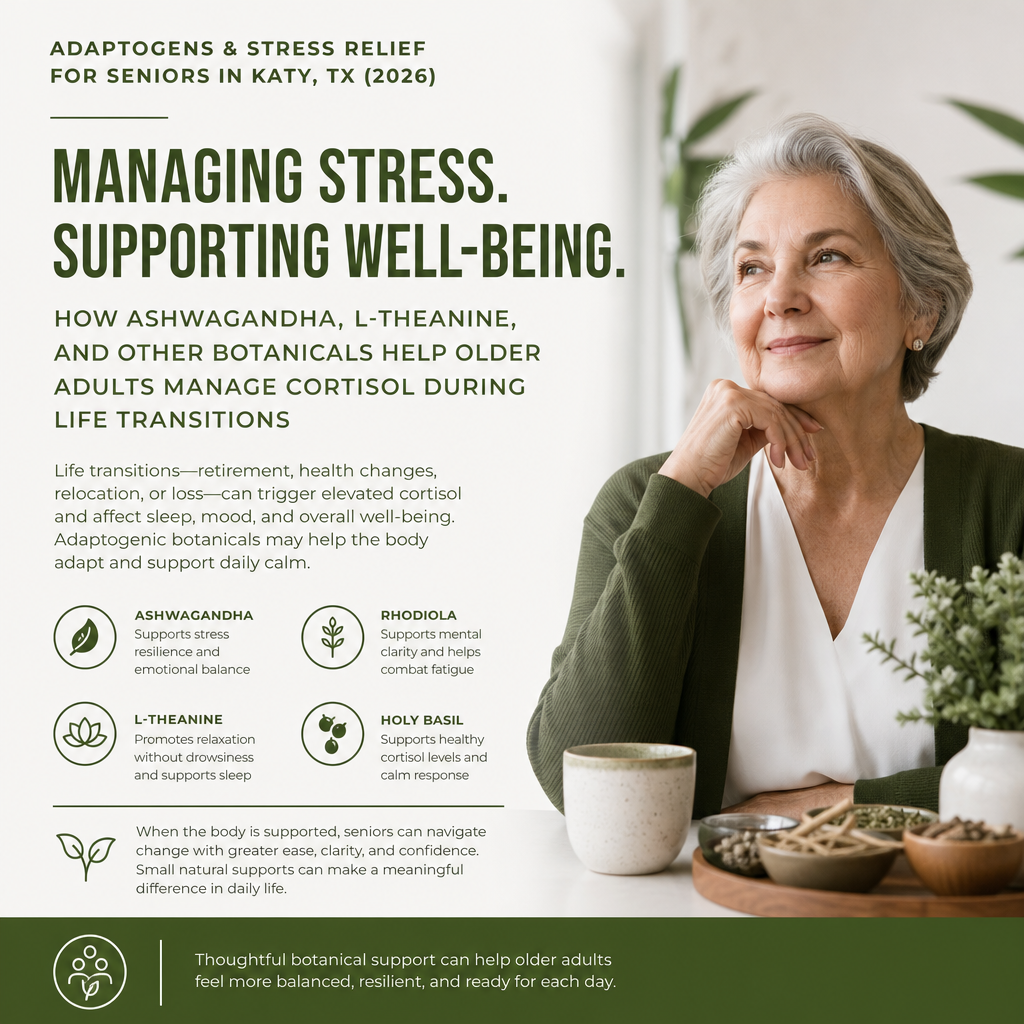
Adaptogens & Stress Relief for Seniors in Katy, TX (2026): How Ashwagandha, L-Theanine, and Other Botanicals Help Older Adults Manage Cortisol During Life Transitions
By Ivan Urrego | Last updated: May 2026 | Evergreen Cottages Blog
If your parent or spouse is preparing to move — or has recently moved — into a senior living community, you have probably noticed that the transition comes with an invisible weight. They may sleep poorly. They may seem more anxious than usual. They may withdraw, become more irritable, or simply look like the life has gone out of them for a while. What you are witnessing is not imagination. It is cortisol — the body's primary stress hormone — doing what it evolved to do. And in older adults, especially those living with Alzheimer's disease, dementia, or cognitive frailty, elevated cortisol doesn't just cause discomfort. It accelerates brain aging.
This is why stress relief for seniors has become one of the most discussed topics in professional senior living circles, from the halls of LeadingAge conferences to the dining rooms of memory care cottages right here in Katy, TX. Families and care teams are asking: beyond medication, beyond routine, what else can we do to help an older adult's nervous system settle, adapt, and thrive?
One growing answer comes from an ancient branch of botanical medicine, now supported by a promising (if still evolving) body of modern research: adaptogens. Plants like Ashwagandha, L-theanine, Rhodiola rosea, and Holy Basil have been used across Ayurvedic, Traditional Chinese, and Nordic medical traditions for millennia to help the body resist stress. Today, researchers and integrative clinicians are taking a serious second look — particularly for older adult populations navigating major life transitions.
This guide is written specifically for families in the greater Katy, TX area who are actively researching care options and want to understand every dimension of wellness available to their loved one. We will go deep on the science, stay honest about the limitations, and always bring it back to what actually matters: helping the person you love feel safe, calm, and at home — wherever home now is.
1. Why Stress Relief for Seniors Is a Medical Priority, Not a Luxury
Stress in older adults is not merely an emotional inconvenience — it is a measurable physiological event with documented links to cognitive decline, cardiovascular disease, immune suppression, and accelerated cellular aging. Understanding this is the first step in appreciating why so many families and care professionals in Katy, TX are investing serious attention in stress reduction strategies for older adults.
The Cortisol Cascade in Aging Bodies
Cortisol (also called hydrocortisone) is a glucocorticoid hormone produced by the adrenal glands in response to perceived threats — physical, emotional, or environmental. In a young, healthy adult, cortisol spikes quickly during stress and then returns to baseline just as quickly. In older adults, this regulatory loop often breaks down. According to research published in the Journal of Clinical Endocrinology & Metabolism, aging is associated with a flattening of the diurnal cortisol rhythm and a slower return to baseline following stressors — meaning older adults stay "flooded" with cortisol for longer periods than younger people do.
This matters enormously in the context of senior living because the very act of transitioning into a new care environment — even a warm, well-designed one — is a potent stressor. Familiar sights, smells, sounds, and routines are gone overnight. For seniors living with dementia or Alzheimer's disease, who rely on environmental consistency for cognitive orientation, this disruption can manifest as agitation, sleep disturbance, accelerated memory loss, or what care professionals call transfer trauma.
What the Data Says About Senior Stress
The statistics are sobering. According to the Alzheimer's Association 2025 Facts and Figures report, approximately 6.9 million Americans age 65 and older are living with Alzheimer's dementia — and chronic psychosocial stress is now recognized as both a risk factor for and accelerant of cognitive decline. The report notes that neuroinflammation driven by chronic cortisol elevation damages the hippocampus, the brain region most critical to memory formation and retrieval.
Meanwhile, the NIC 2025 Consumer Research Report found that nearly 61% of adult children researching senior living options cited their loved one's "emotional adjustment and anxiety" as one of their top three concerns — ranking above physical safety and even cost in some survey segments. Families are not just looking for safe beds. They are looking for places where their loved ones can feel peaceful.
The Opportunity for Natural Intervention
This is exactly where adaptogenic botanicals enter the conversation. As a non-pharmacological complement to evidence-based care, certain plant compounds have demonstrated measurable effects on the hypothalamic-pituitary-adrenal (HPA) axis — the biological system that governs cortisol production. For families seeking natural, gentle approaches to stress relief for seniors, adaptogens offer a scientifically grounded starting point — with appropriate caution and medical oversight.
2. What Are Adaptogens? Defining the Botanical Category
An adaptogen is a class of herbal substance that helps the body resist physical, chemical, and biological stressors by normalizing physiological functions — without causing significant side effects when used at recommended doses. The term was coined in 1947 by Soviet pharmacologist Nikolai Lazarev, who was studying compounds that could increase nonspecific resistance to stress.
The Three Criteria for Classification
For a botanical to be classified as a true adaptogen, it must meet three specific criteria first outlined by Lazarev and later refined by researcher Israel Brekhman:
- Non-specific action: It must increase resistance to a broad spectrum of stressors — physical, chemical, biological, and psychological.
- Normalizing effect: It must bring the body's physiological functions toward homeostasis, regardless of whether the baseline was too high or too low.
- Innocuousness: It must not disturb normal body functions more than minimally — distinguishing adaptogens from stimulants or sedatives.
Traditional Roots, Modern Science
Adaptogens appear across virtually every traditional medical system on Earth. Ashwagandha has been central to Ayurvedic medicine for over 3,000 years. Rhodiola rosea was used by Viking warriors and Siberian shamans. Panax ginseng has anchored Traditional Chinese Medicine for millennia. Holy Basil (Tulsi) is revered in Hindu spiritual and medicinal traditions. What modern pharmacology is now doing is isolating the active compounds within these plants — withanolides in Ashwagandha, salidroside in Rhodiola, theanine in green tea — and testing them in controlled clinical environments.
How Adaptogens Work at a Molecular Level
Most adaptogens exert their effects through modulation of the hypothalamic-pituitary-adrenal (HPA) axis — the neuroendocrine system that controls the release of cortisol and other stress hormones. They also interact with the sympatho-adrenal system (SAS), which governs the "fight-or-flight" response via adrenaline and noradrenaline. By gently down-regulating overactive stress pathways and supporting the body's return to baseline, adaptogens help the nervous system achieve a state of dynamic equilibrium — calm alertness rather than anxious hyperarousal or exhausted collapse.
| Adaptogen | Primary Mechanism | Key Active Compounds | Traditional Origin |
|---|---|---|---|
| Ashwagandha | HPA axis modulation, cortisol reduction | Withanolides, withaferin A | Ayurvedic (India) |
| L-Theanine | Glutamate receptor modulation, GABA support | L-theanine (amino acid) | Green tea (Japan/China) |
| Rhodiola Rosea | SAS regulation, serotonin/dopamine support | Salidroside, rosavin | Norse/Siberian traditions |
| Holy Basil (Tulsi) | Anti-inflammatory, cortisol normalization | Eugenol, ursolic acid | Ayurvedic (India) |
| Panax Ginseng | Adrenal support, immune modulation | Ginsenosides | Traditional Chinese Medicine |
| Lion's Mane Mushroom | Nerve growth factor (NGF) stimulation | Hericenones, erinacines | East Asian traditions |
3. Cortisol and the Aging Brain: What Changes After 65
After age 65, the brain's ability to regulate cortisol declines significantly, making older adults both more vulnerable to the damaging effects of chronic stress and less able to recover from stressful events on their own. This biological reality is at the heart of why stress relief for seniors demands a dedicated, proactive strategy.
The Hippocampus: Cortisol's Primary Target
The hippocampus — the seahorse-shaped brain structure responsible for forming and retrieving memories — is uniquely vulnerable to cortisol. It is densely packed with glucocorticoid receptors, which means it is exquisitely sensitive to cortisol fluctuations. In young adults, the hippocampus can buffer short-term cortisol spikes without lasting damage. In older adults, this buffering capacity diminishes. Research from Stanford University's Center on Longevity has shown that prolonged cortisol elevation is associated with measurable hippocampal atrophy — a finding that directly connects chronic stress to the kinds of memory loss seen in Alzheimer's disease and other dementias.
The Alzheimer's Association 2025 Facts and Figures report notes that cumulative exposure to psychosocial stress is now considered a modifiable risk factor for Alzheimer's disease — meaning that interventions designed to lower stress load across the lifespan, including in the critical period of transitioning into senior living, may genuinely reduce disease progression.
Allostatic Load: The Hidden Toll of Accumulated Stress
Allostatic load is a term used in geroscience to describe the cumulative biological damage that results from chronic stress over time. Think of it as the running total of wear-and-tear that stress hormones inflict on organs, cardiovascular systems, immune cells, and neural architecture. By the time most seniors arrive at a care community, their allostatic load is already substantial — decades of life stress, grief, illness, and loss have left biological fingerprints. Anything a care environment can do to reduce further allostatic loading is clinically meaningful.
Sleep, Cortisol, and the Vicious Cycle
One of the most damaging feedback loops in aging involves cortisol and sleep. Elevated nighttime cortisol disrupts slow-wave and REM sleep. Poor sleep, in turn, triggers higher cortisol the next day. In seniors with dementia, this cycle often manifests as sundowning — increased confusion, agitation, and distress in the late afternoon and evening hours. (You can learn more about this phenomenon in our detailed guide, What Is Sundowning?) Adaptogens that reduce evening cortisol — particularly Ashwagandha and L-theanine — may hold particular promise precisely because of their ability to interrupt this sleep-stress spiral.
4. Ashwagandha (Withania somnifera): The Gold Standard Adaptogen for Older Adults
Ashwagandha is the most extensively researched adaptogen in the context of cortisol reduction, and several double-blind, placebo-controlled trials now support its ability to meaningfully lower serum cortisol levels and reduce subjective stress in adults — including older adult populations. It is, for many integrative clinicians, the first adaptogen they discuss when addressing stress relief for seniors.
The Clinical Evidence: What the Trials Show
The landmark study most frequently cited in this field is a 2019 randomized, double-blind, placebo-controlled trial published in Medicine (Chandrasekhar et al.), which found that adults taking a standardized Ashwagandha root extract (KSM-66) at 240mg/day over 60 days experienced:
- A 23% reduction in serum cortisol levels compared to placebo
- Significant improvements in scores on the Perceived Stress Scale (PSS)
- Improved sleep quality as measured by the Pittsburgh Sleep Quality Index (PSQI)
- Reduced anxiety symptoms on the Hamilton Anxiety Rating Scale (HAM-A)
A 2021 systematic review in the Journal of Ethnopharmacology pooled data from seven Ashwagandha trials and concluded that the herb demonstrated "consistent, statistically significant reductions in stress and anxiety" across diverse adult populations — with an excellent safety profile at doses between 240mg and 600mg daily.
How Ashwagandha Modulates Cortisol
Ashwagandha's primary bioactive compounds — called withanolides — appear to act on the HPA axis by suppressing the release of corticotropin-releasing hormone (CRH) from the hypothalamus, effectively turning down the volume on the body's stress-response system before it reaches the adrenal glands. Withanolides also demonstrate anti-inflammatory properties by inhibiting NF-κB, a molecular pathway involved in both stress-mediated neuroinflammation and Alzheimer's pathology.
Considerations for Seniors Specifically
While the research is promising, older adults require careful consideration before beginning any new supplement. Ashwagandha has thyroid-stimulating properties that may be contraindicated in seniors with hyperthyroidism. It can also interact with sedative medications (benzodiazepines, certain anticonvulsants) and immunosuppressants — both classes commonly prescribed to older adults. The American Botanical Council recommends that seniors always consult their physician or pharmacist before initiating Ashwagandha supplementation.
| Study | Dose | Duration | Cortisol Change | Stress Score Change |
|---|---|---|---|---|
| Chandrasekhar et al., 2019 (Medicine) | 240mg/day KSM-66 | 60 days | −23% | PSS −41% |
| Pratte et al., 2014 (J. Intl. Soc. Sports Nutrition) | 300mg twice daily | 60 days | −27.9% | Significant |
| Langade et al., 2019 (Cureus) | 300mg twice daily | 10 weeks | Not measured | PSQI improved 72% |
5. L-Theanine: The Calm-Without-Sedation Amino Acid
L-theanine is a naturally occurring amino acid found almost exclusively in Camellia sinensis — the plant from which green, black, and white teas are made — and it is one of the most compelling natural compounds for achieving relaxed, focused calm in older adults without causing drowsiness or cognitive dulling. For seniors who need stress relief without sedation, L-theanine is often the compound integrative practitioners reach for first.
The Neuroscience of Theanine
L-theanine crosses the blood-brain barrier within 30–60 minutes of ingestion and exerts several complementary neurological effects:
- Alpha wave induction: EEG studies consistently show that L-theanine promotes alpha-band brain activity (8–14 Hz) — the neurological signature of alert relaxation, the mental state associated with creative flow, meditation, and peaceful focus. This pattern is distinctly different from the theta waves seen in drowsiness.
- GABA support: L-theanine increases levels of gamma-aminobutyric acid (GABA), the brain's primary inhibitory neurotransmitter, which calms overactive neuronal firing without causing sedation.
- Glutamate modulation: By antagonizing AMPA glutamate receptors, L-theanine reduces excitatory neurotoxicity — a pathway implicated in both anxiety and neurodegenerative disease progression.
Evidence Specific to Older Adults
A 2019 randomized controlled trial published in Nutrients specifically examined L-theanine supplementation (100mg/day) in adults aged 50–69 with self-reported cognitive decline and stress. After 12 weeks, participants showed statistically significant improvements in verbal fluency, working memory, and reaction time — alongside reduced scores on the State-Trait Anxiety Inventory (STAI). The authors concluded that L-theanine may represent a well-tolerated, accessible intervention for stress relief for seniors with early cognitive concerns.
The Green Tea Connection and Daily Life
A standard cup of green tea contains approximately 20–40mg of L-theanine. The therapeutic doses used in most trials range from 100mg to 200mg daily — achievable through supplementation or through 3–5 cups of green tea per day. For seniors in communities like Evergreen Cottages in Katy, TX, the incorporation of a daily tea ritual serves dual purposes: the biochemical delivery of L-theanine and the psychological comfort of routine and sensory pleasure — two pillars of stress reduction in their own right. Green tea also pairs with caffeine in a unique synergistic ratio that produces focused calm rather than jittery stimulation, making it one of the most gentle and pleasurable adaptogenic interventions available.
Safety Profile for Older Adults
L-theanine has an excellent safety profile and is generally recognized as safe (GRAS) by the FDA. It does not appear to interact significantly with common medications prescribed to older adults, though seniors taking blood pressure medications should monitor BP when initiating supplementation, as L-theanine may have mild hypotensive effects. As always, physician consultation is recommended.
6. Rhodiola Rosea, Holy Basil, and Other Key Botanicals for Senior Stress Relief
Beyond Ashwagandha and L-theanine, several other well-researched adaptogens offer meaningful support for stress relief in seniors — each with its own mechanism of action, evidence base, and caution profile that families and care teams should understand before consideration.
Rhodiola Rosea: The Energy Adaptogen
Rhodiola rosea, also called "golden root" or "Arctic root," is a succulent plant native to the cold mountainous regions of Europe and Asia. Its primary bioactive compounds — salidroside and rosavin — have been shown in multiple European clinical trials to reduce fatigue, improve stress resilience, and support mood regulation. A 2012 study in Phytomedicine found that Rhodiola extract (400mg/day) significantly reduced burnout symptoms and elevated morning cortisol response in chronically stressed adults. For seniors experiencing the exhaustion of transition — what families often describe as "they just seem so tired" — Rhodiola's anti-fatigue properties make it particularly relevant.
One important caution: Rhodiola has a mild stimulating effect and may disrupt sleep if taken in the late afternoon or evening. For seniors with insomnia or dementia-related sleep disruption, morning dosing is essential.
Holy Basil (Ocimum sanctum / Tulsi)
Holy Basil, known as Tulsi in the Ayurvedic tradition, is sometimes called "the queen of herbs" for its broad therapeutic applications. In the context of stress, its key compounds — eugenol, rosmarinic acid, and ursolic acid — exert anti-inflammatory, anxiolytic (anxiety-reducing), and cortisol-normalizing effects. A 2012 double-blind trial published in the Journal of Ayurveda and Integrative Medicine found that adults taking Holy Basil extract (500mg twice daily) for 60 days showed significant reductions in forgetfulness, sexual problems due to stress, and sleep disturbances compared to placebo. For older adults where cognitive symptoms overlap with anxiety, Holy Basil's dual action is intriguing.
Lion's Mane Mushroom and Cognitive Stress
While not a classical adaptogen, Lion's Mane (Hericium erinaceus) has earned a place in conversations about stress and cognitive aging because of its unique ability to stimulate nerve growth factor (NGF) synthesis — a protein essential for the survival and maintenance of neurons. NGF levels decline with age and are markedly lower in Alzheimer's disease. A 2009 randomized controlled trial in the Phytotherapy Research journal found that Japanese adults aged 50–80 who consumed Lion's Mane biscuits (3g/day) for 16 weeks showed significantly improved cognitive function scores compared to placebo — scores that declined again once supplementation stopped. This suggests ongoing use may be necessary for sustained benefit.
Panax Ginseng: The Immune-Stress Connection
Panax ginseng, the "king of adaptogens" in Traditional Chinese Medicine, modulates the immune-stress axis through its active ginsenosides, which have been shown to regulate cortisol and inflammatory cytokines simultaneously. For older adults — whose immune systems are already stressed by aging (immunosenescence) and for whom infections like UTIs can dramatically worsen cognitive symptoms — the immune-supporting properties of Panax ginseng add a layer of relevance beyond stress reduction alone.
| Botanical | Best For | Senior-Specific Caution | Evidence Level |
|---|---|---|---|
| Ashwagandha | Cortisol reduction, anxiety, sleep | Thyroid interaction, avoid with sedatives | Strong (multiple RCTs) |
| L-Theanine | Calm focus, mild anxiety, sleep quality | Monitor BP with antihypertensives | Strong (multiple RCTs) |
| Rhodiola Rosea | Fatigue, burnout, mood | Stimulating — morning dosing only | Moderate |
| Holy Basil (Tulsi) | Cognitive stress, sleep, inflammation | May lower blood sugar — monitor in diabetics | Moderate |
| Lion's Mane | Cognitive function, NGF support | Possible allergy in mushroom-sensitive individuals | Moderate (promising) |
| Panax Ginseng | Energy, immune function, stress resilience | Interacts with warfarin, MAOIs — physician consult essential | Strong (traditional + clinical) |
7. Adaptogens and Cognitive Decline: What We Know About Dementia and Alzheimer's
The relationship between chronic stress, cortisol dysregulation, and Alzheimer's disease is one of the most actively researched frontiers in neuroscience — and adaptogens occupy a compelling position in this conversation because they address a known driver of neurodegeneration at its biological root.
Stress as a Modifiable Alzheimer's Risk Factor
The Alzheimer's Association 2025 Facts and Figures explicitly identifies psychosocial stress and its physiological sequelae as modifiable risk factors for Alzheimer's disease — meaning interventions that reduce chronic stress may genuinely influence disease trajectory. This is a significant shift from earlier frameworks that viewed Alzheimer's primarily as a genetic inevitability. While genetics matter (particularly APOE-e4 status), researchers increasingly understand Alzheimer's as a disease of multiple intersecting risk factors, many of which are addressable.
The Cortisol-Amyloid Connection
One of the most important emerging findings in Alzheimer's research is the apparent connection between chronic cortisol elevation and the accelerated production and impaired clearance of amyloid-beta — the protein fragment whose accumulation into plaques is a hallmark of Alzheimer's pathology. Animal studies have shown that glucocorticoid administration directly increases amyloid precursor protein (APP) expression and reduces neprilysin — an enzyme that clears amyloid-beta. While human causality is not yet definitively established, the mechanistic plausibility is high, and several research groups, including teams funded by the National Institute on Aging, are currently investigating cortisol-lowering interventions as potential disease-modifying strategies.
Ashwagandha and Amyloid: Early Laboratory Evidence
Several in vitro (cell culture) and animal studies have found that withanolides from Ashwagandha can inhibit beta-secretase activity — the enzyme that cleaves APP into amyloid-beta fragments — and even reverse pre-formed amyloid aggregates in neuronal cultures. A 2011 study in the British Journal of Pharmacology by Bhattacharya et al. found that Ashwagandha extract reversed Alzheimer's-like deficits in a mouse model, including improved spatial memory and reduced amyloid burden. These are laboratory findings, not yet replicated in large human trials, but they add biological plausibility to the clinical interest in Ashwagandha for cognitively vulnerable older adults.
What This Means for Families in Katy, TX
For a family in Katy, TX whose loved one is living with early-to-mid stage Alzheimer's or dementia, the practical implication is this: reducing chronic stress load — through adaptogens, environmental design, consistent routine, and compassionate care — is not a soft, feel-good intervention. It is a biologically grounded approach to supporting the brain's remaining capacity. Every stress spike that can be dampened, every night of deeper sleep that can be facilitated, every moment of calm connection that can be offered, represents a real contribution to cognitive resilience. At Evergreen Cottages, we see this play out in real residents' lives every single week.
8. Environmental Transition Stress: Why Moving Into Senior Living Elevates Cortisol
The transition into a senior living community — even when it is the right decision, even when the community is exceptional, even when it is driven by love and safety — is one of the most cortisol-elevating events in an older adult's life, and understanding why is essential for families who want to support their loved one through it well.
What "Transition Trauma" Actually Means
Relocation stress syndrome (RSS) is a NANDA International nursing diagnosis that describes a cluster of symptoms arising from a transfer or move to a new environment. In older adults, particularly those with cognitive impairment, RSS can manifest as:
- Increased confusion or disorientation
- Sleep disturbance and altered circadian rhythms
- Decreased appetite and weight loss
- Withdrawal from social engagement
- Heightened emotional lability (tearfulness, irritability, fear)
- Physiological signs including elevated blood pressure and suppressed immune function
A 2020 review in Geriatric Nursing found that up to 40% of newly admitted nursing home residents showed clinically significant signs of relocation stress in their first 30 days — a figure that reinforces how common and how serious this phenomenon is.
The Role of Environmental Familiarity in Brain Chemistry
For a senior with dementia, the brain uses environmental anchors — the smell of a familiar kitchen, the texture of a known chair, the view from a habitual window — to compensate for declining internal memory architecture. These external cues literally scaffold cognition. When they disappear overnight, the brain is forced to orient in a wholly unfamiliar context without the neural resources needed to do so efficiently. The result is not simply emotional distress — it is a measurable spike in neurological stress load, cortisol, and inflammatory markers.
The First 90 Days: The Critical Window
Research consistently identifies the first 90 days following a move to senior living as the highest-risk period for cortisol dysregulation and its consequences. This is the window during which family engagement is most protective, consistency of caregiving staff matters most, and gentle, non-pharmacological stress modulation — including adaptogens, structured routine, music therapy, and outdoor time — can make the most meaningful difference. According to LeadingAge, communities that implement formal transition support programs see significantly better outcomes for new residents in the domains of mood, nutrition, and physical health at the 60-day and 90-day marks.
How Evergreen Cottages Approaches Transition in Katy, TX
At Evergreen Cottages in Katy, TX, we approach every new resident's arrival as a carefully choreographed act of welcome. We learn each person's life history, preferences, sensory triggers, and daily rhythms before they walk through our door. We involve family in orientation. We maintain high staff consistency during the first month. And we encourage families to bring familiar objects, photographs, and sensory anchors from home. These are not just warm gestures — they are evidence-based stress reduction strategies rooted in the same science that underlies adaptogen research: give the nervous system predictability, and cortisol will come down.
9. Safety, Drug Interactions, and Dosage Cautions for Older Adults
Adaptogens are not risk-free simply because they are natural — and older adults, who typically carry significant medication burdens and have altered drug metabolism due to aging physiology, require careful, individualized evaluation before beginning any adaptogenic supplement regimen. This section is one of the most important in this entire guide, and we ask that you read it fully before acting.
Polypharmacy: The Critical Context
The majority of Americans over 65 take five or more prescription medications daily — a condition known as polypharmacy. According to a 2022 analysis from the American Geriatrics Society (AGS), approximately 36% of older adults take ten or more medications daily. In this context, the addition of even a "natural" botanical supplement introduces real pharmacokinetic risk. Adaptogens that affect cytochrome P450 liver enzymes — the metabolic pathways responsible for processing most drugs — can either amplify or diminish the effects of prescription medications in unpredictable ways.
High-Risk Interaction Profiles
| Adaptogen | Potential Drug Interaction | Risk Level | Recommended Action |
|---|---|---|---|
| Ashwagandha | Sedatives, thyroid medications, immunosuppressants | Moderate | Physician approval required |
| Panax Ginseng | Warfarin, MAOIs, insulin, stimulants | High | Strong physician oversight |
| Rhodiola | Antidepressants (SSRIs), stimulants, diabetes medications | Moderate | Physician consultation |
| Holy Basil | Blood thinners, diabetes medications, sedatives | Low–Moderate | Monitor glucose and INR |
| L-Theanine | Antihypertensives, stimulants | Low | BP monitoring recommended |
| Lion's Mane | Blood thinners (theoretical) | Low | Report to physician before use |
Age-Related Physiological Changes That Affect Supplement Metabolism
Older adults metabolize supplements differently than younger adults for several interconnected reasons:
- Reduced hepatic (liver) function: Slowed drug metabolism means active compounds may accumulate to higher concentrations than expected.
- Reduced renal (kidney) clearance: Supplements and their metabolites are excreted more slowly, extending their duration of action.
- Decreased albumin binding: More "free" (unbound) drug circulates in the bloodstream, intensifying effects.
- Increased body fat-to-muscle ratio: Lipophilic compounds have greater distribution volume in older bodies.
The Non-Negotiable: Always Consult Before Starting
No matter how compelling the evidence, how gentle the compound, or how many articles you have read (including this one), the right and responsible first step for any family considering adaptogens for their senior loved one is a conversation with their primary care physician or clinical pharmacist. If your loved one resides at a community like Evergreen Cottages, our nursing staff and executive director are also valuable resources — they know the full picture of your loved one's health status and can advocate for safe, integrative approaches within a physician-guided framework.
A Note from Our Team: At Evergreen Cottages in Katy, TX, we welcome conversations about natural wellness approaches and are committed to supporting families who want to explore every dimension of holistic care for their loved ones. Our team works closely with attending physicians to ensure any supplemental protocol is safe, appropriate, and documented.
Meet Our Care Team10. Beyond Supplements: Holistic Stress Relief Strategies in Senior Living Communities
Adaptogens are one tool in a broad toolkit — and in well-designed senior living communities, the most powerful stress relief for seniors comes not from a capsule but from the accumulated architecture of daily life: environment, relationship, meaning, movement, and belonging. This section explores the evidence-based, non-pharmacological strategies that complement adaptogen use and often outperform it.
Music Therapy: The Brain's Most Direct Cortisol Modulator
Of all non-pharmacological interventions studied for stress reduction in seniors with dementia, music therapy has arguably the strongest evidence base. A 2021 meta-analysis in Journal of Affective Disorders found that music therapy significantly reduced cortisol levels in dementia patients across 14 studies, with effect sizes comparable to low-dose anxiolytics — and without any adverse effects. Music accesses emotional memory through pathways that remain relatively intact even in advanced Alzheimer's, allowing people who cannot recognize family members to sing, sway, and smile with full emotional presence. Our own resource on this topic, Helping Alzheimer's and Dementia Patients Reconnect Through Music Therapy, explores this in depth.
Structured Physical Activity: The Cortisol-Lowering Power of Movement
Exercise is one of the most potent, evidence-based cortisol modulators known to science. A 2020 review in Frontiers in Neuroendocrinology found that aerobic exercise at moderate intensity for 30+ minutes produced reliable reductions in cortisol that lasted 6–8 hours post-exercise in older adults. Even gentle movement — chair yoga, walking programs, resistance band exercises — shows measurable HPA axis benefits in seniors with limited mobility. According to our guide on Why Physical Activity Is Crucial for Seniors Above 55, movement is foundational to every dimension of senior health.
Nature, Light, and Sensory Environment
The emerging field of biophilic design in senior living — which incorporates natural elements, natural light, living plants, and outdoor access into care environments — is directly grounded in stress neuroscience. Research consistently shows that even brief exposure to natural views and outdoor environments significantly reduces salivary cortisol, heart rate, and self-reported anxiety in older adults. This is why communities like Evergreen Cottages in Katy, TX prioritize outdoor spaces, natural light through generous windows, and sensory garden areas — not as amenities, but as therapeutic infrastructure.
Small Community Size: The Belonging Effect on Cortisol
Larger senior living settings, with hundreds of residents and high staff turnover, are neurologically noisier environments. For a senior with dementia, navigating a large, stimulating, impersonal setting is a constant cortisol stressor. Smaller, cottage-style communities — like Evergreen Cottages — create the conditions for belonging: known faces, predictable routines, quiet spaces, and individualized attention. The NIC 2025 Consumer Research Report found that families who chose smaller senior living communities over large campus-style settings cited "personalized care and calm atmosphere" as their top reasons — reflecting an intuitive understanding of what research confirms. Read more in our deep dive: Why Less Is More: The Mental Health Perks of Smaller Senior Living Communities.