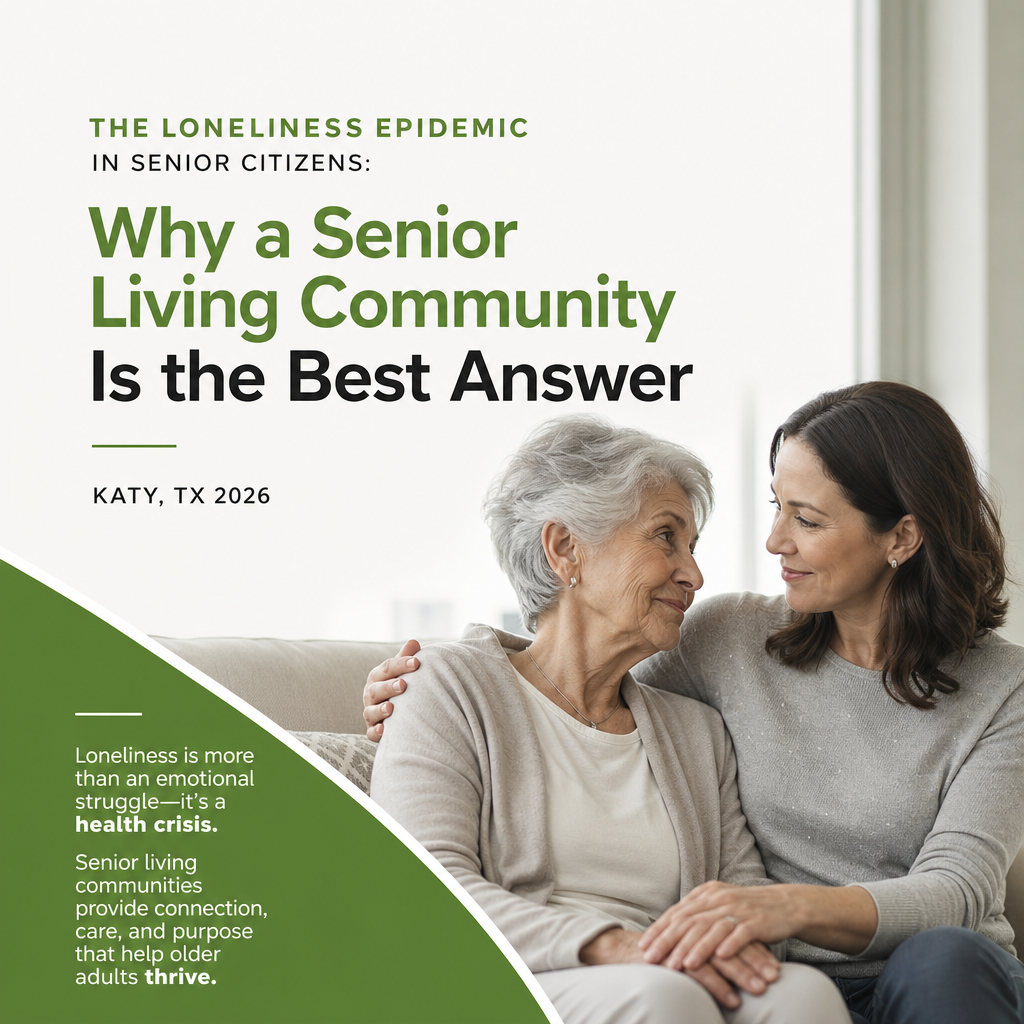
The Loneliness Epidemic in Senior Citizens: Why a Senior Living Community Is the Best Answer (Katy, TX 2026)
What Is Loneliness in Senior Citizens? (And Why It's Different From Solitude)
Loneliness in senior citizens is not simply being alone — it is the painful gap between the social connections a person has and the connections they need. Researchers define it as a subjective, distressing experience that arises when a person's social needs go unmet, regardless of how many people physically surround them.
This distinction matters enormously for families in Katy, TX who may believe that because Mom visits on Sundays or Dad talks to a neighbor occasionally, everything is fine. Solitude — chosen, comfortable time alone — is healthy. Loneliness is the unwanted absence of meaningful connection, and it can exist even in a house full of people.
The Three Dimensions of Senior Loneliness
Gerontologists at UCLA developed the widely used UCLA Loneliness Scale, which identifies three overlapping dimensions:
- Intimate loneliness: Missing a deep, confiding relationship (a spouse who has passed, a lifelong friend who has moved away).
- Relational loneliness: The absence of a satisfying social network of friends, family, and peers who share daily life.
- Collective loneliness: The lack of a sense of belonging to a community, group, or shared purpose.
Many seniors suffering from loneliness experience all three dimensions simultaneously — making it a compounding, layered wound rather than a single problem with a simple fix.
Why Seniors Are Uniquely Vulnerable
Aging brings a cascade of circumstances that strip away connection: retirement removes daily social structure, the deaths of spouses and peers shrink social networks, mobility challenges limit outings, and adult children busy with careers and grandchildren have less time to visit. In Katy, TX — a growing suburban community built around commuter culture and car-dependent mobility — older adults who can no longer drive face particular isolation. When your world shrinks to the four walls of a home, loneliness is not an emotional choice. It becomes the unavoidable architecture of daily life.
Defining Social Isolation vs. Loneliness
Social isolation (the objective measure of few social contacts and interactions) and loneliness (the subjective feeling of being alone) are related but distinct. A person can be socially isolated without feeling lonely, and deeply lonely in a crowd. Research shows that both carry serious health risks, but loneliness is particularly insidious because it is invisible to outside observers — including well-meaning adult children who believe a weekly phone call is enough.
The Scale of the Epidemic: How Many Older Adults Are Truly Isolated
The numbers are sobering. Loneliness in senior citizens is not a niche concern for a small minority — it is the lived reality of a staggering proportion of older Americans, and the data is getting harder to ignore.
The U.S. Surgeon General issued an advisory in 2023 declaring loneliness and isolation a public health epidemic, noting that it affects approximately half of all American adults — with older adults disproportionately represented. The Surgeon General's report emphasized that the health risks of loneliness are comparable to smoking 15 cigarettes per day.
National Data at a Glance
| Statistic | Figure | Source |
|---|---|---|
| Seniors reporting regular loneliness (60+) | 43% | NASEM, 2020 |
| Older adults living alone in the U.S. | ~14.7 million | U.S. Census Bureau, 2023 |
| Increase in risk of dementia linked to loneliness | Up to 50% | Alzheimer's Association, 2025 |
| Increased mortality risk from social isolation | 26–29% | Holt-Lunstad et al., PLOS Medicine |
| Seniors who say lack of meaningful activity worsens isolation | 61% | NIC 2025 Consumer Research Report |
| Family caregivers who underestimate loved one's loneliness | ~70% | AARP Public Policy Institute, 2023 |
The Post-Pandemic Acceleration
COVID-19 did not create the loneliness epidemic — it exposed and dramatically accelerated it. Between 2020 and 2022, millions of seniors who had maintained thin but functional social ties through in-person activities, church groups, and family visits were suddenly completely cut off. Many never fully rebuilt those connections. The NIC 2025 Consumer Research Report found that 61% of surveyed seniors reported that a lack of meaningful daily activity contributed significantly to their feelings of isolation — a statistic that points directly toward the structured community programming that senior living communities like Evergreen Cottages provide.
Texas-Specific Trends
Texas is the second most populous state in the nation, and its senior population is growing rapidly. The Texas Department of Aging and Disability Services has noted a consistent increase in reports of senior social isolation in suburban counties — including the greater Houston metro area and communities like Katy, TX — where car dependency and spread-out neighborhoods create physical barriers to spontaneous social interaction. Seniors who once drove to the Katy Mills Mall, the Katy library, or local church events find themselves housebound far more quickly than their urban counterparts who might walk to a corner store.
The Health Consequences of Loneliness in Senior Citizens
Loneliness in senior citizens is not just an emotional burden — it is a measurable, life-shortening health condition with documented impacts on nearly every major body system. Understanding this is critical for families who may be treating their loved one's isolation as a mood problem rather than a medical emergency.
Cardiovascular Effects
Chronic loneliness triggers sustained activation of the body's stress response, flooding the bloodstream with cortisol and adrenaline. Over time, this leads to measurably higher blood pressure, increased inflammation markers, and accelerated arterial stiffening. A 2022 study published in Heart (BMJ) found that lonely individuals had a 29% higher risk of coronary artery disease and a 32% higher risk of stroke compared to socially connected peers. For older adults in Katy, TX already managing hypertension or heart conditions, loneliness is actively making those conditions worse every single day.
Immune System Suppression
Loneliness suppresses immune function at the cellular level. Research from UCLA's Cousins Center for Psychoneuroimmunology found that lonely individuals show altered expression of genes controlling immune responses — essentially, chronic loneliness reprograms the immune system to be less effective at fighting infection and cancer. This explains why isolated seniors are more frequently hospitalized for illnesses that healthier-living peers fight off without incident.
Mental Health: Depression and Anxiety
The relationship between loneliness and depression is bidirectional — each feeds the other. The Alzheimer's Association 2025 Facts and Figures report notes that depression in older adults increases the risk of cognitive decline significantly, creating a dangerous spiral: loneliness breeds depression, depression accelerates cognitive decline, cognitive decline deepens isolation, and isolation worsens depression. For families watching a loved one slowly withdraw from life in a Katy, TX home, this cycle is often what is happening beneath the surface — whether or not anyone has named it.
Sleep Disruption and Physical Decline
Lonely seniors consistently show worse sleep quality than their socially connected counterparts, according to research published in Sleep (2017). Poor sleep accelerates physical decline, impairs immune function, worsens pain sensitivity, and directly degrades cognitive performance. Loneliness also reduces motivation to eat well, exercise, or maintain hygiene — all of which compound into a downward spiral of health that families often mistake for "just getting old."
Loneliness in Senior Citizens in Katy, TX: A Local Perspective
Katy, Texas is one of the fastest-growing communities in the greater Houston metropolitan area — a place known for excellent schools, master-planned neighborhoods, and a strong family culture. But for older adults aging in place, the same suburban design that makes Katy wonderful for young families can become profoundly isolating.
The Suburban Geography of Isolation
Katy's neighborhoods were designed for cars and families with children. Wide arterials, limited sidewalks, and the absence of walkable town centers mean that a senior who has lost the ability or confidence to drive is essentially cut off from daily life. Unlike downtown Houston or denser urban neighborhoods, there is no corner café, no neighborhood pharmacy within walking distance, no spontaneous encounter with neighbors on a sidewalk. The architecture of Katy's suburban growth, while beautiful and well-intentioned, quietly traps aging adults inside their homes.
The "Successful Aging in Place" Myth
Many families in Katy approach us at Evergreen Cottages after years of believing they were doing the right thing by helping Mom or Dad stay in the family home. And in many cases, the home was genuinely safe — well-maintained, single-story, with grab bars in the bathroom. But safety and thriving are not the same thing. A safe, lonely home is still a lonely home. The NIC 2025 Consumer Research Report found that when families finally transitioned loved ones into senior living communities, the most commonly reported surprise was not the quality of care — it was how much happier and more engaged their loved one became within the first few weeks.
Katy's Growing Senior Population
Fort Bend and Harris Counties — which together encompass Katy, TX — have seen their 65+ populations grow by more than 40% in the past decade, according to U.S. Census Bureau estimates. Many of these older adults are long-term Katy residents who raised families here and feel deeply attached to the community. Evergreen Cottages is uniquely positioned to serve these residents because we are in Katy — meaning seniors don't have to leave the community they love to find the connection they need.
Local Resources That Help (But Aren't Enough Alone)
Katy has some valuable local resources for isolated seniors: the Katy Senior Center on S. Avenue D offers programming and socialization, and various faith communities in the area run outreach programs. These are meaningful, but they require transportation, scheduling, and a level of cognitive and physical independence that many of the seniors most at risk for loneliness no longer have. A senior living community provides that infrastructure 24 hours a day, 7 days a week — not just on Tuesday afternoon.
The Dementia and Alzheimer's Connection to Social Isolation
For families researching memory care options in Katy, TX, the link between loneliness and dementia is one of the most important — and least discussed — pieces of information available. Loneliness in senior citizens is not merely a consequence of dementia; it is increasingly recognized as a contributing risk factor for developing it.
Loneliness as a Dementia Risk Factor
The Alzheimer's Association 2025 Facts and Figures report cites growing evidence that social isolation and loneliness may increase the risk of developing Alzheimer's disease and other dementias by as much as 50%. The proposed mechanism involves the brain's need for consistent stimulation and social engagement to maintain neural pathways and cognitive reserve. When the social brain goes unstimulated — no conversations, no shared laughter, no collaborative activities — those networks weaken over time.
The Vicious Circle for Those Already Diagnosed
For seniors who already have Alzheimer's disease or another form of dementia, loneliness becomes particularly cruel. Cognitive decline can make it difficult to initiate conversation, follow complex social dynamics, or remember faces — all of which drive withdrawal and isolation. That isolation then accelerates cognitive decline, which deepens social difficulty, which worsens isolation. Breaking this circle requires a professionally structured environment designed specifically around the social needs of people with memory impairment — exactly what Evergreen Cottages' memory care program provides.
Social Engagement as a Therapeutic Tool
Research consistently shows that meaningful social engagement slows the progression of dementia symptoms and improves quality of life for those living with Alzheimer's disease. Activities that involve social interaction — group reminiscence therapy, music therapy, shared meals, cooperative games — activate multiple brain regions simultaneously and have been shown to improve mood, reduce agitation, and maintain functional abilities longer than isolation ever could. This is why our activities calendar at Evergreen Cottages is not a luxury — it is medicine.
Caregiver Isolation Is Also a Crisis
There is a second loneliness story hidden inside the first: the isolation of family caregivers. When an adult child in Katy, TX takes on the primary care of a parent with Alzheimer's, they frequently withdraw from their own social world — friendships erode, marriages strain, careers suffer. Both the person with dementia and their caregiver end up isolated together, each reinforcing the other's disconnection. A senior living community like Evergreen Cottages relieves family caregivers of the 24/7 burden, restoring their ability to show up as a loving family member rather than an exhausted caregiver — which, paradoxically, makes visits richer and more meaningful for everyone.
Warning Signs Your Loved One Is Dangerously Lonely
Loneliness rarely announces itself directly. Most seniors will not tell you they are lonely — partly because of pride, partly because they don't want to burden family, and partly because chronic loneliness can numb a person's awareness of their own emotional needs over time. Learning to read the signs is one of the most important things a family in Katy, TX can do.
Behavioral and Emotional Red Flags
- Increased TV or phone use as the primary source of "company." Many lonely seniors report that television has become their main companion — a substitute for real human interaction that provides stimulation but no genuine connection.
- Expressions of meaninglessness or purposelessness. Phrases like "What's the point anymore?" or "I don't have anything to look forward to" are not just pessimism — they are often descriptions of a social life that has collapsed.
- Reluctance to groom, dress, or maintain the home. When there is no one to present yourself to, motivation to maintain personal appearance drops sharply. This is a deeply concerning sign.
- Excessive focus on physical symptoms. Loneliness sometimes expresses itself as somatic complaints — frequent doctor visits, new pains, persistent calls to family about health concerns. Connection-seeking behavior dressed as medical need.
- Clinging behavior during family visits. Extreme distress when family members leave, or calls immediately after a visit saying "I miss you already," can signal that family visits are the only meaningful social contact your loved one has.
Cognitive and Physical Signs
- Noticeable memory or concentration difficulties not previously present
- Increased forgetfulness about medications, meals, or appointments
- Weight loss or loss of appetite (eating alone reduces appetite and meal quality)
- Sleep disturbances — either sleeping too much or persistent insomnia
- Increased alcohol consumption or reliance on sleep aids
What Families Often Misread
One of the most common things we hear from families who have moved a loved one to Evergreen Cottages is: "I thought they were just being difficult." Irritability, withdrawal, and resistance to help are frequently interpreted as personality changes or cognitive decline — when in reality they are the natural responses of a person in chronic social pain. Understanding the root cause changes everything about how a family can respond.
Staying Home Alone vs. Moving to a Senior Living Community
This is the decision that brings most Katy, TX families to our door — and it is rarely easy. The pull toward keeping a loved one in the family home is powerful and understandable. But when loneliness is a factor, the comparison between home and a senior living community deserves an honest, eyes-open examination.
The Real Cost of Staying Home Alone
For many families, the financial cost of senior living feels like the biggest barrier. But the true cost of a lonely senior staying home alone includes: increased hospitalizations (the average cost of a preventable hospitalization for a senior in Texas is over $28,000 per episode, according to Texas Health and Human Services data), accelerated cognitive and physical decline requiring higher levels of care sooner, family caregiver burnout, and the incalculable human cost of years of unnecessary suffering. The cost of assisted living in Katy, TX often becomes more financially sensible when weighed against the full picture.
| Factor | Staying Home Alone | Senior Living Community |
|---|---|---|
| Daily social interaction | Minimal or none | Structured, daily, purposeful |
| Meals | Often skipped or nutritionally poor | Chef-prepared, shared, social |
| Safety | Falls and emergencies unwitnessed | 24/7 staff present and trained |
| Mental stimulation | Television, limited engagement | Daily programming, activities, therapy |
| Family caregiver burden | High and often unsustainable | Dramatically reduced |
| Sense of purpose | Declining without structure | Maintained through community roles |
| Physical activity | Usually declining | Encouraged through group programming |
| Medication management | Errors common without oversight | Professionally managed daily |
The "I Want to Stay Independent" Conversation
When a senior says they want to stay independent, they are expressing something profound and valid: the desire for autonomy, dignity, and self-determination. That desire should always be honored and respected. But it is worth exploring with them what "independence" actually means in their current daily life. If independence means spending 14 hours a day alone, eating crackers for dinner, and watching reruns with the sound turned up because loneliness has become their only companion — that is not independence. That is abandonment dressed in familiar furniture. A good senior living community does not take away independence. It restores the conditions under which independence can be genuinely exercised.
Addressing the Guilt Factor
Many families in Katy, TX delay making the move to senior living because of guilt — the feeling that choosing a community for Mom or Dad means failing at the promise to "take care of them." This guilt is real and deserves compassion. But as our blog on overcoming the guilt of professional care explores, choosing a qualified senior living community is not abandonment. It is an act of love that provides your loved one with round-the-clock professional care, social connection, and safety that no single family — however devoted — can replicate alone.
How a Senior Living Community Directly Combats Loneliness in Senior Citizens
A thoughtfully designed senior living community does not simply provide a place to sleep and meals to eat — it creates the entire ecosystem of human connection that lonely seniors have lost. Understanding the specific mechanisms by which community living fights loneliness helps families see the move as a health intervention, not just a housing decision.
Structured Daily Programming That Creates Natural Connection
One of the most powerful anti-loneliness tools in a senior living community is a thoughtfully designed activities calendar. Not bingo for the sake of bingo — but purposeful programming that creates shared experiences, inside jokes, group accomplishments, and recurring routines that build genuine friendships over time. According to LeadingAge, seniors in communities with strong programming report significantly higher satisfaction scores and lower depression rates than those in communities with minimal activities. At Evergreen Cottages, our activities calendar is designed specifically around the interests and abilities of our residents, including those living with memory impairment.
Shared Meals: The Daily Ritual of Belonging
Eating alone is one of the most consistent predictors of loneliness and malnutrition in older adults. Shared dining is not just about nutrition — it is a daily ritual of belonging, conversation, and human presence that restores a sense of community life. Research from the Journal of Nutritional Health and Aging found that seniors who eat in social settings consume significantly more calories, more variety, and report greater enjoyment of their meals. Shared dining is, quite literally, life-sustaining in more ways than one.
Peer Relationships: The Connection Only Other Seniors Can Provide
There is something uniquely powerful about relationships with peers — people of the same generation who share cultural references, life experiences, and the particular wisdom of having lived a long life. Family love is irreplaceable, but it is different from friendship with someone who remembers the same songs, the same world events, the same generational touchstones. Senior living communities create the conditions for those peer friendships to form naturally and consistently — something a senior living alone in Katy, TX simply cannot access.
Staff Relationships: The Consistent Human Presence
Consistent, caring relationships with trained staff members are a frequently underestimated dimension of how senior living communities fight loneliness. When a resident knows that a caregiver by name will greet them in the morning, ask about yesterday's activity, and remember that they prefer their coffee with two sugars — those small, consistent moments of recognition are profoundly powerful. The ALFA (Assisted Living Federation of America) has long emphasized that staff continuity and relationship-based care are among the strongest predictors of resident wellbeing and family satisfaction.
The Evergreen Cottages Difference: Community Built Around Connection
Evergreen Cottages in Katy, TX was built from the ground up with the understanding that human connection is not a nice-to-have amenity — it is the foundation of genuine wellbeing for older adults, particularly those living with memory impairment. Every design decision, staffing philosophy, and daily schedule reflects this belief.
A Home-Like Setting That Encourages Natural Interaction
Large institutional facilities — long corridors, cavernous dining rooms, hundreds of residents — can paradoxically intensify loneliness. When the environment is overwhelming and impersonal, seniors often retreat to their rooms rather than engage. Evergreen Cottages is designed as a small, home-like community where residents know each other, know the staff, and experience genuine belonging rather than anonymous co-habitation. Our research page on the science of belonging explains exactly why smaller communities produce better social outcomes.
Memory Care and Assisted Living Under One Compassionate Roof
We provide Memory Care, Assisted Living, Alzheimer's Care, and Dementia Care — recognizing that loneliness and isolation strike hardest among those whose cognitive changes make social navigation difficult. Our memory care team is trained to facilitate meaningful connection for residents who can no longer initiate it independently, creating social experiences that are both safe and genuinely enriching.
Purposeful Programming, Not Passive Entertainment
At Evergreen Cottages, the difference between entertainment and engagement matters deeply to us. Passive entertainment — a movie on in the background — does not fight loneliness. Purposeful engagement — a group garden project, a music therapy session, a reminiscence circle, a shared cooking activity — does. Our programming is designed to create the conditions for genuine human connection: shared purpose, laughter, memory, and meaning. The evolution of senior living programming at Evergreen Cottages reflects the latest research in what actually works for older adults.
Family Partnership: Staying Connected While Letting Go of Caregiver Burden
We believe that family members are essential partners in our residents' lives — not visitors to be managed. Our family support programs are designed to keep loved ones deeply connected while relieving them of the unsustainable burden of sole caregiving. When a family member walks through our doors no longer carrying a to-do list of care tasks, they can simply be present with their loved one — and those visits become rich, warm, and mutually restorative in ways that weren't possible when every visit was also a care shift.
How Families in Katy, TX Can Help Bridge the Gap Right Now
If your loved one is not yet ready for, or not yet in, a senior living community, there are meaningful steps families can take today to reduce the acute suffering of loneliness while longer-term decisions are being made. These strategies are not substitutes for community living — but they are genuine acts of love that matter.
Increase the Frequency and Quality of Contact
Research consistently shows that the quality of social interaction matters more than quantity. A 30-minute deeply engaged visit means more than three hurried drive-bys. When you visit, put the phone down. Ask specific, memory-triggering questions: "Tell me about the summer you turned 25." "What did your grandmother's kitchen smell like?" These conversation techniques, documented in therapeutic literature, activate autobiographical memory networks and create genuine emotional connection even in seniors with mild to moderate cognitive impairment.
Leverage Technology Strategically
Video calling tools — FaceTime, Zoom, Skype — can meaningfully supplement in-person visits for family members who live at a distance. Research published in The Gerontologist found that video calls reduced loneliness significantly more than phone calls alone, because seeing a familiar face activates the same social brain networks as physical presence. Setting up a recurring weekly video call creates the predictable social rhythm that lonely seniors desperately need.
Connect Them With Local Resources
The Katy Senior Center, local faith community senior groups, the Fort Bend County Senior Services programs, and volunteer visiting programs can provide supplemental social contact. Be realistic about what these resources can provide — they are excellent complements, not comprehensive solutions. But for a senior who is still relatively mobile and cognitively intact, they offer genuine social value.
Start the Conversation About Senior Living Early
The best time to have a thoughtful, unhurried conversation about senior living options is before a crisis makes the decision for you. Families who tour Evergreen Cottages well before they need to make a decision almost universally report that the experience reframes what they thought senior living looked like. Many parents who were resistant to the idea have a completely different reaction after spending an hour in our community and seeing the warmth, engagement, and dignity of daily life here.
Choosing the Right Senior Living Community to Fight Loneliness
Not all senior living communities are equally effective at combating loneliness. Knowing what to look for — and what questions to ask — helps families make a genuinely informed choice rather than defaulting to the nearest or cheapest option.
The Size Question: Small Communities vs. Large Facilities
The NIC 2025 Consumer Research Report found that resident satisfaction scores were consistently higher in smaller, more intimate senior living communities than in large institutional settings — and the primary driver was the quality of social relationships. In a smaller community, residents know each other. They notice when someone misses breakfast. They celebrate each other's birthdays. They develop the kind of genuine friendships that require shared history and daily proximity. Our blog on the mental health benefits of smaller communities explores this research in depth.
Programming: Look Beyond the Monthly Calendar
Ask to see not just the activities calendar but evidence of how programming is actually delivered. Are activities adapted for residents with different abilities? Is there a dedicated activities director? Are programs developed based on resident interests, or is it a one-size-fits-all approach? The difference between a community with a genuine programming culture and one that offers activities as a box-checking exercise is immediately visible to a discerning visitor.
Staff Continuity and Relationship-Based Care
Ask about staff turnover rates — one of the most telling indicators of care quality. High turnover destroys the relationship continuity that is essential for fighting loneliness. When a resident's caregiver changes every few weeks, they cannot build the trust and familiarity that makes a place feel like home. ALFA research consistently shows that low staff turnover correlates strongly with higher resident quality of life and lower rates of depression and behavioral symptoms in memory care residents.
A Practical Evaluation Checklist
| What to Look For | Green Flag | Red Flag |
|---|---|---|
| Dining environment | Shared, social, warm, attractive | Clinical, tray-delivery, isolated eating |
| Resident engagement during your visit | Residents active, chatting, laughing | Residents alone in rooms or hallways |
| Staff interactions with residents | Warm, by name, genuinely caring | Transactional, rushed, impersonal |
| Activities programming | Purposeful, varied, resident-led | Minimal, passive, generic |
| Community size and atmosphere | Home-like, familiar, intimate | Institutional, overwhelming, impersonal |
| Family communication | Proactive, transparent, consistent | Reactive only, hard to reach |
Trust Your Gut — And Your Loved One's Reaction
When touring a senior living community, watch how your loved one responds to the environment. Do they relax? Do they notice the residents and want to engage? Does something shift in their affect when they walk through the door? These intuitive responses are data. They are telling you something important about whether this environment could be home — and whether it could be a genuine cure for the loneliness that has been quietly eroding their health and joy.
Frequently Asked Questions About Loneliness in Senior Citizens
These are the questions we hear most often from families in Katy, TX who are wrestling with the realities of senior isolation. We've answered them as directly and honestly as we know how.
Is loneliness in senior citizens really as dangerous as doctors say?
Yes — unequivocally. The U.S. Surgeon General's 2023 advisory, backed by decades of peer-reviewed research, confirms that chronic loneliness is associated with a 26–29% higher risk of premature death, comparable to smoking 15 cigarettes daily. It raises heart disease risk by 29%, stroke risk by 32%, and dementia risk by up to 50%. This is a genuine medical emergency that deserves to be treated as such.
My parent lives with us — can they still be lonely?
Absolutely. Loneliness is not about physical proximity to other people — it is about the quality and meaningfulness of social connection. A senior living in a multigenerational household where everyone is working and busy all day may be profoundly lonely despite never being "alone." Without peer relationships, purposeful activities, and consistent meaningful engagement, loneliness can thrive in any environment.
Will my loved one resist moving to a senior living community?
Many seniors express initial resistance — and that resistance deserves respect and a thoughtful conversation, not dismissal. However, the NIC 2025 Consumer Research Report found that the majority of seniors who transition to senior living report higher satisfaction with their quality of life within 60–90 days. Resistance often dissolves once they experience the warmth, engagement, and peer connection of community life firsthand.
What makes Evergreen Cottages in Katy, TX different from other senior living options?
Evergreen Cottages is specifically designed as a small, home-like community providing Memory Care, Assisted Living, Alzheimer's Care, and Dementia Care. Our intentionally intimate scale, relationship-focused staffing model, purposeful programming, and deep roots in Katy, TX combine to create a community where loneliness is actively addressed every single day — not just on the activities calendar.
How soon will I see a difference in my loved one after moving to a senior living community?
Most families report noticeable improvements in mood, appetite, and engagement within the first two to four weeks of a loved one moving to a well-matched senior living community. Full social integration typically takes one to three months. The transition period benefits greatly from frequent family visits, especially in the first few weeks, to help your loved one feel anchored in their new environment.
Does loneliness worsen Alzheimer's or dementia symptoms?
Yes. Research published in Ageing Research Reviews (2023) and cited in the Alzheimer's Association 2025 Facts and Figures confirms that loneliness and social isolation both independently accelerate cognitive decline and worsen behavioral symptoms in people living with Alzheimer's and dementia. Conversely, consistent social engagement in a memory care setting has been shown to slow decline, reduce agitation, and meaningfully improve quality of life.