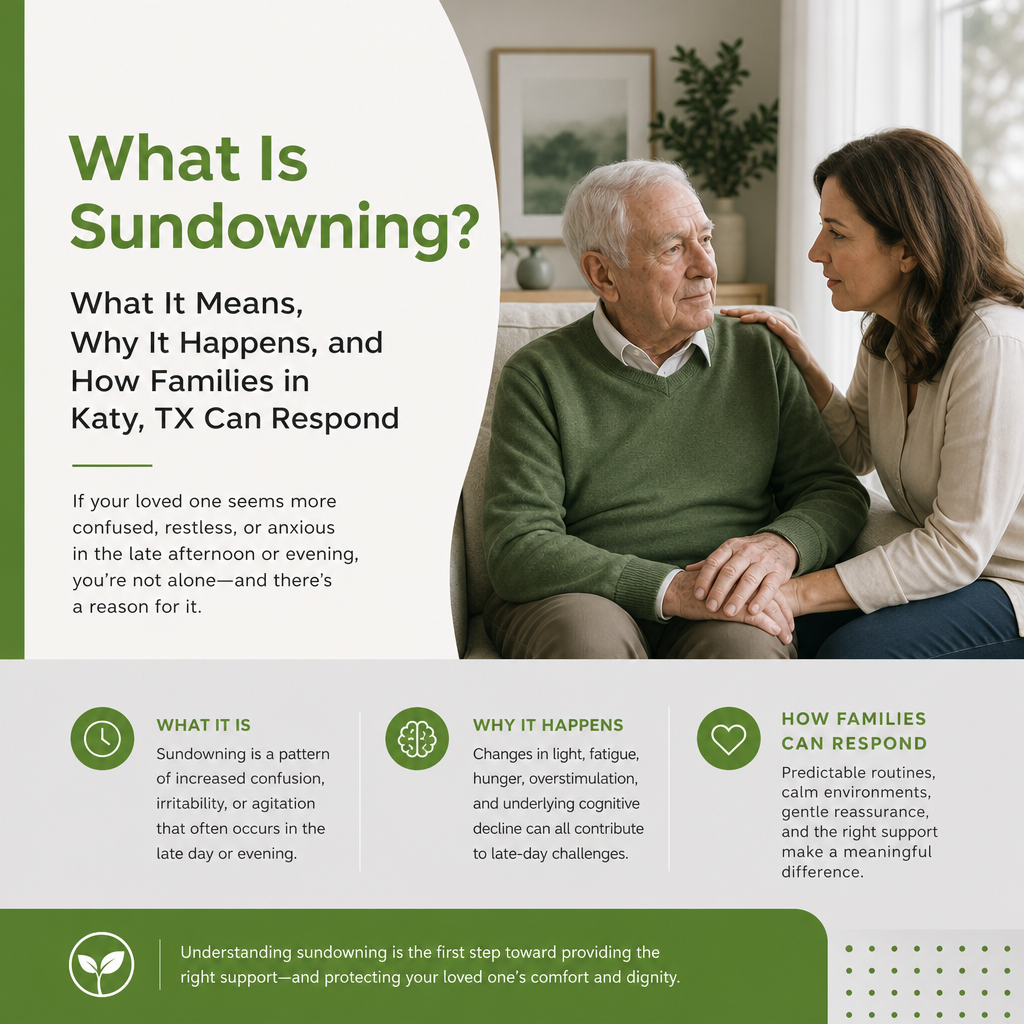
What Is Sundowning? What It Means, Why It Happens, and How Families in Katy, TX Can Respond
By Ivan Urrego | Last updated: May 2026 | Evergreen Cottages Blog
Table of Contents
- Sundowning: What It Means and the Definition Every Family Needs to Know
- Who Experiences Sundowning? Prevalence and Risk Factors
- The Science Behind Sundowning: What Happens in the Brain
- Recognizing Sundowning Symptoms: What It Looks Like in Real Life
- Common Triggers That Make Sundowning Worse
- Sundowning vs. Delirium: Understanding the Critical Difference
- Managing Sundowning at Home: Evidence-Based Strategies
- Light Therapy and Sleep Hygiene for Sundowning
- Medications and Medical Treatments for Sundowning
- How Memory Care Communities Manage Sundowning Differently
- How Evergreen Cottages in Katy, TX Addresses Sundowning
- Caregiver Burnout and Sundowning: Protecting Your Own Health
- Frequently Asked Questions About Sundowning
Sundowning: What It Means and the Definition Every Family Needs to Know
Sundowning — what it means at its core — is a pattern of increased confusion, agitation, anxiety, and behavioral changes that appears in the late afternoon and evening hours in people living with Alzheimer's disease or another form of dementia. The term "sundowning" is not a disease itself; it is a clinical syndrome that describes a predictable worsening of neurological and behavioral symptoms as daylight fades.
If you have noticed that your mother is calm and relatively clear-minded in the morning, but by 4:00 PM she is pacing the hallway, convinced she needs to "go home," or becoming unusually fearful and combative — that is sundowning. It is one of the most common and most distressing behavioral complications of dementia, and it affects families across Katy, TX and throughout the Houston metro every single day.
The Origin of the Term
The word "sundowning" was popularized in clinical literature in the 1980s and derives from the observation that symptoms reliably tracked the movement of the sun — worsening at dusk and often persisting into the night. While the name has a poetic quality, the experience itself is anything but peaceful. For the person with dementia, sundowning can feel terrifying and disorienting. For the caregiver, it can feel relentless and defeating.
Sundowning Is Not Misbehavior
One of the most important things to understand about sundowning — what it means neurologically — is that your loved one is not being difficult on purpose. The behavioral changes are driven by real neurological disruptions happening inside the brain. The confusion, the accusations, the repetitive questions, the desire to leave — none of it is deliberate, and none of it is something willpower or reasoning can overcome. Understanding this distinction is the first step toward responding with compassion rather than frustration.
Who First Described It?
Geriatric psychiatrists and neurologists have documented sundowning-like patterns in patients with cognitive impairment for over a century, but it was not systematically studied until the late 20th century. Today, the Alzheimer's Association, the American Geriatrics Society, and major academic medical centers all recognize sundowning as a clinically significant component of dementia care planning.
Who Experiences Sundowning? Prevalence and Risk Factors
Sundowning affects a significant portion of people living with dementia, making it one of the most frequently discussed behavioral challenges in memory care communities like Evergreen Cottages in Katy, TX.
According to the Alzheimer's Association 2025 Facts and Figures Report, approximately 6.9 million Americans age 65 and older are living with Alzheimer's dementia. Of those, studies consistently show that between 20% and 45% will experience sundowning symptoms at some point during their illness — with the highest prevalence occurring in the middle stages of Alzheimer's disease.
Which Types of Dementia Cause Sundowning?
While sundowning is most commonly associated with Alzheimer's disease, it can occur in virtually any form of dementia that disrupts the brain's circadian rhythm system. These include:
- Alzheimer's Disease — the most common cause, affecting the hippocampus and suprachiasmatic nucleus early in the disease course
- Lewy Body Dementia — associated with vivid hallucinations that may worsen at night
- Vascular Dementia — caused by reduced blood flow to the brain, disrupting sleep-wake cycles
- Frontotemporal Dementia — behavioral changes that can intensify in the evening
- Mixed Dementia — a combination of the above, increasingly common in older adults
Risk Factors for More Severe Sundowning
Not everyone with dementia will experience sundowning equally. Certain factors appear to increase the likelihood and severity of symptoms:
| Risk Factor | How It Contributes |
|---|---|
| Advanced age (75+) | Circadian rhythms naturally weaken with age, amplifying disruption |
| Mid-to-late stage dementia | Greater neurological damage means less ability to self-regulate |
| Sleep disorders (e.g., sleep apnea) | Fragmented sleep worsens daytime and evening confusion |
| Pain or unmanaged physical discomfort | Inability to communicate pain leads to behavioral expression |
| Environmental overstimulation | Too much noise or activity exhausts cognitive reserves by day's end |
| Social isolation | Lack of daytime engagement disrupts routine and worsens anxiety |
| Caregiver fatigue (care quality declines in evening) | Reduced quality of interaction increases resident anxiety |
The Science Behind Sundowning: What Happens in the Brain
Understanding sundowning — what it means at a neurological level — requires a quick look at how the healthy brain manages time. Deep inside the brain sits a tiny region called the suprachiasmatic nucleus (SCN), located in the hypothalamus. This cluster of roughly 20,000 neurons functions as the body's master clock, regulating our 24-hour circadian rhythm and coordinating sleep, wakefulness, hormone production, and alertness.
In Alzheimer's disease and other dementias, this internal clock is progressively damaged. As neurons die and plaques form, the SCN loses its ability to synchronize the brain and body with the external day-night cycle. The result: the person with dementia loses their internal sense of time, becomes unable to distinguish day from night, and experiences a cascade of neurological and behavioral disruptions — most dramatically in the late afternoon and evening hours when light levels drop and environmental cues shift.
The Role of Melatonin and Circadian Disruption
Research published in the journal Brain and reviewed by the Alzheimer's Association has shown that people with Alzheimer's disease produce significantly less melatonin — the hormone that signals the brain to prepare for sleep — compared to healthy older adults. Lower melatonin levels mean the brain cannot effectively transition into a calm, nighttime state as darkness falls. This biochemical deficit is a central driver of sundowning behavior.
Acetylcholine Deficiency
Alzheimer's disease is characterized by a severe depletion of acetylcholine, a neurotransmitter critical for memory, attention, and sleep regulation. As acetylcholine levels fall, the brain becomes less capable of moderating emotional responses and maintaining cognitive clarity — particularly when fatigue and reduced light compound the challenge in the evening hours.
Sensory Deprivation at Dusk
As natural light fades, people with dementia lose the visual and environmental cues that help anchor them in time and place. A healthy brain fills this gap automatically using memory and context. A dementia-affected brain cannot. The loss of light becomes, neurologically speaking, a loss of reality anchoring — which triggers fear, confusion, and the urgent desire to find safety, often expressed as a need to "go home" even when the person is already home.
Recognizing Sundowning Symptoms: What It Looks Like in Real Life
Sundowning — what it means in daily life — shows up differently in every person, but there are consistent patterns that families and professional caregivers recognize. The most important thing to understand is that symptoms typically begin before sunset, often as early as 2:00 or 3:00 PM, and can last well into the night.
If you are caring for a parent or spouse in Katy, TX and you notice a reliable shift in mood, behavior, or cognition every afternoon, sundowning is a strong possibility worth discussing with your loved one's physician.
Behavioral Symptoms
- Pacing or restless walking that seems purposeless or agitated
- Repeatedly asking to "go home" even when in their own home
- Insisting they need to pick up the children from school or go to work
- Becoming suspicious, accusatory, or paranoid toward caregivers
- Shadowing — following the caregiver from room to room relentlessly
- Increased verbal aggression, yelling, or emotional outbursts
- Resistance to evening routines like bathing, eating dinner, or going to bed
Cognitive Symptoms
- Dramatically increased confusion about time, place, or identity
- Difficulty recognizing familiar people, including family members
- Increased difficulty following conversations or instructions
- Disorientation — believing it is a different decade or that deceased relatives are alive
Physical and Sensory Symptoms
- Visual or auditory hallucinations that are more vivid in low light
- Insomnia or reversed day-night sleep patterns
- Increased falls risk due to decreased vigilance and fatigue
- Loss of appetite during dinner due to confusion or agitation
| Time of Day | Typical Sundowning Pattern |
|---|---|
| Morning (6AM–Noon) | Relatively calm, clearer cognition, cooperative with ADLs |
| Early Afternoon (Noon–3PM) | Slight increase in restlessness, fatigue begins |
| Late Afternoon (3PM–6PM) | Peak agitation onset, pacing, confusion, emotional distress |
| Evening (6PM–10PM) | Heightened confusion, potential hallucinations, resistance to bedtime |
| Night (10PM–Dawn) | Sleep disturbances, wandering, may try to leave the home |
Common Triggers That Make Sundowning Worse
Sundowning — what it means in practice — is not random. It has identifiable triggers that, when recognized and addressed, can meaningfully reduce the frequency and severity of episodes. This is genuinely good news for families in Katy, TX: knowledge gives you leverage.
Environmental Triggers
The physical environment plays a larger role in sundowning than most families realize. Key environmental triggers include:
- Declining natural light: As daylight fades, the dementia brain loses its primary orientation anchor. Rooms that are dim or poorly lit in the afternoon amplify disorientation.
- Background noise and activity shifts: In households where TV, cooking sounds, and family conversations shift in the late afternoon, the sensory change can trigger confusion about what time it is or where one is.
- Mirror reflections: Many people with dementia become frightened by their own reflection, especially in low light. Mirrors can be a significant but overlooked trigger.
- Changes in routine: Any disruption to the daily schedule — a medical appointment, a visitor, a meal served at a different time — can compound sundowning symptoms.
Physical Triggers
- Hunger or thirst: Dehydration and low blood sugar are common culprits in afternoon agitation. Many older adults do not feel thirst reliably.
- Fatigue: Cognitive exhaustion from a full day of compensating for dementia-related deficits is one of the most reliable sundowning triggers.
- Pain: A person with advanced dementia who cannot articulate that their back hurts or their feet are uncomfortable may express that pain as aggression or agitation.
- Medication timing: Some medications wear off in the afternoon, and their diminishing effect coincides precisely with peak sundowning hours.
- Urinary tract infections (UTIs): In older adults with dementia, a UTI can dramatically worsen cognitive symptoms and mimic or amplify sundowning. This is frequently under-recognized.
Psychological and Social Triggers
- Caregiver anxiety: Research published in the Journal of Gerontological Nursing has shown that a caregiver's own stress and anxiety can be directly sensed and mirrored by a person with dementia, increasing their agitation.
- Overstimulation: A day with too many visitors, activities, or stimulating events can deplete cognitive reserves and precipitate a more severe sundowning episode.
- Isolation: Paradoxically, too little engagement during the day can be equally destabilizing, leaving the person with dementia without structure or orientation.
Sundowning vs. Delirium: Understanding the Critical Difference
Sundowning — what it means clinically — is often confused with delirium, and this confusion can have serious consequences for your loved one's care. While the two conditions can look similar and even co-occur, they have different causes, different timelines, and require different responses.
What Is Delirium?
Delirium is an acute, sudden-onset state of severe confusion that develops over hours or days and is typically caused by a specific underlying medical event: an infection, a medication reaction, surgery, dehydration, or a metabolic imbalance. Unlike sundowning, delirium is not tied to the time of day, comes on rapidly, and usually resolves once the underlying cause is treated.
Key Differences at a Glance
| Feature | Sundowning | Delirium |
|---|---|---|
| Onset | Gradual, predictable (afternoons) | Sudden, within hours to days |
| Cause | Circadian disruption from dementia | Acute medical event (UTI, dehydration, surgery) |
| Pattern | Recurring daily pattern, time-linked | Fluctuating, not time-locked |
| Duration | Chronic, ongoing | Temporary; resolves with treatment |
| Attention level | Varies but not dramatically | Severely impaired, fluctuating |
| Required action | Behavioral and environmental management | Immediate medical evaluation |
When to Call the Doctor Immediately
If your loved one in Katy, TX suddenly shows a dramatic change in cognitive function — much worse than their typical sundowning pattern — do not wait to see if it resolves on its own. This could signal delirium, which requires prompt medical attention. New hallucinations, sudden inability to recognize family, or extreme lethargy alongside confusion are red flags that warrant a call to their physician or a visit to an emergency room.
Managing Sundowning at Home: Evidence-Based Strategies
If you are currently caring for a loved one with dementia at home in Katy, TX, managing sundowning is likely one of your greatest daily challenges. The good news is that there are well-researched, non-pharmacological strategies that can meaningfully reduce episode frequency and intensity. The goal is not to eliminate sundowning — which may not be possible — but to reduce its severity and protect both your loved one and yourself.
Establish a Consistent Daily Routine
The dementia brain craves predictability. A structured schedule that delivers meals, activities, rest, and social interaction at the same times each day reduces cognitive load and gives your loved one anchors to hold onto as the afternoon approaches. According to LeadingAge, structured daily routines are among the most consistently effective non-pharmacological interventions for behavioral symptoms of dementia, including sundowning.
Maximize Morning Activity, Minimize Evening Stimulation
Shift the majority of stimulating activities — outings, exercise, social visits, doctor appointments — to the morning hours when your loved one is at their cognitive best. Reserve the late afternoon and evening for calming, familiar activities: gentle music, looking at family photo albums, simple crafts, or quiet television programs they have always enjoyed. This "front-loading" strategy conserves cognitive reserves for the hours when they are most vulnerable.
Use Light Strategically
Keep interior spaces well-lit throughout the afternoon and early evening using warm-spectrum bulbs (2700–3000K). Open blinds and curtains to maximize natural light during the day. As evening approaches, dim the lights gradually rather than abruptly — mimicking a gentle sunset rather than a sudden shift to darkness. This gradual transition gives the brain time to adjust. Close curtains before dark to minimize the disorienting effect of darkness and reflections.
Calming Sensory Interventions
Research consistently supports the use of sensory-based interventions to reduce sundowning agitation:
- Music therapy: Familiar music from your loved one's youth has been shown to reduce agitation and improve mood during sundowning episodes. For more on this, see our guide on music therapy for Alzheimer's and dementia patients.
- Aromatherapy: Lavender and lemon balm have modest evidence supporting their use in reducing agitation in dementia patients.
- Gentle touch: Hand massage or light physical contact from a trusted caregiver can interrupt an agitation spiral.
- Pet therapy: Interaction with a calm, gentle animal can be remarkably effective in grounding a person during a sundowning episode.
Practical Evening Routine Tips
- Serve dinner earlier — 5:00 PM rather than 7:00 PM — to complete the meal before peak agitation
- Limit caffeine after noon (including tea and chocolate)
- Ensure adequate hydration throughout the day; offer water, juice, or decaf beverages regularly
- Use gentle reminders of the time and place throughout the afternoon: "It's 4 o'clock, Mom — we're getting ready for dinner soon"
- Avoid arguing about false beliefs; redirect and reassure instead
Light Therapy and Sleep Hygiene for Sundowning
Among the most evidence-supported non-pharmaceutical approaches to managing sundowning is the use of bright light therapy (BLT) — a targeted intervention that uses artificial bright light to help reset the brain's disrupted circadian clock. For families in Katy, TX navigating the challenges of dementia care, this is a strategy worth knowing well.
How Bright Light Therapy Works
Bright light therapy involves exposing your loved one to a high-intensity light source (typically 2,500–10,000 lux) for 30 to 60 minutes each morning. This timed light exposure mimics the orienting effect of morning sunlight, which signals the SCN — the brain's master clock — to suppress melatonin and establish a clearer wakefulness cycle. When the circadian clock is better anchored in the morning, the afternoon-evening disruption of sundowning tends to be less severe.
A meta-analysis published in Ageing Research Reviews found that morning bright light therapy significantly reduced sleep-wake cycle disruptions and behavioral symptoms in patients with Alzheimer's disease, though effect sizes vary by individual. It is considered safe for most older adults, though those with certain eye conditions or who take photosensitizing medications should consult a physician before beginning.
Sleep Hygiene Practices That Help
Improving overall sleep quality is one of the most powerful levers for reducing sundowning. When a person with dementia gets more restorative nighttime sleep, their cognitive reserve is higher the following afternoon — reducing vulnerability to sundowning episodes.
- Maintain a consistent bedtime and wake time every day, including weekends
- Avoid long daytime naps (limit to 20–30 minutes before 2:00 PM)
- Ensure the bedroom is cool, dark, and quiet at night
- Use white noise or soft nature sounds to mask disorienting nighttime sounds
- Consider night lights in hallways and bathrooms to reduce fall risk while maintaining a dim, calming environment
- Discuss melatonin supplementation with your loved one's physician — low-dose melatonin (0.5–1mg) 60–90 minutes before bedtime has modest evidence for improving sleep onset in dementia patients
Exercise and Sundowning
Regular physical activity — even gentle walking, chair exercises, or stretching — has been associated with reduced sundowning symptoms in multiple studies. The Alzheimer's Association recommends incorporating movement into the morning routine as a strategy to improve nighttime sleep and reduce afternoon behavioral disruption. In our own Katy, TX community, we build structured movement into every resident's day.
Medications and Medical Treatments for Sundowning
When behavioral and environmental strategies are not sufficient to manage sundowning safely, a physician may consider pharmacological options. It is important for families in Katy, TX to understand that medication is generally considered a last resort for sundowning management — not a first response — because the medications available carry real risks in older adults with dementia.
Why Medications Are Used Cautiously
The FDA has not approved any medication specifically for sundowning. Medications commonly used to manage its symptoms — including antipsychotics, benzodiazepines, and sleep aids — all carry what is called a "black box warning" for use in elderly patients with dementia-related psychosis, due to an increased risk of stroke and death. This does not mean they are never appropriate, but it does mean the decision must be made carefully, with full family involvement and regular reassessment.
Medications Sometimes Used Off-Label
| Medication Class | Examples | Potential Use | Key Risks |
|---|---|---|---|
| Atypical antipsychotics | Quetiapine, risperidone | Severe agitation, hallucinations | Stroke risk, sedation, falls |
| Cholinesterase inhibitors | Donepezil, rivastigmine | May modestly improve sleep-wake cycles | GI upset, nightmares |
| Melatonin supplements | OTC low-dose (0.5–1mg) | Improving sleep onset | Generally well-tolerated |
| Antidepressants (SSRIs) | Citalopram, escitalopram | Reducing anxiety component of agitation | QT prolongation at high doses |
| Benzodiazepines | Lorazepam | Short-term crisis management only | High fall risk, cognitive worsening |
Questions to Ask Your Loved One's Physician
- Have we thoroughly explored non-pharmacological options first?
- What specific symptom are we targeting with this medication?
- What are the black box warnings and how do they apply to my loved one?
- How will we measure whether it is working?
- How often will we reassess whether this medication is still needed?
- Are there any medications my loved one is currently taking that could be contributing to the sundowning?
How Memory Care Communities Manage Sundowning Differently
Understanding sundowning — what it means for the level of care required — is central to the question many Katy, TX families eventually face: can we continue managing this at home, or is it time to consider a professional memory care community? The answer is not one of love or capability — it is one of resources, environment, and safety.
The Structural Advantages of Memory Care
Professional memory care communities are purpose-built to address the very conditions that worsen sundowning at home. Consider the structural differences:
| Challenge | Home Setting | Memory Care Community |
|---|---|---|
| Consistent daily routine | Disrupted by family schedules, appointments, fatigue | Structured 7-day-a-week routine designed for cognitive stability |
| Evening supervision | Often 1 exhausted caregiver covering 24 hours | Trained staff present throughout evening and overnight shifts |
| Safe wandering environment | Home exits require constant vigilance | Secured, monitored perimeter with safe walking paths |
| Lighting and environment | Standard home lighting; may not be optimized | Intentionally designed with circadian-supportive lighting |
| Caregiver stress transmission | High — family stress directly affects loved one | Professional staff are trained to remain calm under pressure |
| Social engagement during the day | Limited; depends on family and community resources | Daily programming maintains cognitive stimulation and routine |
Specialized Staff Training
In quality memory care communities, staff members are specifically trained in dementia-specific communication techniques, de-escalation during agitation episodes, and the behavioral patterns of sundowning. They understand, for example, that during a sundowning episode, reasoning and correcting only escalates distress — while validation, redirection, and sensory comfort techniques are far more effective.
According to ALFA (Assisted Living Federation of America), communities that provide dementia-specific staff training have measurably lower rates of behavioral incidents and resident falls compared to communities without specialized programming. This training difference is one of the most important — and often overlooked — factors when evaluating memory care options in Katy, TX.
Person-Centered Care Plans
In a well-run memory care community, every resident has an individualized care plan that documents their personal sundowning pattern, known triggers, preferred comfort interventions, and optimal daily schedule. This plan is updated regularly and shared across all shifts, so the night-shift caregiver knows exactly what soothes your mother during a 2:00 AM confusion episode — because it was documented by the team who knows her best.
How Evergreen Cottages in Katy, TX Addresses Sundowning
At Evergreen Cottages in Katy, TX, we have built our entire care philosophy around the reality that dementia care — including sundowning management — requires not just expertise, but an environment and a culture specifically designed to reduce distress and preserve dignity. Sundowning is not a problem we manage reactively. It is a condition we actively prevent through every aspect of daily life at our community.
Our Small-Home Model and Its Impact on Sundowning
One of the most significant and often underappreciated factors in sundowning management is community size. At Evergreen Cottages, we operate as a small, home-like community rather than a large institutional setting. Research consistently shows — and our daily experience confirms — that residents in smaller communities experience less environmental overstimulation, more personalized attention, and more predictable daily routines. All three of these factors directly reduce sundowning frequency and severity.
The NIC 2025 Consumer Research Report found that families increasingly prioritize smaller, more personalized senior living environments, citing concerns about institutional overstimulation and depersonalization. Our Katy, TX cottage model was designed with exactly these concerns in mind.
Our Daily Programming Strategy
Our activities calendar is deliberately structured to front-load stimulating and engaging activities in the morning, transitioning to progressively calmer, sensory-supportive activities as the afternoon progresses. By 3:00 PM — the peak onset window for sundowning — our residents are engaged in familiar, low-demand activities: familiar music, gentle movement, reminiscence conversations, or quiet crafts. This deliberate de-escalation of the afternoon environment is one of our most effective sundowning prevention tools.
Lighting and Physical Environment
Our facility uses circadian-supportive lighting — brighter, cooler-spectrum light in the morning and warmer, dimmer light in the evening — to help reinforce natural sleep-wake cycles. We keep common areas well-lit throughout the afternoon and eliminate environmental cues that could contribute to evening disorientation. Our enclosed, secure outdoor spaces allow residents to spend time outside during daylight hours, accessing natural light and gentle physical activity without safety risk.
Family Communication and Partnership
We believe that families are our partners, not bystanders. When a new resident joins us, we gather detailed history about their personal sundowning patterns, preferred comfort strategies, life history (the music they loved, the routines they kept for decades), and what tends to escalate or de-escalate their distress. This information forms the foundation of their individualized care plan — and we share sundowning updates with families proactively, not just when things go wrong.
Caregiver Burnout and Sundowning: Protecting Your Own Health
Let's be honest about something most medical guides don't say plainly enough: managing sundowning as a home caregiver is one of the most physically and emotionally grueling experiences a family member can face. Night after night of disrupted sleep, evening after evening of de-escalating fear and confusion, while managing your own grief about your loved one's decline — it is not sustainable indefinitely, and recognizing that truth is not a failure. It is wisdom.
The Numbers Are Stark
The Alzheimer's Association 2025 Facts and Figures report found that approximately 11.5 million Americans provide unpaid care for people with Alzheimer's or other dementias — totaling an estimated 18.4 billion hours of care annually. Of those caregivers, nearly 60% report high levels of emotional distress, and roughly 40% report symptoms of clinical depression. These are not outliers. These are the statistical reality of dementia caregiving, and sundowning — with its relentless evening and nighttime demands — is a primary driver.
Recognizing Caregiver Burnout
Caregiver burnout does not arrive all at once. It accumulates slowly, and by the time most caregivers recognize it, they are already in crisis. Warning signs include:
- Persistent exhaustion that sleep does not relieve
- Increasing irritability or resentment toward your loved one
- Withdrawing from friends, family, and activities you used to enjoy
- Neglecting your own medical appointments or health needs
- Feeling that caregiving has consumed your entire identity
- Fantas