Parkinson's Disease Fall Risk & Prevention in Katy, TX (2026 Complete Guide for Families)
By Ivan Urrego | Last updated: May 2026 | Evergreen Cottages Blog
Table of Contents
- Why Parkinson's Disease Increases Fall Risk
- Warning Signs a Fall Is Coming
- The Sobering Statistics Katy Families Should Know
- Home Modifications That Reduce Fall Risk
- Exercise and Physical Therapy for Parkinson's Fall Prevention
- Medications and Fall Risk in Parkinson's
- Assistive Devices and Mobility Aids
- Nutrition, Hydration, and Fall Prevention
- When Dementia and Parkinson's Overlap
- Practical Caregiver Strategies
- When Professional Care Becomes the Safer Option
- How Evergreen Cottages Addresses Parkinson's Fall Risk
- Frequently Asked Questions
1. Why Parkinson's Disease Increases Fall Risk
Parkinson's disease causes motor and non-motor impairments that work together to make falling significantly more likely than in the general senior population. Understanding the "why" is the first step toward prevention.
Motor Impairments That Destabilize Gait
Parkinson's depletes dopamine, the neurotransmitter responsible for smooth, coordinated movement. The result is bradykinesia (slowness of movement), rigidity (muscle stiffness), and postural instability — a reduced ability to catch oneself when balance shifts. Together, these create a shuffling, forward-leaning gait pattern that is mechanically vulnerable to falls on uneven surfaces, thresholds, and rugs common in older homes throughout Katy, TX.
Freezing of Gait
Freezing of gait (FOG) is an episodic inability to initiate or continue walking, as if the feet are suddenly glued to the floor. It strikes most often when entering doorways, turning corners, or navigating crowds — situations that are unavoidable in daily life. FOG is one of the strongest independent predictors of falls in Parkinson's disease, according to research published in Movement Disorders (2024).
Non-Motor Contributors
Falls in Parkinson's are not purely a movement problem. Orthostatic hypotension (a sudden drop in blood pressure when standing), vision changes, cognitive slowing, and anxiety all impair the body's ability to respond to a balance threat in time. For families in Katy, TX caring for a parent at home, these invisible contributors are easy to overlook until a fall has already occurred.
2. Warning Signs a Fall Is Coming
Falls rarely happen without warning. Catching the early signs gives families and caregivers a critical window to intervene before an injury occurs.
Physical Red Flags
Watch for increased stumbling, a shorter stride length, difficulty stepping over thresholds, near-misses ("I almost went down"), and episodes where your loved one reaches for walls or furniture for support. A noticeable increase in time needed to stand from a chair is another early indicator that postural control is declining.
Behavioral and Cognitive Clues
Hesitation at doorways, reluctance to walk without a companion, increased confusion in low-light environments, and new anxiety about walking outdoors are all behavioral signals worth taking seriously. These changes are often the first things family members notice — trust that instinct.
Recent History as a Predictor
The single strongest predictor of a future fall in Parkinson's disease is a previous fall. According to the Parkinson's Foundation, two-thirds of people with Parkinson's who fall will fall again within six months. If your loved one has already experienced a fall, the time to act is now — not after the second one.
| Warning Sign | What It May Indicate | Recommended Action |
|---|---|---|
| Shuffling, dragging feet | Worsening bradykinesia | Neurology appointment; PT referral |
| Freezing at doorways | Freezing of gait (FOG) | Cueing strategies; home assessment |
| Dizziness when standing | Orthostatic hypotension | Medication review with physician |
| Reluctance to walk alone | Fear of falling | Mobility aid evaluation; safety plan |
| Recent near-miss or minor fall | High recurrence risk | Immediate fall-prevention assessment |
3. The Sobering Statistics Katy Families Should Know
The numbers behind Parkinson's disease fall risk and prevention are stark — and they make a compelling case for acting proactively rather than reactively.
National and Statewide Context
Approximately 1 million Americans are living with Parkinson's disease, and that number is projected to reach 1.2 million by 2030, according to the Parkinson's Foundation. In Texas, the aging of the Houston suburbs — including Katy — means more families are navigating this condition every year. The CDC reports that falls are the leading cause of fatal and non-fatal injuries in adults 65 and older nationally.
The Cost of a Fall
Hip fractures — the most serious fall consequence — carry a one-year mortality rate of up to 30% in older adults, according to the American Academy of Orthopaedic Surgeons. Beyond mortality, fall-related hospitalizations average $35,000 per incident (CDC, 2024), and recovery often requires a transition to a higher level of care. Prevention is far less costly in every sense.
Fear of Falling Creates Its Own Risk
Studies cited by LeadingAge show that fear of falling causes many older adults to restrict activity, which leads to muscle weakness and deconditioning — ironically increasing the very risk they fear. Breaking this cycle requires a structured, confidence-building approach to mobility.
4. Home Modifications That Reduce Fall Risk
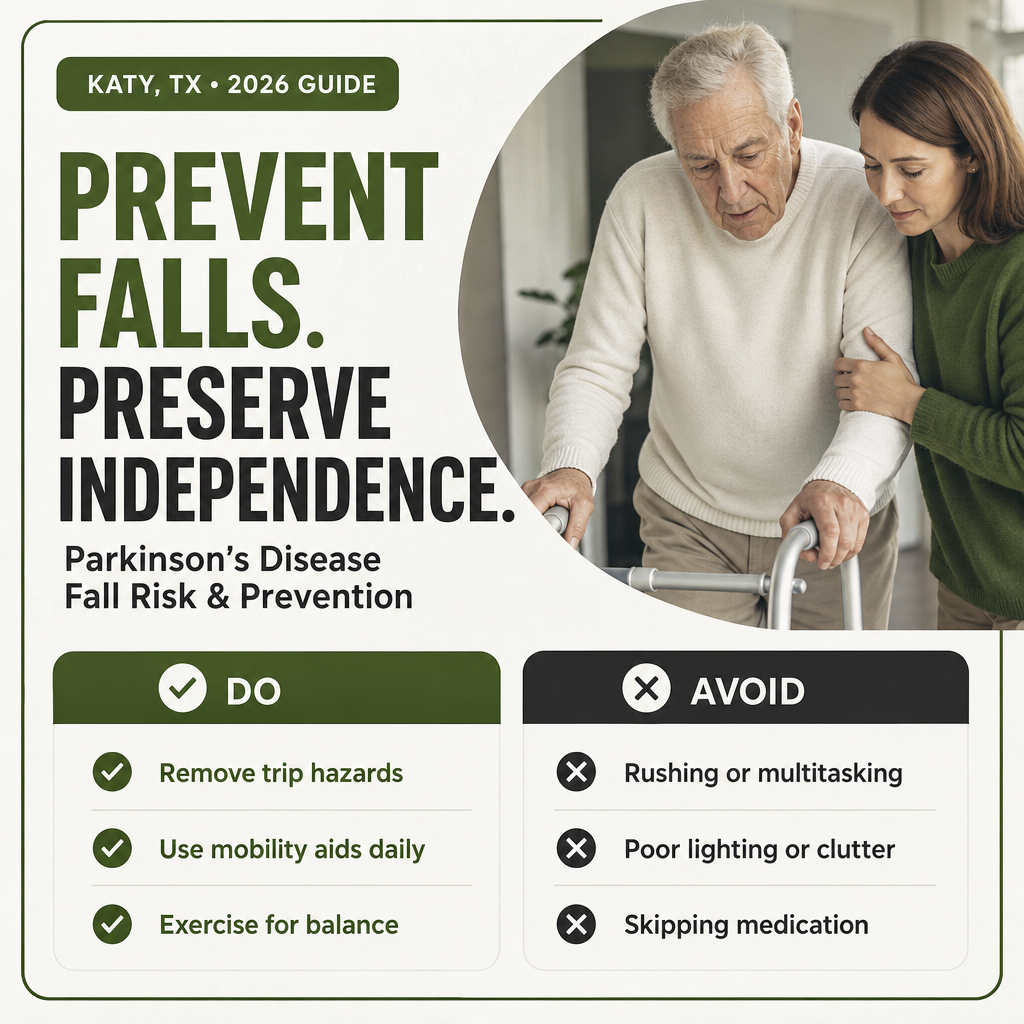
For loved ones still living at home in Katy, TX, targeted environmental changes can dramatically lower Parkinson's disease fall risk without requiring a move — at least in the early stages of the disease.
Bathroom and Bedroom Safety
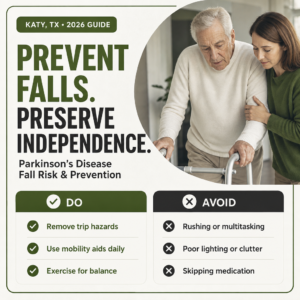
The bathroom is the most dangerous room in the house for someone with Parkinson's. Install grab bars beside the toilet and inside the shower (not suction-cup versions — wall-anchored only). Use a shower chair or bench to eliminate the balance demands of standing while bathing. In the bedroom, bed rails and a firm mattress edge help with sit-to-stand transitions. Clear a straight, unobstructed path from bed to bathroom — nighttime trips account for a significant portion of falls.
Flooring and Lighting
Remove throw rugs, which catch shuffling feet. Secure carpet edges. Improve lighting in hallways and stairs — motion-activated nightlights are especially effective. High-contrast tape on stair edges helps those with Parkinson's-related visual processing difficulties perceive depth more accurately.
Cueing the Environment
Visual cues on the floor — colored tape lines or contrasting floor transitions — can help interrupt freezing of gait episodes. Some families use a small laser pointer device (cane-mounted or wearable) that projects a line on the floor for the person to step over, which neurologically bypasses the FOG pathway.
5. Exercise and Physical Therapy for Parkinson's Fall Prevention
Exercise is one of the most evidence-backed interventions for Parkinson's disease fall risk and prevention — and it is never too late to start.
Why Exercise Works
Targeted exercise improves balance, gait speed, muscle strength, and confidence. Research from the Parkinson's Foundation confirms that structured exercise programs can delay functional decline and reduce fall frequency. Even 2.5 hours per week of moderate physical activity has shown measurable neuroprotective effects in people with Parkinson's.
Programs With Evidence Behind Them
- LSVT BIG: An intensive physical therapy protocol specifically designed for Parkinson's that trains larger, more intentional movements.
- Rock Steady Boxing: A non-contact boxing-based fitness program with chapters in the Greater Houston area that builds coordination and confidence.
- Tai Chi: Shown in multiple trials to significantly reduce fall rates by training balance and weight-shifting skills.
- Treadmill Training: Improves gait speed and step length under supervised conditions.
Physical Therapy Referrals in Katy, TX
Ask your loved one's neurologist for a referral to a physical therapist specializing in neurological conditions. Many Katy-area PT clinics have therapists certified in Parkinson's-specific programs. Consistent therapy — not a one-time evaluation — is what produces lasting results.
6. Medications and Fall Risk in Parkinson's
Medications play a dual role in Parkinson's disease fall risk and prevention — the right regimen reduces symptoms and improves mobility, while the wrong one can make falling more likely.
Parkinson's Medications and Timing
Levodopa and other dopaminergic medications are the cornerstone of Parkinson's treatment, and when timed correctly, they reduce the motor fluctuations that increase fall risk. "Off" periods — times when medication effects wear off — are particularly dangerous for falls. Families should work with the neurologist to minimize off-period duration and ensure medications are given on a consistent, physician-prescribed schedule.
Polypharmacy: The Hidden Risk
Many older adults with Parkinson's take multiple medications for other conditions. Sedatives, antidepressants, antihistamines, and blood pressure medications all carry fall-risk side effects. A comprehensive medication review — ideally with a pharmacist and the prescribing physician — should be done annually or whenever a fall occurs.
Orthostatic Hypotension Management
If your loved one consistently feels dizzy when standing, report this to the neurologist. Simple strategies — rising slowly, compressive stockings, adequate sodium intake, and certain medications — can significantly reduce blood-pressure-related fall risk.
7. Assistive Devices and Mobility Aids
The right mobility aid can be life-changing for someone with Parkinson's — but only when it is properly fitted and the person has been trained to use it safely.
Canes, Walkers, and Rollators
A standard cane is rarely sufficient for advanced Parkinson's because it requires balance to use. A rollator walker (four-wheeled with brakes) is often more appropriate, as it allows continuous forward movement — helpful for someone with FOG. U-Step walkers, designed specifically for Parkinson's, offer greater stability and include a laser line option to address freezing episodes.
Wearable Technology
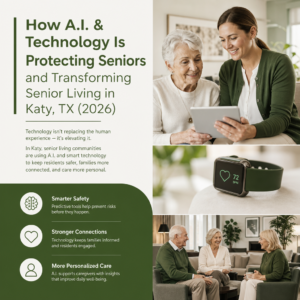
Wearable fall-detection devices — including smartwatches and clip-on sensors — can alert caregivers or emergency contacts immediately after a fall. Some newer devices use AI to detect pre-fall body movements and alert caregivers proactively. For families in Katy, TX who cannot be present 24/7, these devices add a meaningful layer of safety.
Getting Properly Fitted
Never purchase a mobility aid without a physical therapist's assessment. An incorrectly fitted walker or cane can worsen posture and increase — not decrease — fall risk. A PT evaluation is typically covered by Medicare Part B when prescribed by a physician.
8. Nutrition, Hydration, and Fall Prevention
What your loved one eats and drinks each day has a direct effect on muscle strength, blood pressure stability, and cognitive clarity — all of which influence fall risk in Parkinson's disease.
Protein, Bone Health, and Muscle Strength
Adequate protein intake supports muscle mass, which is the body's primary shock absorber against falls. Calcium and Vitamin D are critical for bone density — reducing fracture severity if a fall does occur. The Alzheimer's Association 2025 Facts and Figures report notes that nutritional deficiencies are common in older adults with neurodegenerative conditions and often go unaddressed.
Hydration and Orthostatic Hypotension
Dehydration worsens the blood pressure drops associated with Parkinson's, increasing dizziness when standing. Katy's hot Texas summers make dehydration a year-round concern. Aiming for at least six to eight cups of water daily — or more in summer months — is a simple, impactful intervention. For more on this topic, see our Complete Hydration Guide for Seniors in Katy, TX.
Protein-Levodopa Interactions
High-protein meals can interfere with levodopa absorption, causing unpredictable off periods. Work with a dietitian familiar with Parkinson's to time protein intake appropriately — typically shifting larger protein portions to the evening meal — without compromising overall nutrition.
9. When Dementia and Parkinson's Overlap
Up to 80% of people with Parkinson's disease will develop some degree of cognitive impairment or dementia over time, and this overlap significantly amplifies fall risk in ways that require specialized care strategies.
Parkinson's Disease Dementia (PDD)
Parkinson's disease dementia (PDD) develops when cognitive decline emerges in the context of an existing Parkinson's diagnosis. It differs from Alzheimer's in its pattern — executive function and visuospatial processing are affected early, making it harder for the person to plan movements, judge distances, and react to environmental hazards. This combination makes independent living increasingly unsafe.
Lewy Body Dementia
Lewy body dementia (LBD) is closely related to Parkinson's and shares many of the same motor symptoms alongside pronounced cognitive fluctuations and visual hallucinations. People with LBD are at exceptionally high fall risk because their attention and alertness fluctuate unpredictably throughout the day. Our post on 10 Types of Dementia Families in Katy, TX Should Know covers LBD in greater detail.
Why Memory Care Is Often the Right Answer
When Parkinson's and cognitive decline coexist, round-the-clock supervision becomes essential — not because independence isn't valued, but because the unpredictability of both conditions creates moments of danger that no home-based schedule can reliably cover.
10. Practical Caregiver Strategies
Family caregivers in Katy, TX are often the first line of defense against falls — and with the right strategies, you can meaningfully reduce risk without burning out in the process.
Build a Daily Routine
Parkinson's symptoms are often more predictable within a consistent daily structure. Schedule the most physically demanding activities — bathing, walking, therapy — during peak medication effectiveness periods. Reduce activity demands during known "off" windows.
Verbal and Visual Cueing
Rhythmic verbal cues ("left, right, left, right") help interrupt freezing of gait. Counting out loud, marching in place, or using music with a steady beat can help your loved one initiate movement more smoothly. These low-tech strategies are among the most effective — and free — tools in the Parkinson's caregiver toolkit.
Caregiver Wellness Matters Too
A fatigued caregiver cannot supervise safely. If you are managing Parkinson's-related fall risk alone, please read our resource on Self-Care for Caregivers of Loved Ones with Dementia — it applies equally to Parkinson's caregiving. And if the weight has become unmanageable, that is not failure. It is a signal that professional support deserves serious consideration.
11. When Professional Care Becomes the Safer Option
There comes a point in many Parkinson's journeys when the level of supervision and specialized support needed to prevent falls genuinely exceeds what home-based care — no matter how loving — can reliably provide.
Signs It May Be Time
Consider professional assisted living or memory care when your loved one has experienced two or more falls in six months, requires physical assistance with all transfers (bed-to-chair, chair-to-standing), has Parkinson's combined with significant cognitive decline, or when caregiver exhaustion is compromising the quality of supervision. These are not signs of giving up — they are signs of loving clearly.
What Research Shows About Professional Care
According to the NIC 2025 Consumer Research Report, families who transitioned a loved one to assisted living sooner rather than waiting for a crisis reported significantly higher satisfaction with the outcome — and lower rates of guilt. Structured professional environments with trained staff and fall-prevention protocols are better equipped to manage Parkinson's fall risk around the clock than any single caregiver can be.
Understanding Your Financial Options
Cost is a real concern for many Katy, TX families. Veterans may be eligible for VA Aid and Attendance benefits. For a comprehensive breakdown, see our guide on How to Pay for Assisted Living in Katy, TX.
12. How Evergreen Cottages Addresses Parkinson's Fall Risk
At Evergreen Cottages in Katy, TX, Parkinson's disease fall risk and prevention is not an afterthought — it is built into every layer of how we design spaces, train staff, and care for each resident individually.
A Purpose-Built Environment
Our cottage-style community was intentionally designed to minimize fall hazards. Wide, clear hallways; consistent, non-glare lighting; slip-resistant flooring; and absence of raised thresholds are features that make a measurable difference for someone with a Parkinsonian gait. Our small, home-like scale means residents are never navigating a large, disorienting building — a critical advantage for those with freezing of gait or cognitive overlap. Learn more about why this scale matters in our post on The Science of Belonging in Smaller Senior Communities.
Staff Training and Supervision
Our caregivers are trained in Parkinson's-specific transfer techniques, cueing strategies for FOG, and the early warning signs that a resident's fall risk is escalating. Because our community is small, our staff-to-resident ratio is high — meaning your loved one is genuinely known as an individual, not a room number.
Coordinated Care and Family Partnership
We work closely with neurologists, physical therapists, and families to ensure each resident's care plan reflects their current stage of Parkinson's. Our team communicates proactively — you will never be the last to know when something changes. That is the Evergreen Cottages difference. Explore Our Care Approach or Meet Our Team to learn more.
13. Frequently Asked Questions
These are the questions Katy, TX families most often ask us about Parkinson's disease fall risk and prevention. Each answer is designed to give you immediate, actionable clarity.
How common are falls in people with Parkinson's disease?
Falls are extremely common — approximately 60–70% of people with Parkinson's fall at least once per year, and about half of those fall repeatedly. This is two to three times the fall rate of the general older adult population, according to the Parkinson's Foundation. Fall prevention should begin at diagnosis, not after the first fall.
What is the most dangerous time of day for Parkinson's falls?
Nighttime and early morning are the highest-risk periods. This is when medication levels are lowest, lighting is poor, and transitions from bed to bathroom are required. Nighttime falls account for a disproportionate share of serious Parkinson's-related injuries. Nightlights, bed rails, and a bedside commode can make an immediate difference.
Can exercise actually reduce falls in Parkinson's disease?
Yes — significantly. Multiple clinical trials confirm that structured exercise programs (particularly LSVT BIG, Tai Chi, and treadmill training) reduce fall frequency in Parkinson's. The key is consistency and proper guidance. A physical therapist specializing in neurological conditions should design and supervise the program for maximum safety and benefit.
What is freezing of gait and how can it be managed?
Freezing of gait (FOG) is an episodic inability to initiate or continue walking, most common at doorways or when turning. Management strategies include rhythmic verbal cueing, visual floor cues (tape lines or laser pointers), stepping over an obstacle, and medication timing optimization. A neurologist and physical therapist working together offer the most effective FOG management.
When should I consider assisted living for a parent with Parkinson's?
Consider assisted living or memory care when your loved one has had multiple falls, requires physical assistance with all transfers, has Parkinson's alongside cognitive decline, or when caregiver capacity is genuinely stretched. According to the NIC 2025 Consumer Research Report, families who act proactively — rather than waiting for a crisis — report better outcomes for everyone involved.
Your Loved One Deserves to Feel Safe Every Day
Parkinson's disease fall risk and prevention is one of the most pressing concerns families face — and you do not have to navigate it alone. Whether you are exploring home modifications, physical therapy, or considering a move to professional care, Evergreen Cottages is here to help you think it through with clarity and compassion.
Our Katy, TX community offers the small-scale, relationship-centered care that people with Parkinson's and dementia thrive in. Come see it for yourself.
Schedule Your Personal Tour TodayExplore Evergreen Cottages
Found this guide helpful? Share it with someone who needs it.
About Ivan Urrego
Ivan Urrego is a professional copywriter for the senior living industry and an award-winning contributor to Argentum, MALA, and other leading aging-services organizations. He writes exclusively for Evergreen Cottages in Katy, TX, translating complex care decisions into clear, compassionate guidance for families at every stage of the journey.
Sources
- Parkinson's Foundation. (2025). Falls and Parkinson's Disease. parkinson.org
- Centers for Disease Control and Prevention (CDC). (2024). Older Adult Falls: Data and Statistics. cdc.gov/falls
- NIC (National Investment Center for Seniors Housing & Care). (2025). 2025 Consumer Research Report. nic.org
- LeadingAge. (2024). Fear of Falling and Activity Restriction in Older Adults. leadingage.org
- Alzheimer's Association. (2025). 2025 Alzheimer's Disease Facts and Figures. alz.org
- American Academy of Orthopaedic Surgeons. (2024). Hip Fracture Outcomes and Mortality. aaos.org